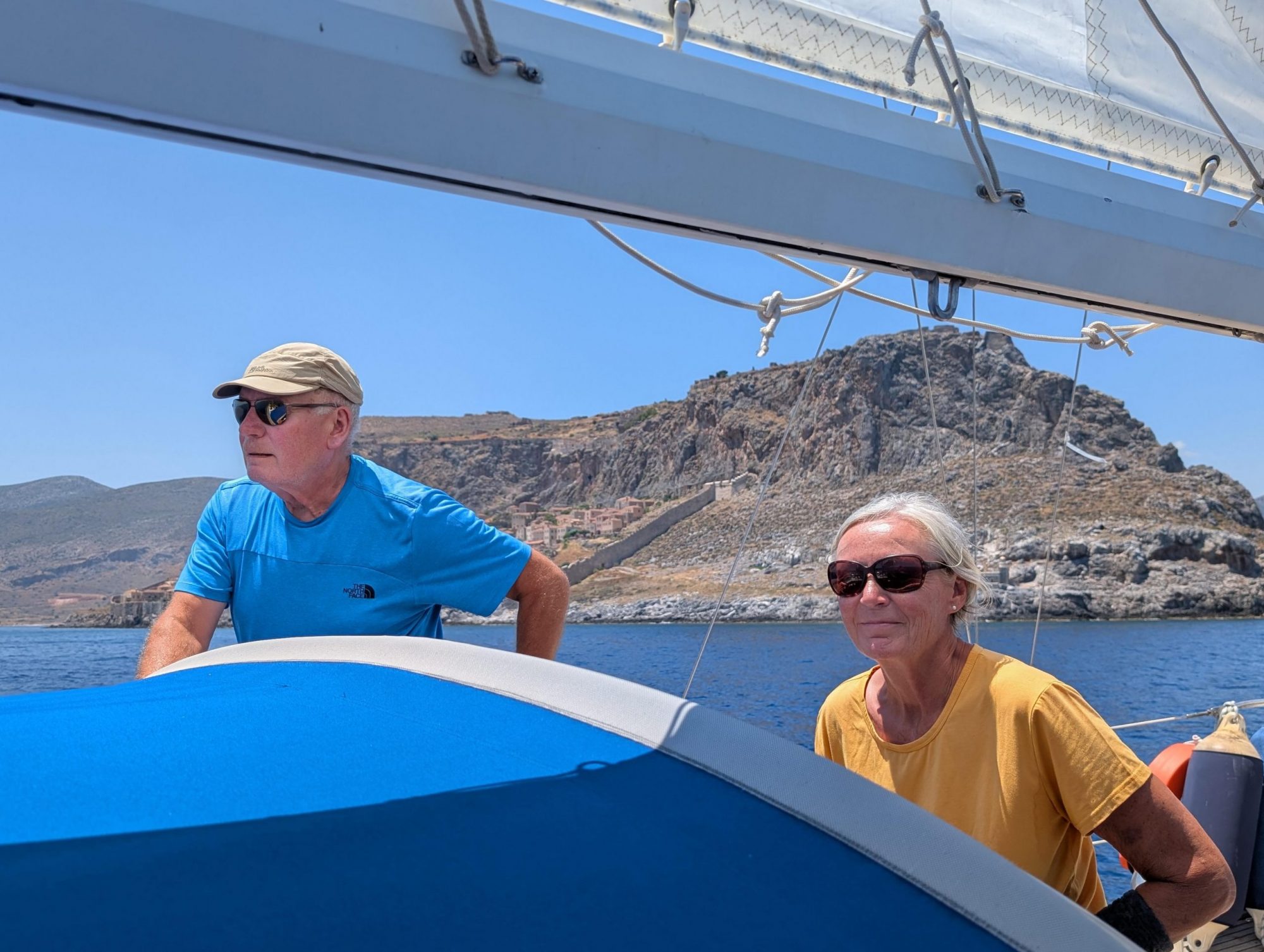
Willkommen! Dies ist die Website von Gisela und Walter Würfel. Hier berichten wir über die Reisen und das Leben auf unserer Segelyacht Aglaya. / Welcome! This is the website of Gisela and Walter Wuerfel. Here we report about the journeys and the life on our sailing yacht Aglaya.
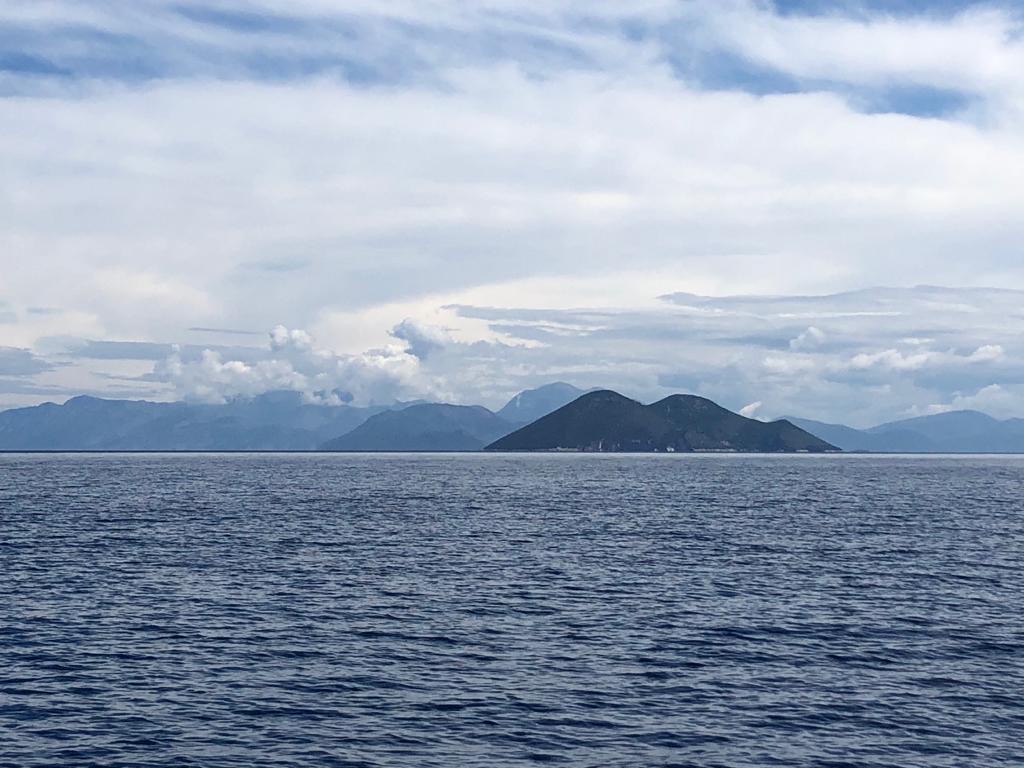
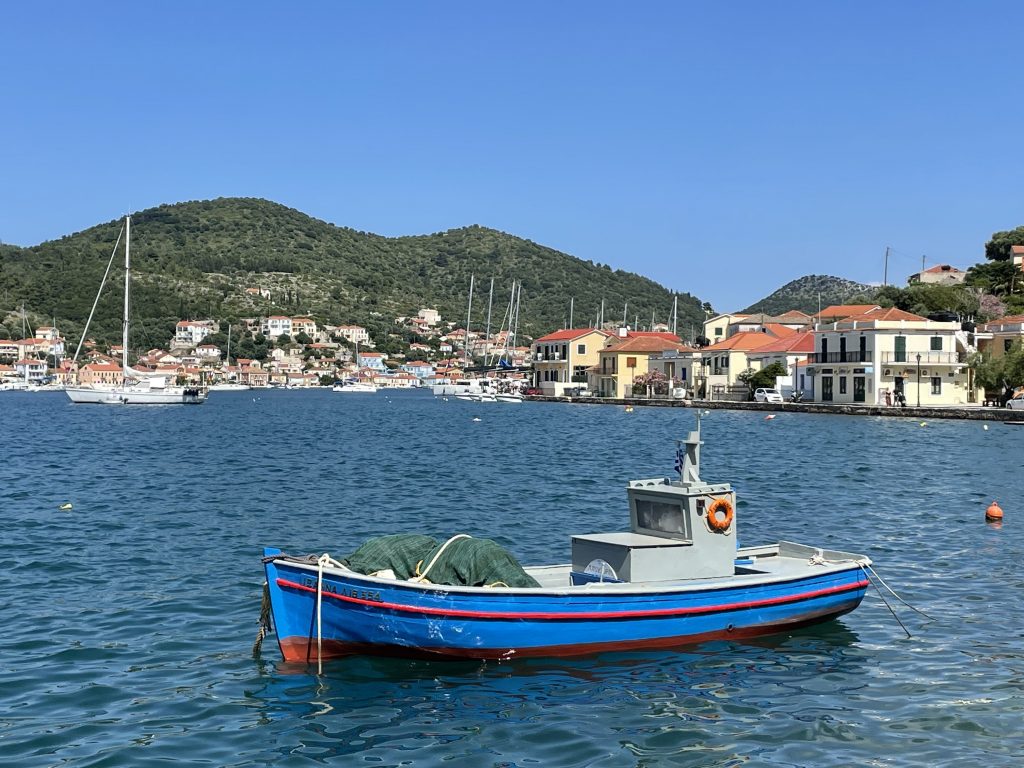
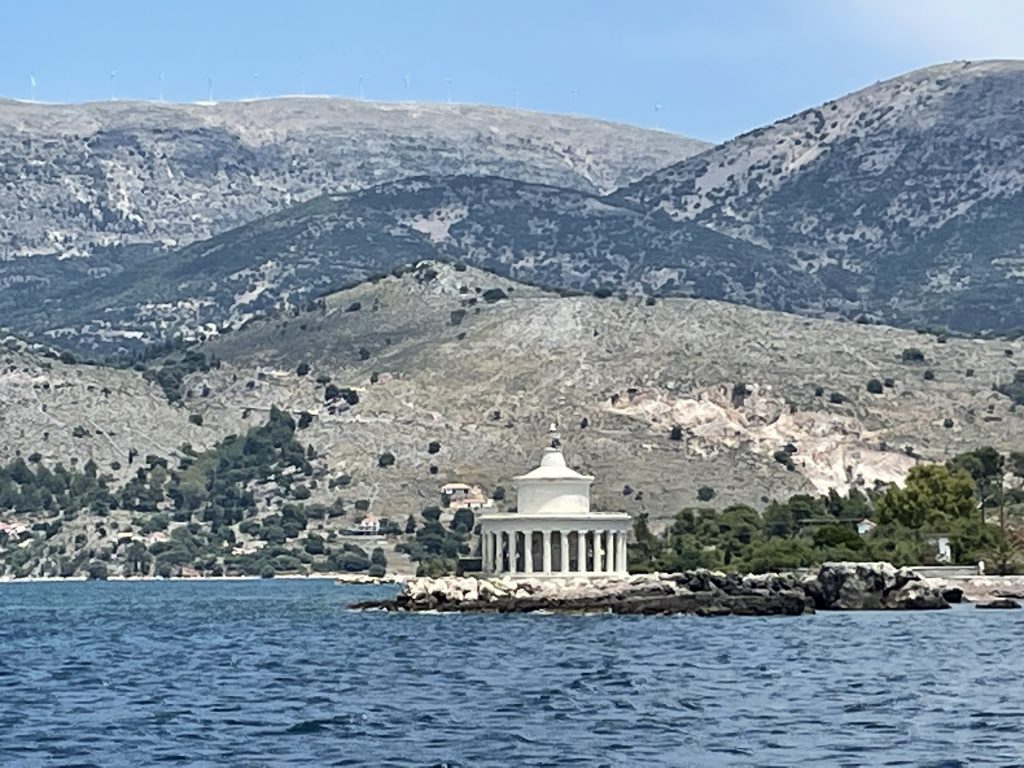
We sail between the Ionian Islands (Kefallonia, Ithaca, Zakynthos and many smaller ones) and the Greek mainland. Some of the islands have high mountains, the smaller ones are cone-shaped, almost all of them are green.
We move like on a huge alpine lake, everywhere you look, mountains. There are many small cozy and sheltered anchorages and bays between the islands and the mainland, but also harbors like Astakos opposite Ithaka or Poros on Kefallonia. The distances between the many possible places are not particularly large, sometimes less than 10 miles, so you don't have to leave so early in the morning and in the evening you can still find a place in the harbor or in a bay to anchor. And the taverns in the harbors leave nothing to be desired - and fish to cook or fry yourself is also available directly from the fisherman.
A wonderful (water) landscape, relaxed sailing, and finally the summer is here - what more could you want?
Wir hatten ja schon vermutet, dass das mehrere Wochen lang stabile Hoch über Mitteleuropa dazu geführt hat, dass alle Tiefs daran vorbei in den Mittelmeerraum ziehen. Unbeständiges, eher kühles Wetter mit viel Regen und Gewitter - das ist im Mai und Juni in Griechenland eher ungewöhnlich. So hatten wir bisher unsere warme Kleidung noch nicht weggepackt.
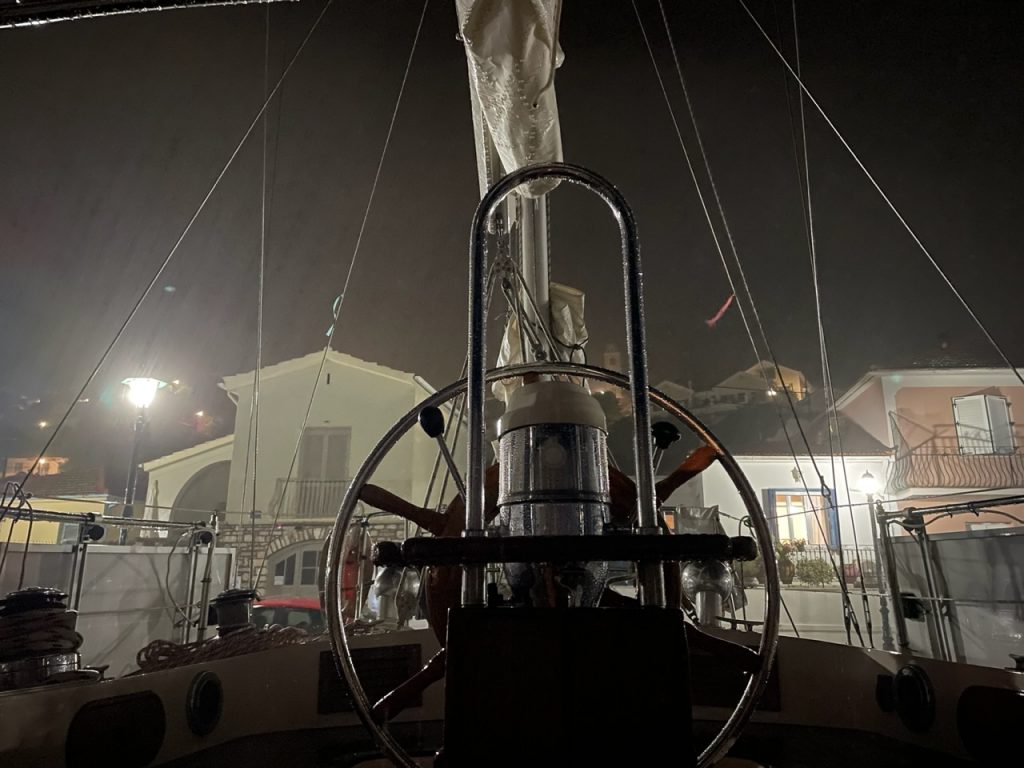
Und jetzt wissen wir es genau: Die Omega-Wetterlage hat uns diese Schlechtwetterphase beschert: in Mitteleuropa ein beständiges Hoch und im Westen und Osten Tiefdruckgebiete. Normalerweise wandern die Wettersysteme, die für Griechenland relevant sind, von Nordwesten nach Südosten. Das Hoch über Mitteleuropa hat diese Bewegung blockiert. So konnten wir feststellen, dass die Temperaturen bei uns zu Hause in Deutschland häufig höher waren als bei uns am Peloponnes und im Ionischen Meer. Und unsere Freunde zu Hause haben uns schon um den Regen beneidet, weil es bei ihnen viel zu trocken war. Zuletzt haben wir auf Ithaka in Vathy drei besonders ungemütliche Tage verbracht: Dauerregen mit Gewittern und Starkwind. Die meiste Zeit haben wir unser Boot bewacht.
Und warum Omega? Das Strömungsfeld um die beiden Tiefs und das Hoch sehen auf der Wetterkarte aus wie der griechische Großbuchstabe Ω.
Inzwischen sieht die Wetterkarte anders aus. Das Omega ist verschwunden. Wir konnten bei Sonne und tollem Segelwind ans Festland nach Astakos segeln. Jetzt wird es jeden Tag wärmer, sodass wir immer häufiger unser Sonnensegel auspacken.
We had already suspected that the high pressure over Central Europe, which was stable for several weeks, caused all lows to pass it and move into the Mediterranean area. Unstable, rather cool weather with lots of rain and thunderstorms - that is rather unusual in May and June in Greece. So we hadn't packed away our warm clothes yet.
And now we know it for sure: The Omega weather system has given us this bad weather phase: in Central Europe a steady high pressure system and in the West and East low pressure areas. Normally, the weather systems relevant for Greece move from northwest to southeast. The high over Central Europe blocked this movement. So we noticed that the temperatures at home in Germany were often higher than here in the Peloponnese and the Ionian Sea. And our friends at home already envied us for the rain, because it was much too dry at their place. Most recently, we spent three particularly uncomfortable days on Ithaca in Vathy: continuous rain with thunderstorms and strong winds. Most of the time we were guarding our boat.
And why Omega? The flow field around the two lows and the high look like the Greek capital letter Ω on the weather map.
Meanwhile, the weather map looks different. The omega has disappeared. We could sail to the mainland to Astakos with sun and great sailing wind. Now it is getting warmer every day, so we unpack our sun sail more and more often.
At some point you have to untie the ropes again, otherwise you get the Poros syndrome (see blog from May 24th). So we left the lonely marina of Argostoli on June 8th. And with what destination? Poros - not the Poros in the Saronic Gulf, after which we named the syndrome, but the small Poros on the east side of Kefalonia. There we were directed by Spiros, the energetic, fit, nice and humorous harbormaster directly to the new floating jetty, which is not yet marked in the harbor guides and in Navionics ("I want to see your beautiful money." means: pay harbor dues). Although the big ferry from Kyllini docks here several times a day, it is a nice, quiet place with an eternally long pebble beach.
But like Odysseus we wanted to go on, to Ithaca. We didn't have to wander around for ten years like him, who wanted to get back there from Troy. Just a little more than 20 nautical miles and we were there. We wanted to go to the bay of Vathy, the main town of the island. Surprise: rather light winds outside and on entering the bay winds gusting up to 40 knots. No good anchorage free, the pier full. So we fled, again some nautical miles back to the south into the beautiful and well protected anchorage Filiatro. There we could anchor well, enjoy the peace and the great scenery and swim extensively in the clear turquoise water.
But we could also see here that the high season has just begun. Had we seen so far only a few charter boats, they came now in ever greater numbers. In the harbor of Vathy, which we then approached two days later in calm weather, we felt finally catapulted into the high season. Like a string of pearls, the boats arrive here, many of them catamarans. The long piers are already full from the early afternoon. Anchoring is busy in the bay. After the rush hour for the free berths on the pier, we can admire catamarans with at least ten half-naked young men with suboptimal figure and bad taste in music. Well, they have a week's vacation, there must be something going on. We are retired and have time. But from the aesthetic point of view, we find some things to be an imposition. So: We arrived in the high season in the Ionian Islands. We have to get used to it.
Nevertheless: It is beautiful here. And there are always nice encounters with other sailors. And we will continue to find beautiful anchorages again and again.
Despite all this beauty that we are allowed to enjoy here every day, we are aware that obviously the Greek coast guard is probably one of the worst and most inhumane in the EU as far as refugees are concerned. We are horrified by the death of so many people in the boat accident south of the Peloponnese.
Irgendwann muss man die Leinen wieder losmachen, sonst erwischt einen das Poros-Syndrom (siehe Blogeintrag vom 24. Mai). Also haben wir am 8. Juni die einsame Marina von Argostoli verlassen. Und mit welchem Ziel? Poros - aber nicht das Poros im Saronischen Golf, nach dem wir das Syndrom benannt haben, sondern das kleine Poros auf der Ostseite von Kefalonia. Dort wurden wir von Spiros, dem energischen, fitten, netten und humorvollen Hafenmeister direkt an den neuen Schwimmsteg dirigiert, der in den Hafenführern und in Navionics noch gar nicht eingezeichnet ist („I want to see your beautiful money.“ heißt: Hafengebühr bezahlen). Obwohl hier mehrmals am Tag die große Fähre von Kyllini anlegt, ist es ein netter, ruhiger Ort mit einem ewig langen Kiesstrand.
Aber wie Odysseus damals wollten wir weiter, nach Ithaka. Wir mussten nicht wie er, der damals von Troja aus dorthin zurück wollte, zehn Jahre lang herumirren. Nur wenig mehr als 20 Seemeilen und wir waren da. Wir wollten in die Bucht von Vathy, dem Hauptort der Insel. Überraschung: draußen eher schwachwindig und bei der Einfahrt in die Bucht Wind mit Böen bis zu 40 Knoten. Kein guter Ankerplatz frei, die Pier voll. Da sind wir geflüchtet, wieder einige Seemeilen zurück nach Süden in die schöne und gut geschützte Ankerbucht Filiatro. Dort konnten wir gut vor Anker liegen, die Ruhe und die tolle Szenerie geniessen und ausgiebig im klaren türkisfarbenen Wasser schwimmen .
Wir konnten hier dann aber auch feststellen, dass gerade die Hochsaison begonnen hat. Hatten wir bisher nur vereinzelt Charterboote gesehen, kamen sie jetzt in immer größerer Zahl. Im Hafen von Vathy, das wir dann zwei Tage später bei ruhigem Wetter doch angelaufen haben, fühlten wir uns endgültig in die Hochsaison katapultiert. Wie an einer Perlenkette laufen hier die Boote ein, davon viele Katamarane. Die langen Piers sind schon ab dem frühen Nachmittag voll. In der Bucht wird fleißig geankert. Nach der Rushhour auf die freien Liegeplätze an der Pier können wir Katamarane mit mindesten zehn halbnackten jungen Männern mit suboptimaler Figur und schlechtem Musikgeschmack bewundern. Na ja, die haben eine Woche Urlaub, da muss was abgehen. Wir sind in Rente und haben Zeit. Aber vom Ästhetischen her gesehen empfinden wir Manches doch als Zumutung. Also: Wir sind in der Hochsaison in den Ionischen Inseln angekommen. Ist für uns gewöhnungsbedürftig.
Trotzdem: Es ist wunderschön hier. Und es gibt immer wieder nette Begegnungen mit anderen Seglern. Und schöne Ankerplätze werden wir auch weiterhin immer wieder finden.
Trotz dieser ganzen Schönheit, die wir hier jeden Tag genießen dürfen, ist uns bewusst, dass offensichtlich die griechische Küstenwache, was Flüchtlinge betrifft, wohl in der EU eine der schlimmsten und unmenschlichsten ist. Wir sind entsetzt über den Tod so vieler Menschen bei dem Bootsunglück südlich des Peloponnes.
It was not easy for us to say goodbye to the Peloponnese. In the last three years we have developed something like a feeling of home. But we had no time to think about it when we left Kyllini on June 1st. For three quarters of an hour we were busy getting rid of the heavy anchor - probably of a fishing boat - in which our chain had got caught. But then: off to Zakynthos! This time we didn't moor in the main harbor, but in the very northeast, in the bay of Agios Nikolaos. When we entered the bay we thought about anchoring instead of going to the pier because of the swell. The decision was taken from us by Kosta, who rushed in with his dinghy and guided us to an anchor buoy. Good solution! The buoy cost nothing, but going to eat at Kosta's taverna, he was already expecting. Good deal!
The next day we went straight on, past the rugged north coast of Zakynthos with many caves, northwest to the next island - Kefalonia. In Argostoli, the main town, we moored in the abandoned marina. No water, no shore power, but peace and quiet with a beautiful view of the town, which we could reach via a long stone bridge (Bosset bridge, 750m long). There it was worthwhile to finally get the Farräder out again.
In the meantime we did a lot of things here: Bicycle trip to the sinkholes. Here seawater flows underground to the other side of the island. Bicycle trip around the lagoon, a biotope with a wonderful flora, birds and sea turtles.
And a special highlight: ride by local bus through the mountains and along the spectacular west coast to Fiskardo. Many sailors come to the harbor of Fiskardo. We don't want that, because the harbor is often full from noon on. Since the pier is laid out in a semicircle, anchor-salad with diver is pre-programmed. And we could see that it is noisy and bustling at the pier. One falls from the cockpit directly on the tables in the tavernas. We watched all this, that was enough. And we had a two-hour bus ride each way with beautiful and spectacular views. A land trip can also be very nice.
Der Abschied vom Peloponnes ist uns nicht leicht gefallen. In den letzten drei Jahren ist bei uns ein bisschen so etwas wie ein Heimatgefühl entstanden. Aber wir hatten erst einmal keine Zeit, darüber nachzudenken, als wir am 1. Juni in Kyllini ablegten. Eine Dreiviertelstunde lang waren wir damit beschäftigt, den schweren Anker - vermutlich eines Fischerbootes, in den sich unsere Kette verhakelt hatte, wieder loszuwerden. Aber dann: auf nach Zakynthos! Dieses mal haben wir nicht im Haupthafen festgemacht, sondern ganz im Nordosten, in der Bucht von Agios Nikolaos. Bei der Einfahrt in die Bucht überlegten wir noch, ob wir wegen des Schwells nicht besser ankern anstatt an die Pier zu gehen. Die Entscheidung wurde uns von Kosta abgenommen, der mit seinem Schlauchboot heranrauschte und uns an eine Ankerboje lotste. Gute Lösung! Die Boje kostete nichts, aber Essen gehen in Kostas Taverna, das erwartete er schon. Guter Deal!
Am nächsten Tag ging es gleich weiter, vorbei an der schroffen Nordküste von Zakynthos mit vielen Höhlen, nach Nordwesten zur nächsten Insel - Kefalonia. In Argostoli, dem Hauptort, machten wir in der verlassenen Marina fest. Kein Wasser, kein Landstrom, dafür aber Ruhe mit einem schönen Blick auf die Stadt, in die wir über eine lange Steinbrücke (Bosset-Brücke, 750m lang) gelangen konnten. Da lohnte es sich, endlich mal wieder die Farräder herauszuholen.
Inzwischen haben wir hier Einiges unternommen: Fahrradausflug zu den Dolinen. Hier fließt Meerwasser unterirdisch bis auf die andere Seite der Insel. Fahradausfahrt um die Lagune, ein Biotop mit einer herrlichen Pflanzenwelt, Vögeln und Meeresschildkröten.
Und ein besonderes Highlight: Fahrt mit dem lokalen Bus durchs Gebirge und an der spektakulären Westküste entlang nach Fiskardo. In den Hafen von Fiskardo kommen viele Segler. Wir wollen das nicht, denn der Hafen ist ab mittags oft schon voll. Da die Pier in einem Halbrund angelegt ist, ist Ankersalat mit Tauchereinsatz vorprogrammiert. Und wir konnten feststellen, dass es an der Pier laut und trubelig ist. Man fällt aus dem Cockpit direkt auf die Tische in den Tavernas. Haben wir uns alles angeschaut, das reicht. Und wir hatten jeweils eine zweistündige Busfahrt mit schönen und spektakulären Ausblicken. Eine Landfahrt kann auch sehr schön sein.