Willkommen! Dies ist die Website von Gisela und Walter Würfel. Hier berichten wir über die Reisen und das Leben auf unserer Segelyacht Aglaya. / Welcome! This is the website of Gisela and Walter Wuerfel. Here we report about the journeys and the life on our sailing yacht Aglaya.
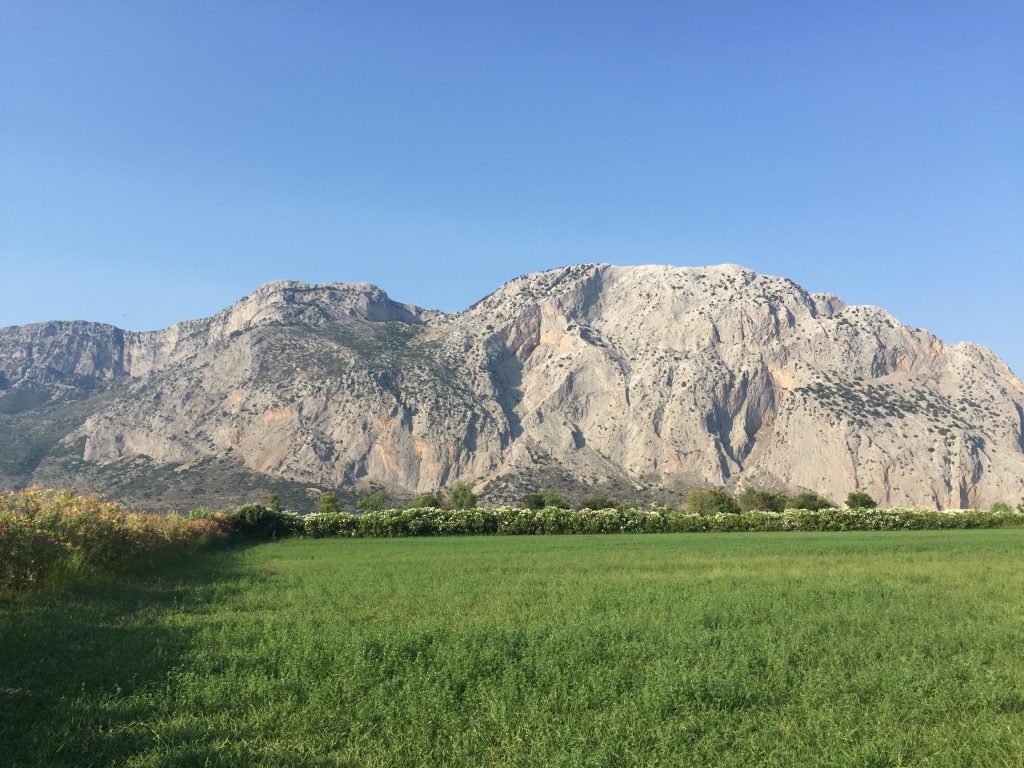
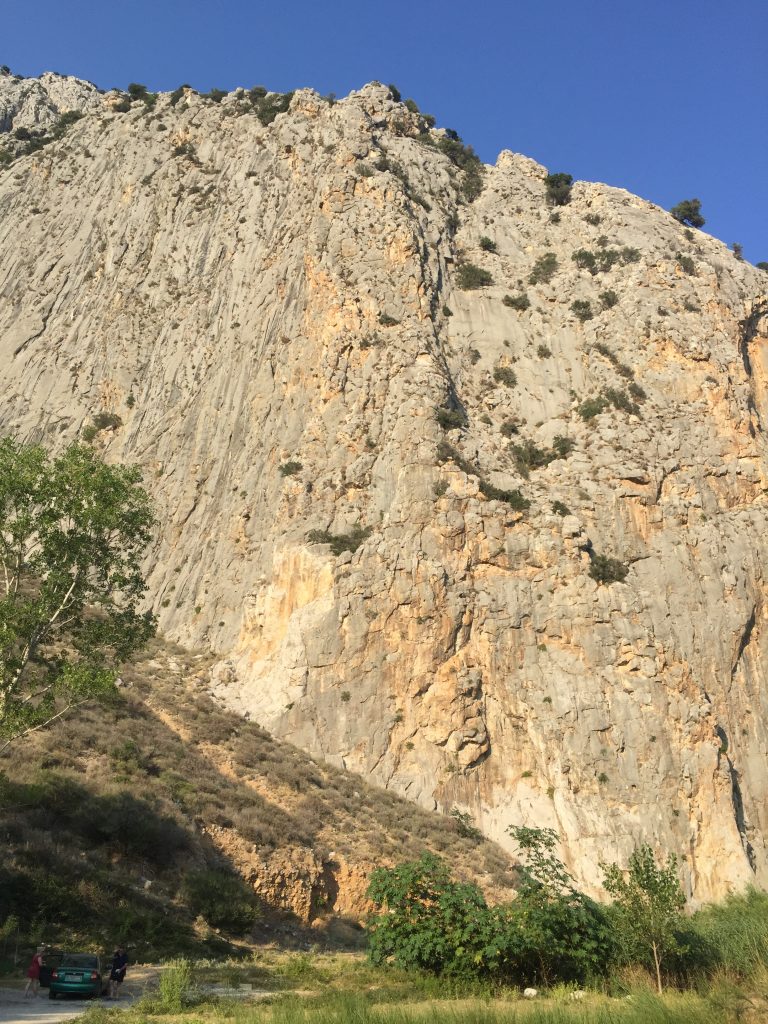
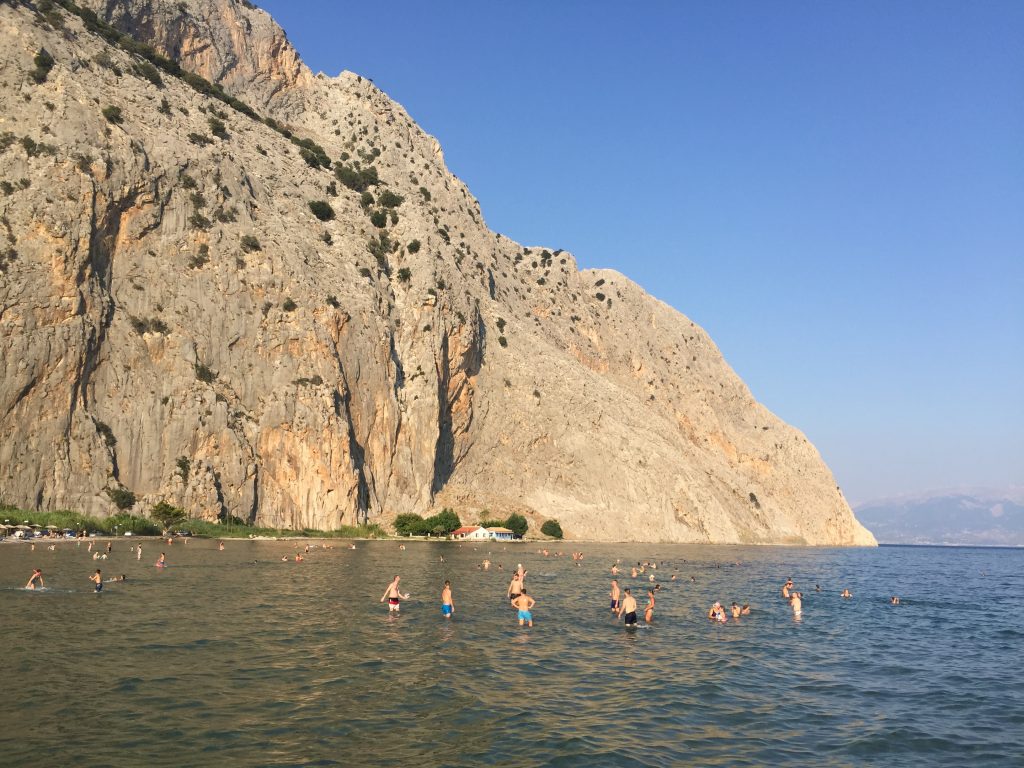
Diese Woche finden sogar die Griechen, dass es etwas heiß ist. BIs 37 Grad……… Was kann man da tun? Richtig: Baden gehen. Unser derzeitiger Hausberg ist ja der Varàsova, knapp 1000 m hoch, seine riesige Felswand ragt senkrecht aus dem Meer.
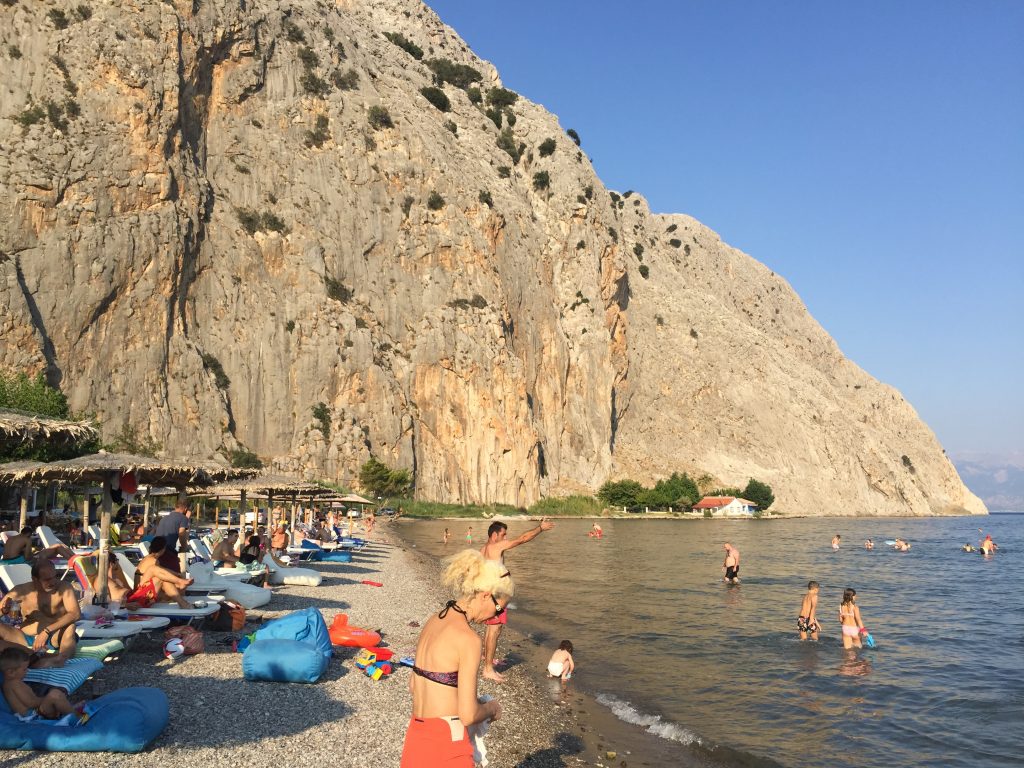
Keine 100 m davor liegt Kryonéri, ein winziges Dorf, das einen kleinen Fischerhafen hat und mehrere urige Kneipen. Und das Besondere an dieser Location ist, dass man auf Sand- und Kiesstrand direkt vor der Felswand baden kann - und dass es dort ganz flach ins Wasser geht. Es sind die typischen griechischen Badeplätze: Ein Sonnenschirm, darunter ein kleiner Tisch, links und rechts eine Liege. Man bestellt sich was zu trinken und hat damit sozusagen die Benutzungsgebühr bezahlt, eine sehr angenehme Regelung, finden wir. Kryonéri liegt etwa 15km östlich von Messolonghi, man liegt schräg gegenüber von Patras mit seiner riesigen Rion-Brücke. Und der Wind, der aus dem Golf von Patras herausweht, macht das Baden und das Liegen selbst bei 37 Grad nicht nur erträglich, sondern richtig angenehm.
This week even the Greeks think it's a little hot. Until 37 degrees…….. What can you do? Take a bath. Our current local mountain is the Varàsova, barely 1000 m high, its huge rock face rises vertically from the sea.
Less than 100 m in front of it there is Kryonéri, a tiny village with a small fishing harbour and several rustic pubs. And the special thing about this location is that you can swim on a sandy and pebble beach right in front of the rock face - and that the water is shallow there. These are the typical Greek bathing places: A parasol, under it a small table, on the left and right a sun bed. One orders something to drink and by doing so, one has so to speak paid the user fee, a very pleasant regulation, we think. Kryonéri is located about 15km east of Messolonghi, you are diagonally opposite Patras with its huge Rion bridge. And the wind that blows out of the Gulf of Patras makes bathing and lying even at 37 degrees not only bearable but really pleasant.
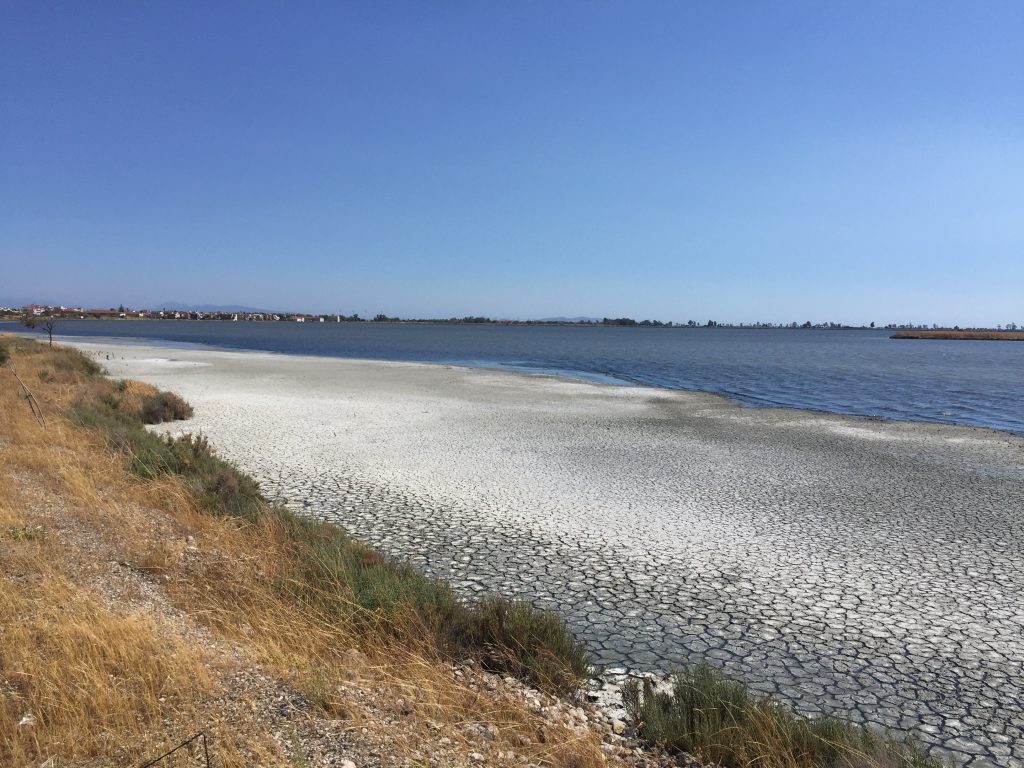
Today with our car: Our destination was Astakos at the Ionian Sea, from where the ferries to Ithaca depart, about 45 km from Messolonghi. The landscape: Aetolia Arcania. Messolonghi is located in the lagoon nature park Messolonghi- Ätoliko. So first we went along the lagoons, which remind strongly of the Camargue, here salt is also extracted on a large scale. With one difference: the lagoons are bordered on the land side by a wild steep rugged mountain range, where there are vertical rockfalls and which is covered with maquis, if anything grows there. Ätoloko is a small town completely located on an island, it has two access roads on a narrow arched bridge. In this area there is agriculture - olives, maize, wine, watermelons…….and there is fishing, namely - because of the shallow water - eels. They are smaller than the ones we know in Germany, they are not smoked, but fried and taste very good. Sometimes, as in Messolonghi, the flat wooden houses of the fishermen stand on stilts like pile dwellings in or near the water.
Lagoon-Landscape near Messolonghi
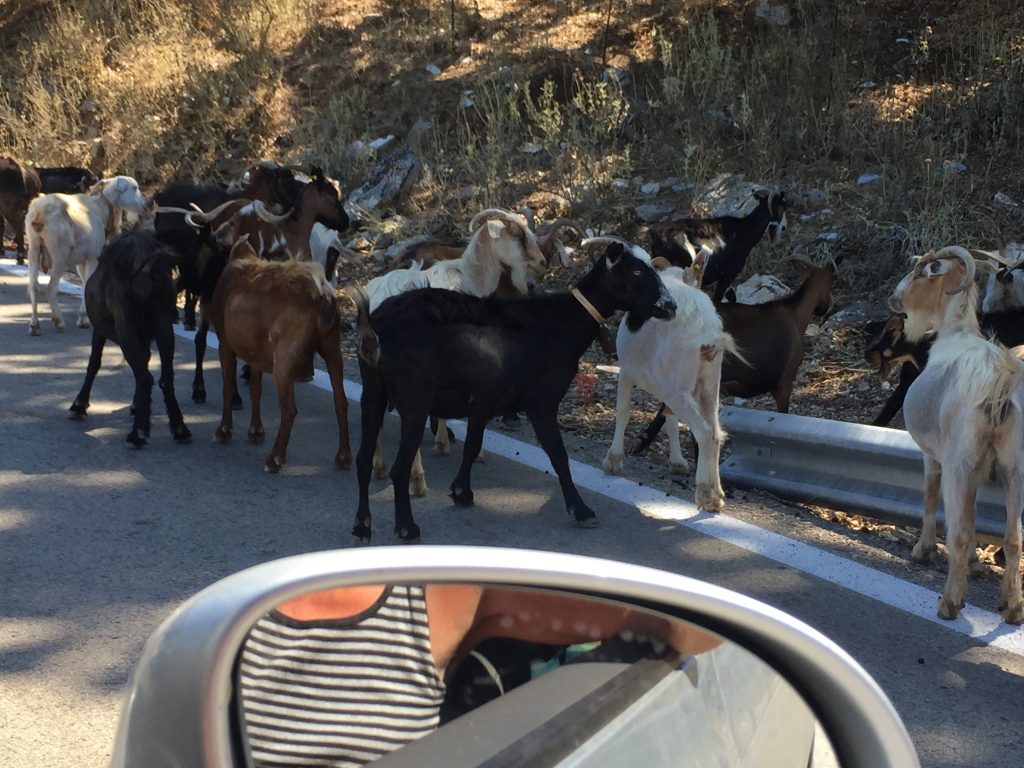
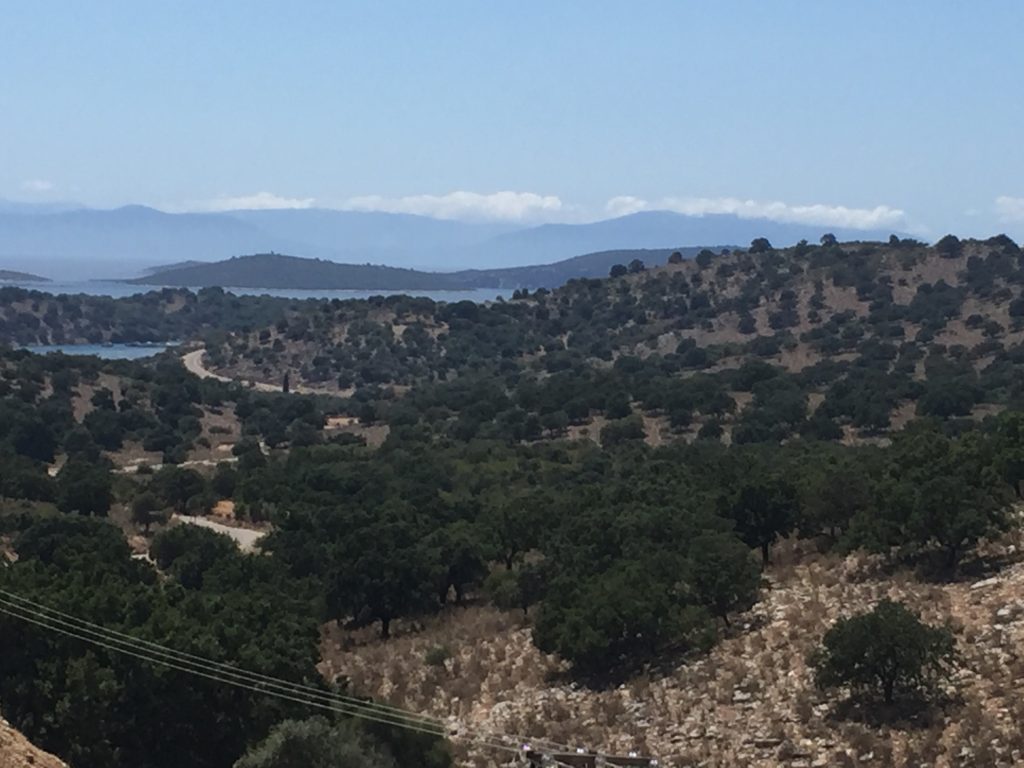
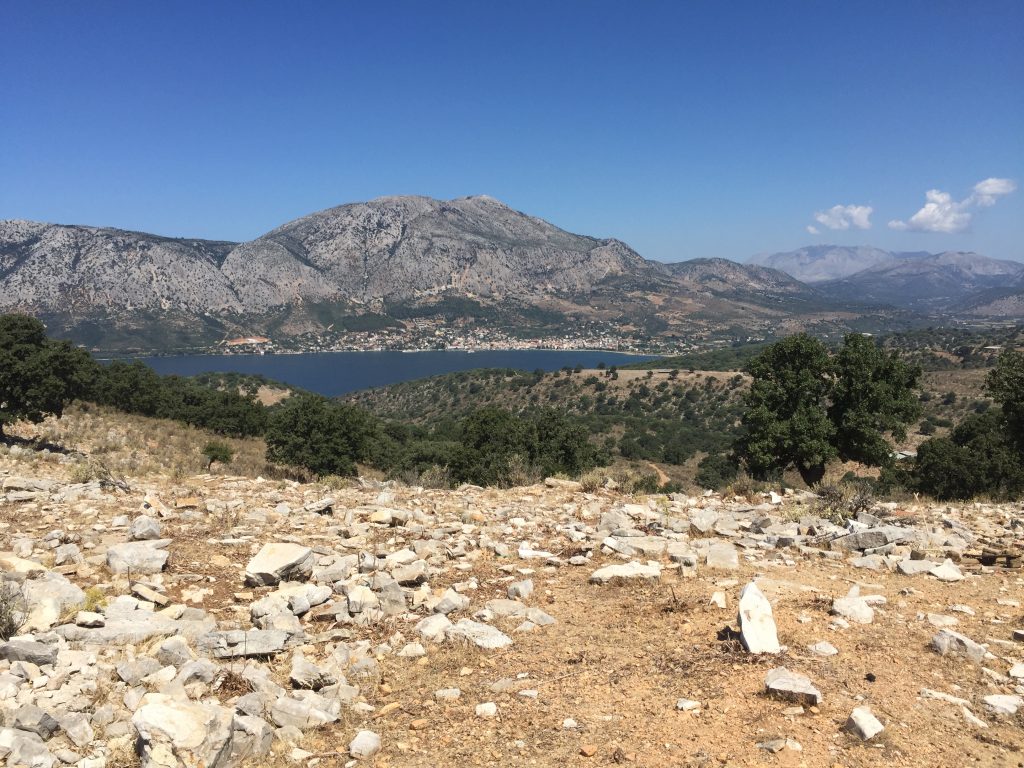
To the north, the route continues into the mountains, in serpentines and narrow curves. You have to be careful, because behind a curve suddenly a herd of goats can stand. Already here you have wonderful views of the strongly structured coastal landscape of the Ionian Sea, brown-red limestone cliffs and the deep blue sea, partly green between eucalyptus or cork oak trees.
View to the Ionian Islands
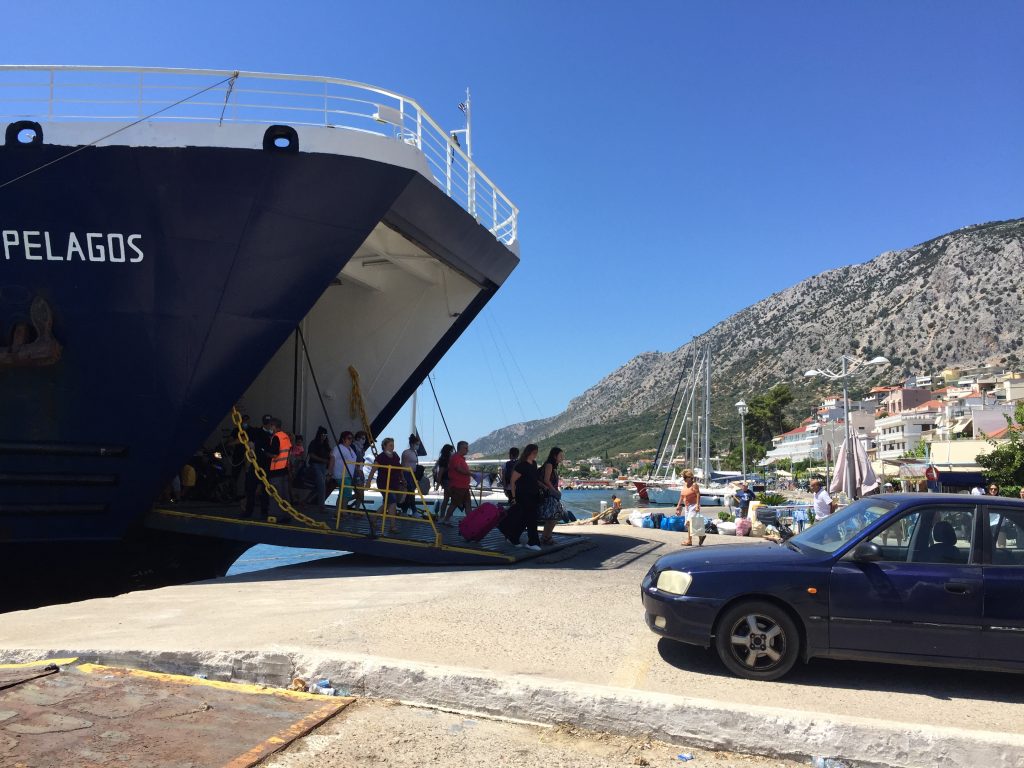
The rock formations are wild and varied: right next to each other there are calcareous layers, volcanic forms like weathered lava rivers and then again huge sloping plates like slates. Astakos is a tiny beautiful town with a pier where fishing boats, but also sailing boats moor. There are restaurants preferably with fish dishes - we have tried one and can recommend it.
Astakos
The car ferry to Ithaca drives with its bow flap directly onto the pier, 20 meters further you can swim, an idyll.
On the return trip we made several small detours into the bays and drank a very good espresso freddo in Ätoliko - a completely successful Sunday trip.
Heute mal mit dem Auto: Unser Ziel war Astakos am Ionischen Meer, von dem aus die Fähren nach Ithaka abgehen, etwa 45 km von Messolonghi entfernt. Die Landschaft: Ätolien-Arkanien. Messolonghi liegt im Lagunen-Naturpark Messolonghi-Ätoliko. Also ging es zuerst entlang der Lagunen, die stark an die Camargue erinnern, hier wird auch in großem Stil Salz gewonnen. Mit einem Unterschied: Die Lagunen werden auf der Landseite von einem wilden steilen zerklüfteten Gebirge begrenzt, in dem es senkrechte Felsstürze gibt und das mit Macchia bedeckt ist, wenn überhaupt etwas dort wächst. Ätoloko ist eine kleine Stadt, die komplett auf einer Insel liegt, sie hat zwei Zufahrten auf einer schmalen Bogenbrücke. In dieser Gegend gibt es Landwirtschaft - Oliven, Mais, Wein, Wassermelonen……und es wird gefischt, und zwar - wegen des Flachwassers - Aale. Sie sind kleiner als die, die wir in Deutschland kennen, sie werden auch nicht geräuchert, sondern gebraten und schmecken ganz ausgezeichnet. Teilweise stehen, wie in Messolonghi auch, die flachen Holzhäuser der Fischer auf Stelzen wie Pfahlbauten im oder am Wasser.
Lagunenlandschaft bei Messolonghi
Nördlich gehts weiter ins Gebirge, in Serpentinen und engen Kurven. Aufpassen muss man, weil hinter einer Kurve plötzlich eine Ziegenherde stehen kann. Schon hier hat man wunderschöne Ausblicke auf die stark gegliederte Küstenlandschaft des Ionischen Meeres, braunrote Kalkfelsen und das tiefblaue Meer, teilweise Grün dazwischen von Eukalyptus- oder Korkeichenbäumen.
Blick auf die Ionischen Inseln
Die Gesteinsformationen sind wild und abwechslungsreich: Direkt nebeneinander gibt es Kalkschichten, vulkanische Formen wie verwitterte Lavaflüsse und dann wieder riesige schräg stehende Platten wie Schiefer. Astakos ist ein winziges schönes Städtchen mit einer Pier, an der Fischerboote, aber auch Segelboote festmachen. Es gibt Restaurants vorzugsweise mit Fischgerichten - wir haben eins ausprobiert und können es empfehlen.
Astakos
Die Autofähre nach Ithaka fährt mit ihrer Bugklappe direkt auf die Pier, 20 Meter weiter wird gebadet, eine Idylle.
Auf der Rückfahrt haben wir verschiedene kleine Abstecher in die Buchten gemacht und in Ätoliko noch einen sehr guten Espresso freddo getrunken - ein rundum gelungener Sonntagsausflug.
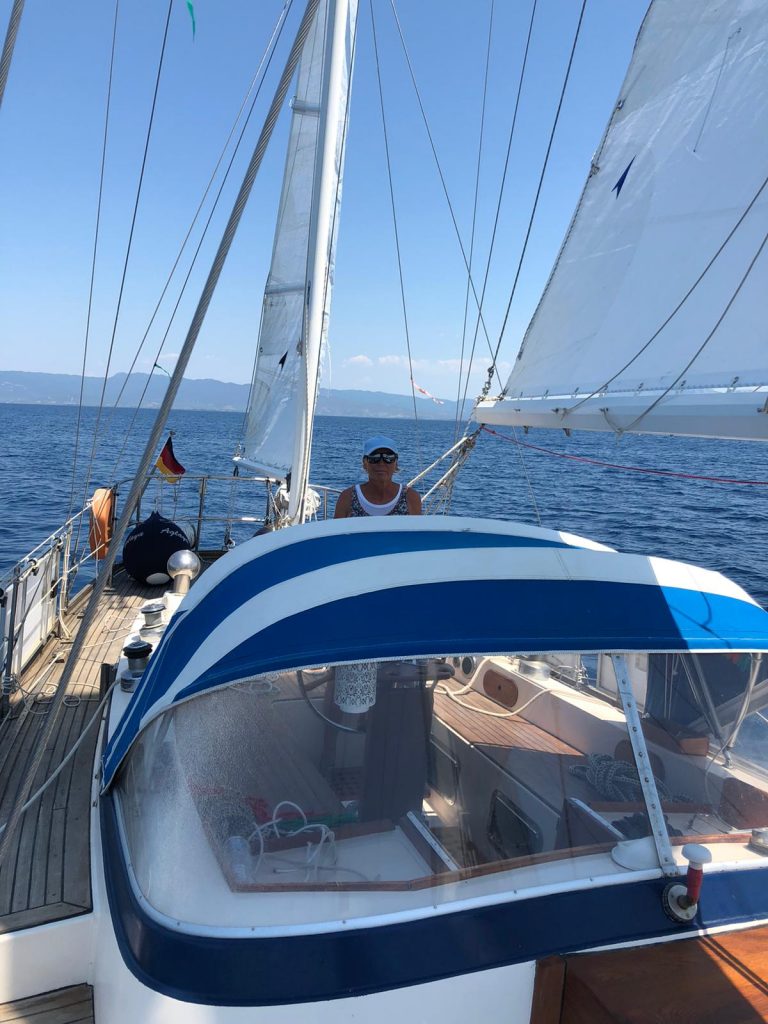
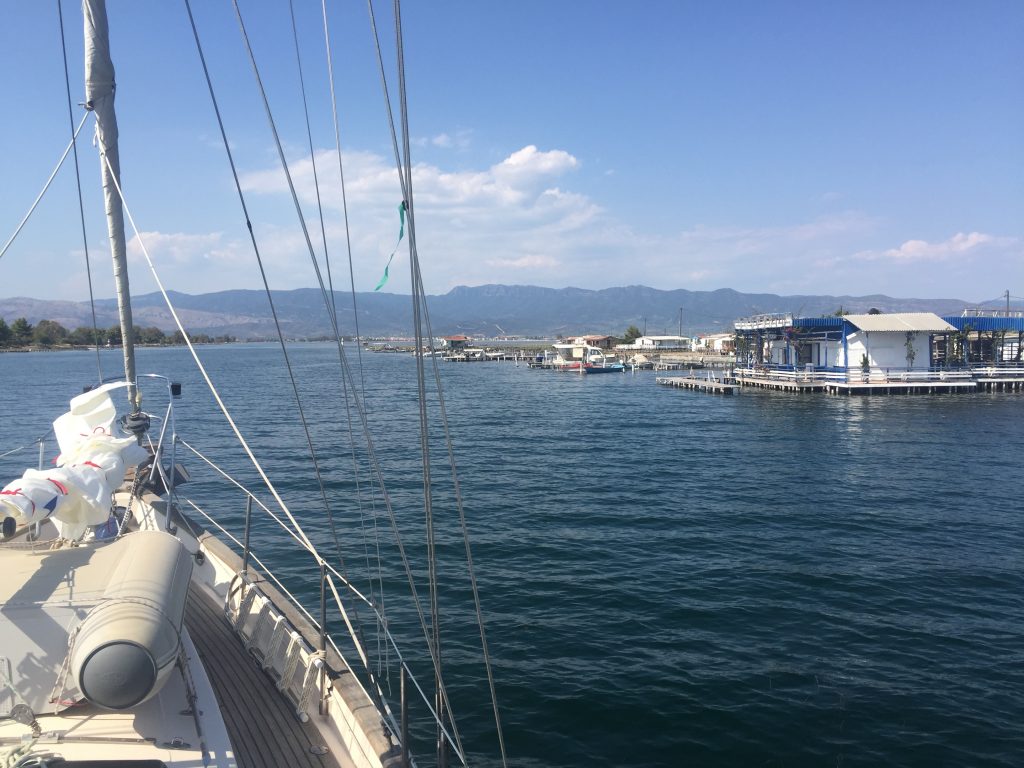
Yesterday, light wind was predicted - we wanted to use this to finally try out all sails and test the sailing characteristics of Aglaya. No sooner said than done: First out of the long channel (Messolonghi is located in a lagoon) under engine. Then at sufficient depth the sails are hoisted - three out of four are brand new. They can be set very well. Then they stand well - very well. Nevertheless, with mainsail, jib, furling genoa and mizzen it is of course hard work - especially at 30 degrees outside temperature. Aglaya sails beautifully - and the sea behaviour of the hull is just as we had imagined: Calm, softly setting into the wave, very stable, no need to balance with the rudder, even when the waves come from the side. So: A beautiful sailing day all around with a wonderful boat.
Cruising the Golfe of PatrasEnterich the channel to Messolonghi Harbour
Gestern war leichter Wind vorhergesagt - den wollten wir nutzen, um endlich einmal alle Segel auszuprobieren und die Fahreigenschaften von Aglaya zu testen. Gesagt, getan: Erstmal aus dem langen Kanal (Messolonghi liegt ja in einer Lagune) unter Motor raus. Dann bei genügender Tiefe die Segel hochgezogen - Von vieren sind ja drei nagelneu. Sie lassen sich sehr gut setzen. Sie stehen dann auch gut - bestens. Trotzdem ist es natürlich bei Großsegel, Baumfock, Rollgenua und Besan dann doch Knochenarbeit - erst recht bei 30 Grad Außentemperatur. Aglaya segelt wunderschön - und das Seeverhalten des Rumpfs ist genauso wie wir es uns vorgestellt haben: Ruhig, weich in die Welle einsetzend, sehr stabil, auch bei Welle von der Seite keinerlei Ausgleichsbewegungen mit dem Ruder notwendig. Also: Ein rundum schöner Segeltag mit einem wunderbaren Boot
Auf dem Golf von Patras unterwegsEinfahrt in den Kanal von Messolonghi
for Prof. Dr.-Ing. Hans Gerd Dohmen, my dear brother-in-law
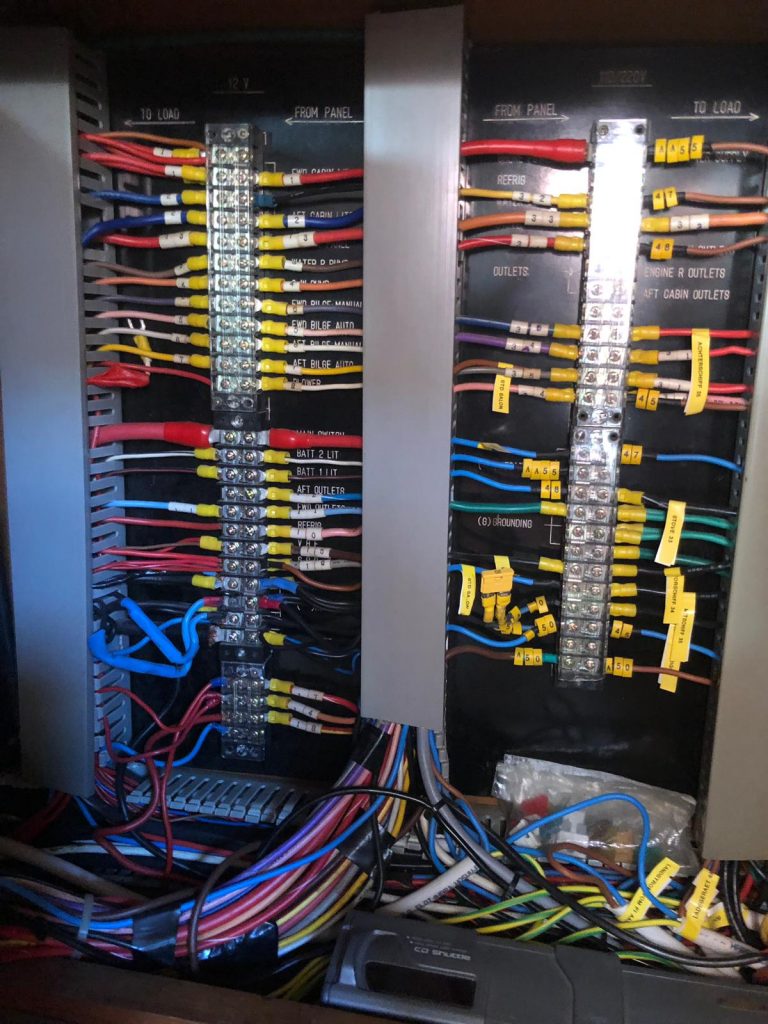
The main energy source for the sailor - wind, of course. But if you want to live on a boat, that's obviously not enough. Aglaya has two bathrooms, each with a toilet, shower and washbasin, all cutely small of course. Furthermore a kitchen with a four-flame gas stove with upper and lower heat (very rare on such boats), a sink, a refrigerator, a freezer. And of course a complete water supply system with a total of 8 pumps. And of course a diesel engine. The stove is supplied with energy by a gas bottle, which is still relatively simple.
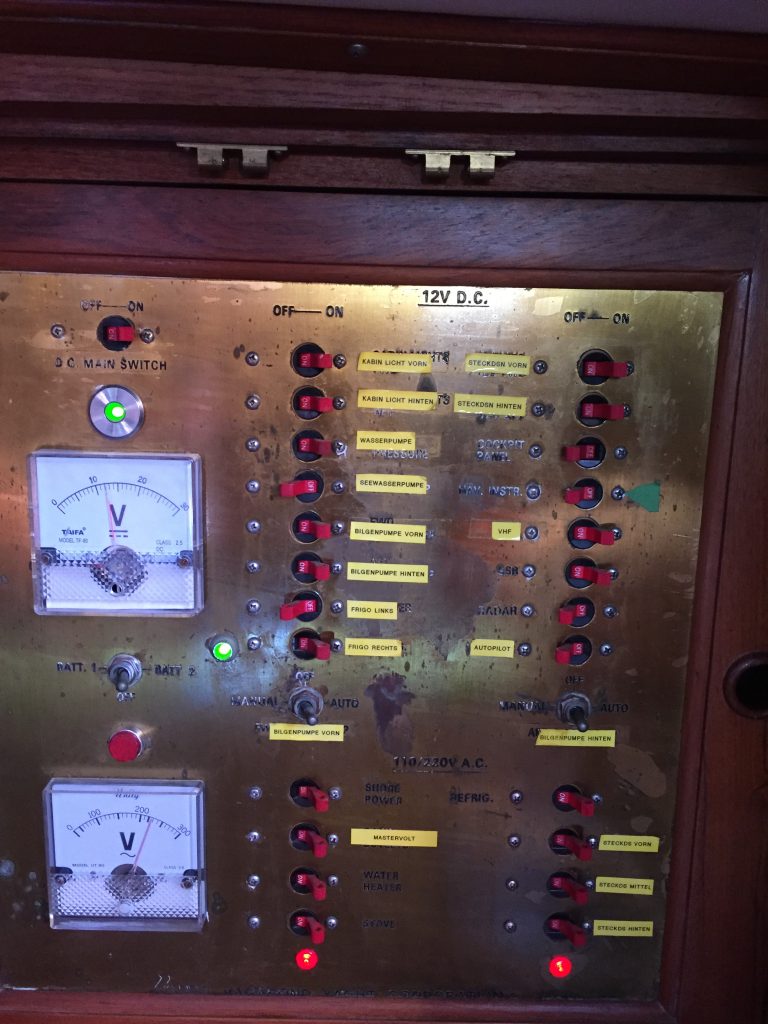
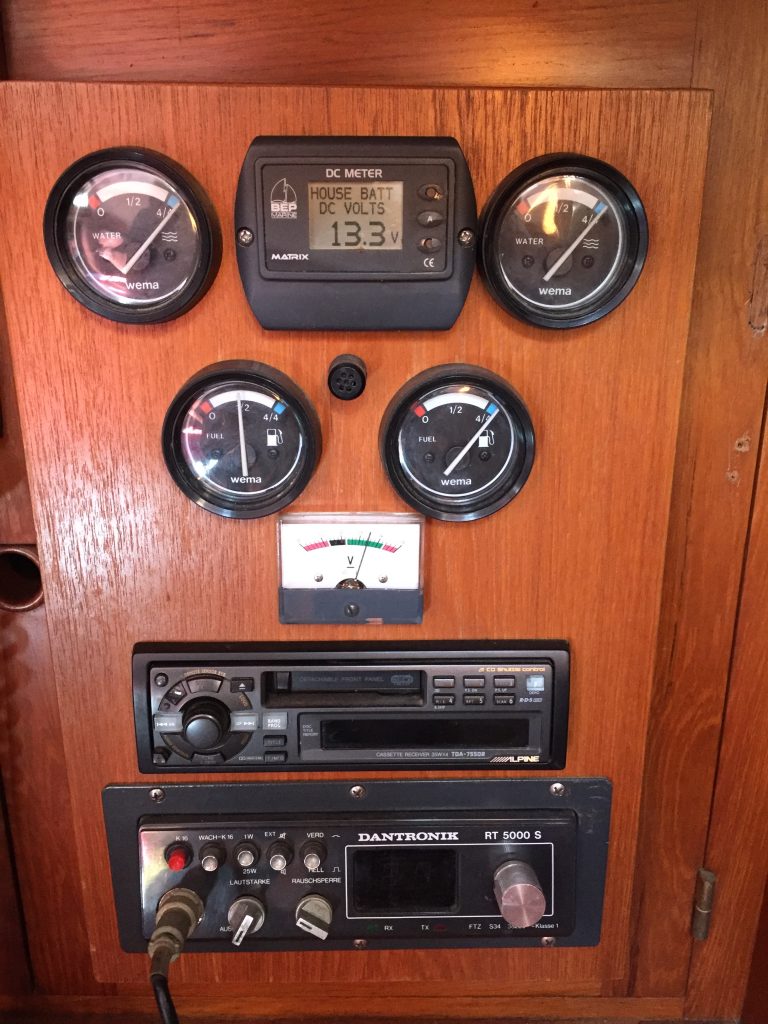
Electricity (voltage) comes from the socket - but only if the boat is moored at a jetty that has a power connection - shore power. This supplies the batteries with electricity via a charger, which works very tricky, and charges them.
At the same time it regulates the distribution of the electricity, because there are four additional solar panels attached to the railing, which can be placed so that the sun shines on them. Then they bring up to 13-15 ampere into the boat. There is a starter battery that starts the engine, it is separated from all other consumers. There are also three large batteries for everything else - a total capacity of 670 ampere hours, in a 12-volt system.
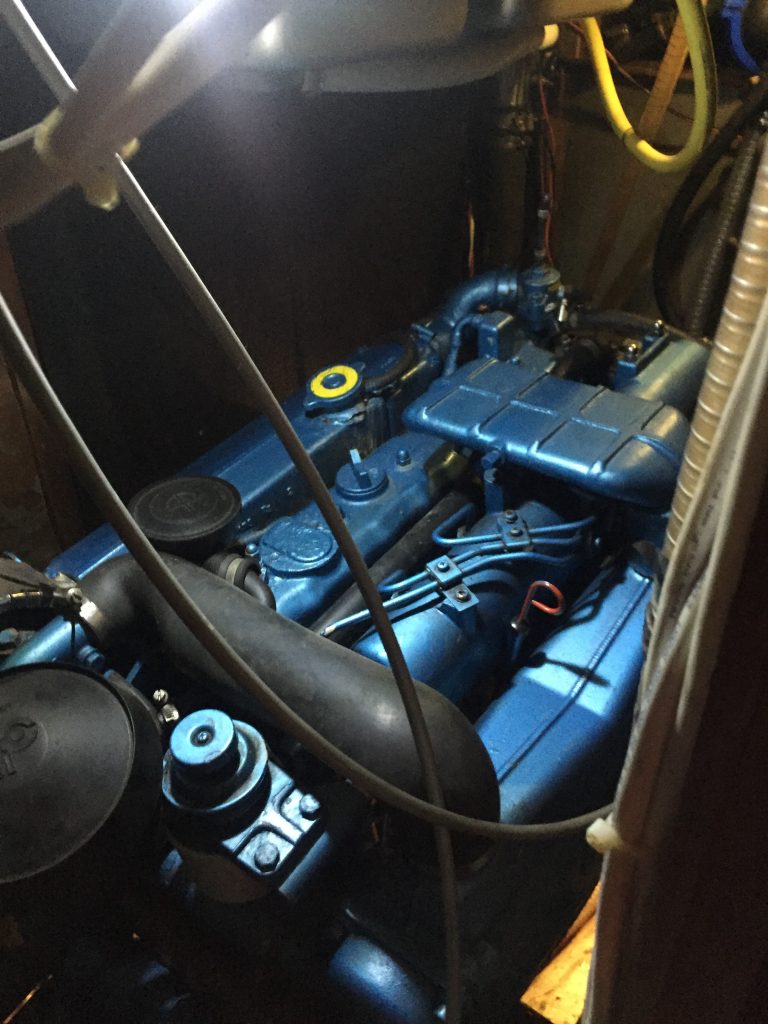
The engine is an 86 hp turbo diesel. Pretty big, the boat we sailed across the Atlantic in 20 years ago had a similar engine, but was two metres longer and six tonnes heavier than ours. A lot of power when you have to manoeuvre, that's reassuring. Of course, there are various navigation instruments, an A.I.S. radar that shows ships nearby, two GPS receivers, depth gauge (echo sounder), log (speed indicator) and much more. All very complex, very tricky. When you are outside, you can't even go to the garage if there is a problem. Of course there are also shipyards and repair shops, but they are usually far away and you have to try to repair or replace as much as possible yourself.