Willkommen! Dies ist die Website von Gisela und Walter Würfel. Hier berichten wir über die Reisen und das Leben auf unserer Segelyacht Aglaya. / Welcome! This is the website of Gisela and Walter Wuerfel. Here we report about the journeys and the life on our sailing yacht Aglaya.
No, we didn't take any photos of this meeting. We were far too busy. When we wanted to set off yesterday with our boat, freshly showered from the night's heavy rain, and pulled in our anchor chain, we already suspected that the boat, that had just moored next to us, had put its chain over ours. And so it was. Normaly you can quickly free yourself from someone else's anchor with an auxiliary line. But this time, our anchor winch kept breaking down when our neighbour's anchor came into view. No wonder! It turned out that there were two more anchors hanging from the two anchors. Four anchors were wedged into each other. We are strong and always have new ideas on how to solve unforeseen problems. But here nothing worked any more. Help arrived in a dinghy from two of the other boats involved. With joined forces we tried to free the anchors from each other. From time to time it looked as if we wouldn't succeed. We also feared that the two energetic helpers might capsize with their dinghy or that the anchors might damage the dinghy. But giving up was not an option. And finally, after just under an hour, we made it. With two auxiliary lines and a lot of physical strength, we were free to set off. And the other three anchors could slumber peacefully again in the harbour basin of Orei. We are now in the city harbour of Volos and have no bad dreams about wedged anchors, because there are lazylines (murings) here. 😊
Nachdem wir uns vom starken Südwind in Karistos und der nächtlichen Brückenpassage in Chalkis im Hafen von Nea Artaki wunderbar ausgeruht hatten, ging es weiter nach Norden zwischen dem Festland (Attika) und Euböa. Hohe Berge auf beiden Seiten, eine eindrucksvolle Kulisse. Wie vor drei Jahren machten wir wieder einen Stopp im Fischerhafen von Loutra Edipsou und weichten unsere Körper in den heißen Quellen ein.
Vom Boot aus konnten wir beobachten, wie die Fischer ihre Boote für die nächtliche Ausfahrt zum Fischen vorbereiteten. Viele der Männer, die auf den Booten arbeiten, kommen aus Ägypten. Da wird vor der Abfahrt dann erst noch der Teppich fürs Abendgebet ausgebreitet. Wir brauchten nicht auf unseren Kompass zu schauen, um zu wissen, wo an diesem Ort Osten ist. Morgens um sieben Uhr (am Sonntag) waren alle Boote wieder zurück und die Styropor-Kisten wurden mit dem Fang vollgepackt. Bei sehr wenig Wind motorten wir dann weiter auf die Nordseite von Euböa, zwischen mehreren kleine Inselchen hindurch, die von den Einheimischen „Griechische Bahamas“ genannt werden. Das konnten wir nachvollziehen.
Was die Menschen, die unterm Sonnenschirm am Strand liegen, nicht merken: Es gibt dort eine starke Strömung. Zum Glück hatte Gisela vorher nicht geschaut, wieviel Knoten die Strömung haben kann. Sonst hätte sie gesagt „Wir fahren außen herum“. Walter hat es verschwiegen, wusste aber: bis zu acht Knoten. Na ja, war gut so. Aber es war heftig: plötzlich lauter Strudel um uns herum, der Bug unseres Bootes wird hin und her gerissen. Da musste die Steuerfrau heftig gegensteuern. Das ging ganz schnell und dann waren wir durch. Dafür kam dann Wind auf, von vorne mit über 30 Knoten und stärker werdender Dünung. Keine Chance, um unter Segeln Höhe zu machen. Also wieder weiterhin Motor. Im kleinen Hafen des geschichtsträchtigen Ortes Oreoi gelang es uns dann, mit Seitenwind entgegen dem Schraubeneffekt nach mehreren Versuchen rückwärts doch noch in eine der letzten beiden Lücken an der Pier „einzuparken“. Wieder mal geschafft.
After a wonderful rest from the strong southerly wind in Karistos and the night-time bridge passage in Chalkis in the harbour of Nea Artaki, we continued north between the mainland (Attica) and Euboea. High mountains on both sides, an impressive scenery. Just like three years ago, we stopped at the fishing harbour of Loutra Edipsou and soaked our bodies in the hot springs.
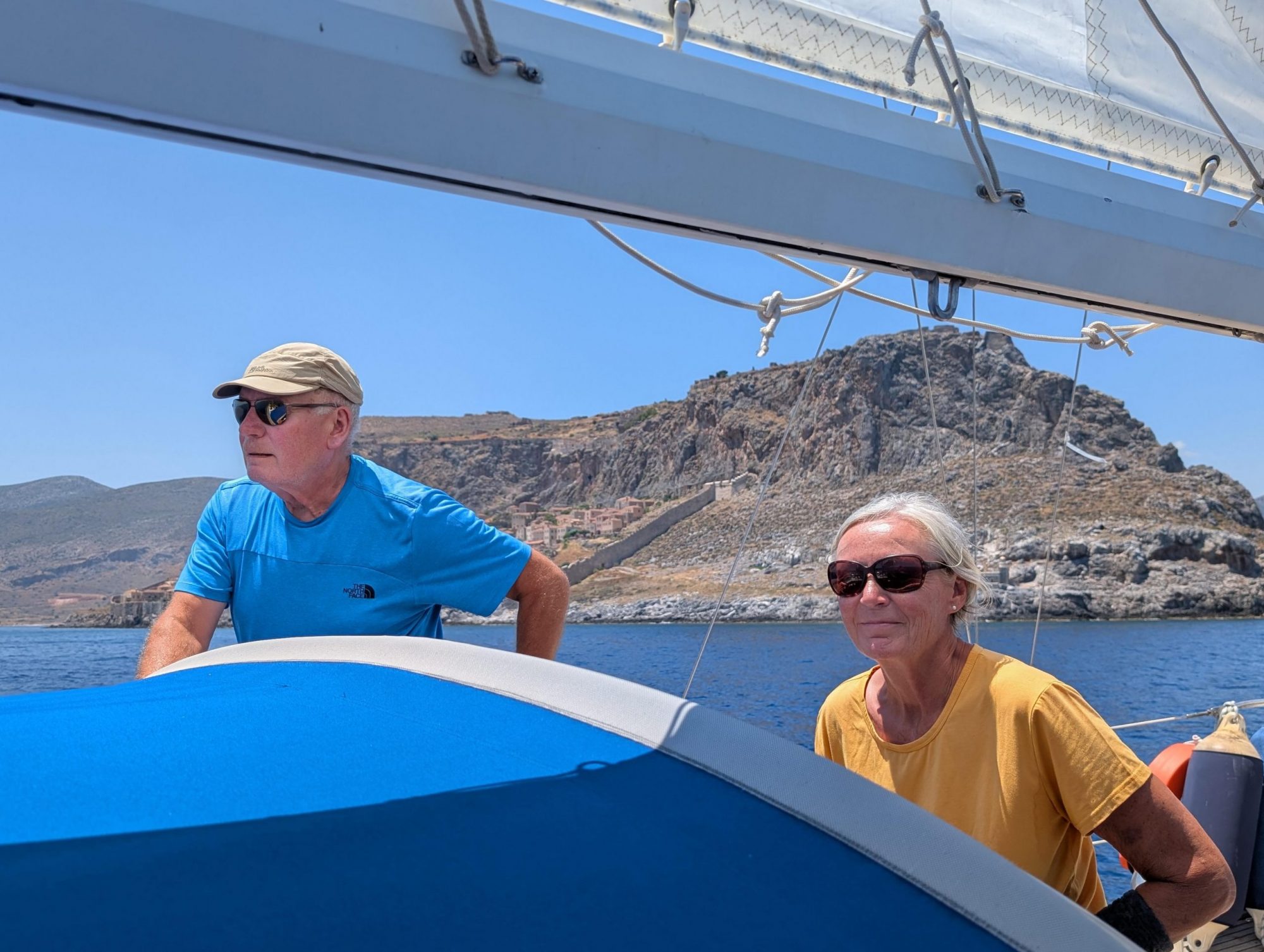
From the boat, we could see the fishermen preparing their boats for the night fishing trip. Many of the men working on the boats come from Egypt. They spread out the carpet for evening prayers before setting off. We didn't need to look at our compass to know, where east was in this place. At seven o'clock in the morning (on Sunday), all the boats were back and the polystyrene boxes were packed full with the catch. With very little wind, we motored on to the north side of Euboea, between several small islets, which the locals call the ‘Greek Bahamas’. We could understand that.
What the people lying under parasols on the beach don't realize is, that there is a strong current there. Fortunately, Gisela hadn't checked beforehand how many knots the current could be. Otherwise she would have said ‘We're going round the outside’. Walter didn't say anything, but he knew: up to eight knots. Well, afterwards that was OK. But it was violent: suddenly lots of whirlpools around us, the bow of our boat was being torn back and forth. The helmswoman had to counter-steer violently. It happened very quickly and then we were through. But then the wind came up from the front at over 30 knots and the swell got stronger. No chance of gaining height under sail. So we continued to motor again. In the small harbour of the historic village of Oreoi, we then managed to ‘park’ backwards into one of the last two gaps in the pier after several attempts with a crosswind against the screw effect. Another job well done.
In the meantime, we have travelled a long way north from Agia Marina on the island of Aegina. On the Cycladic island of Kea, we anchored nicely in the bay of Voukari and, after Walter had screwed something new to our anchor block, we were able to enjoy the beautiful landscape around us and remember the sleeping lion up on the mountain, that we had visited three years ago.
A very strong southerly wind was forecast. We wanted to be somewhere safe. So we headed north to the south side of the island of Eböa. We were safely moored in Karistos harbour, but the storm from the south was so strong, that we spent a day guarding our boat at the pier, just like the other sailors, who had taken refuge in the harbour. Big breakers came over the breakwater and the wind brought a lot of Sahara dust with it. A bit of doomsday atmosphere.
Pure sunshine again the next day. So we set off northwards again in the Gulf of Euboea between the mainland and the island, unfortunately under motor at first. But then the wind picked up and we made good progress until just before Bufalo Bay. The small, well-protected bay was already full of anchoring boats, but we still found a spot right in front of the tavernas behind the sandbank. Another quiet night in the middle of an idyllic setting.
Stay another day or sail on? Gisela couldn't decide at first, but then we set off for the strait in Chalkis. We actually wanted to go to the marina south of the bridge, but we were told there was no room. So we decided to cross the bridge to the north the next night. The registration by e-mail worked well. This meant we didn't have to moor at the very high pier and pay at the harbour office, as we did on our first passage. Last time we had to wait until half past two until the water was still and the bridge opened. This time we were able to go through at half past eleven. With the current, it went quite quickly, but it wasn't easy to steer. We were then able to sleep peacefully at anchor in the large bay north of the town.
We are now moored in the fishing harbour of Nea Artaki (three nautical miles north of Chalkis) for the third day - to rest, but also to remove the Sahara dust from our boat and give it a thorough clean below deck. And: we discovered a problem with the power supply from land. The cause was quickly found with the help of a very nice electrician: The heating rod in the hot water boiler was almost completely clogged with limescale. When we switched on the boiler, the main fuse blew, as did the fuse in the power column on land. We were lucky again: the electrician specialised in the type of boiler we had and had the right heating element in the car. Problem solved, and immediately afterwards we washed our hair with warm water. It had been overdue for a while.
The village of Nea Artaki, not far from the highest mountain in Euboea, was founded in 1923 by Greek refugees, the Pontos Greeks. They had been expelled when Atatürk (who himself came from Thessaloniki!) came to power and the state of Turkey was formed. The 19th of May is a public holiday for the Pontos Greeks. We were able to observe how many people gathered at the small church at the harbour of Nea Artaki in the evening and a mass was celebrated. The idea of establishing an ‘ethnically pure’ state is so cruel and absurd! But as we know, these terrible attempts, which cause so much suffering, have happened time and again in history and are still happening today.
Inzwischen sind wir von Agia Marina auf der Insel Ägina ein ganzes Stück weiter nach Norden gekommen. Auf der Kykladeninsel Kea haben wir in der Bucht von Voukari schön geankert und konnten, nachdem Walter an unserem Ankerblock etwas neu verschraubt hatte, die schöne Landschaft um uns herum genießen und uns an den schlafenden Löwen oben am Berg erinnern, den wir vor drei Jahren besucht hatten.
Ein sehr starker Südwind wurde vorhergesagt. Da wollten wir an einen sicheren Platz. Also Kurs Nord zur Südseite der Insel Eböa. Im Hafen von Karistos lagen wir zwar sicher, aber der Sturm aus Süd war so stark, dass wir einen Tag lang unser Boot an der Pier bewacht haben, genauso wie die anderen Segler, die sich in den Hafen geflüchtet hatten. Große Brecher kamen über den Breakwater und der Wind brachte viel Sahara-Staub mit. Ein bisschen Weltuntergangsstimmung.
Am nächsten Tag wieder Sonne pur. So machten wir uns im Golf von Euböa zwischen dem Festland und der Insel wieder auf den Weg nach Norden, leider erst mit Motor. Dann aber kam schöner Segelwind und wir kamen bis kurz vor der Bufalo Bay gut voran. Die kleine, gut geschützte Bucht war schon voll mit Ankerliegern, aber wir fanden noch einen Platz direkt vor den Tavernen hinter der Sandbank. Wieder eine ruhige Nacht mitten in der Idylle.
Noch einen Tag bleiben oder weiter segeln? Gisela konnte sich zuerst nicht entscheiden, aber dann brachen wir doch auf zur Meerenge in Chalkis. Eigentlich wollten wir dort südlich der Brücke in den Yachthafen, aber man sagte uns, es gäbe keinen Platz. So entschlossen wir uns, schon in der kommenden Nacht die Brücke nach Norden zu passieren. Die Anmeldung per E-Mail funktionierte gut. So mussten wir nicht - wie bei unserer ersten Passage - an der sehr hohen Pier anlegen und im Hafenbüro bezahlen. Beim letzten Mal mussten wir bis halb drei Uhr warten, bis Stillwasser war und die Brücke öffnete. Dieses Mal konnten wir schon um halb zwölf durchfahren. Mit der Strömung ging das ganz flott, war aber nicht ganz einfach zu steuern. In der großen Bucht nördlich der Stadt konnten wir dann vor Anker ruhig schlafen.
Im Fischerhafen von Nea Artaki (drei Seemeilen nördlich von Chalkis) liegen wir nun den dritten Tag - zum Ausruhen, aber auch, um unser Boot vom Saharastaub zu befreien und unter Deck mal gründlich zu putzen. Und: Wir stellten ein Problem mit der Stromversorgung von Land fest. Die Ursache war mit Hilfe eines sehr netten Elektrikers schnell gefunden: Der Heizstab im Heißwasserboiler war fast komplett mit Kalk zugesetzt. Wenn wir den Boiler anmachten, flog bei uns die Hauptsicherung raus und auch an Land in der Stromsäule. Wir hatten mal wieder Glück: Der Elektriker war spezialisiert auf den Typ unseres Boilers und hatte den passenden Heizstab gleich im Auto dabei. Problem gelöst, und gleich danach mal mit warmem Wasser Haare gewaschen. Das war schon länger fällig gewesen.
Der Ort Nea Artaki, nicht weit vom höchsten Berg Euböas, wurde 1923 von griechischen Flüchtlingen, den Pontos-Griechen, gegründet. Sie waren damals, als Atatürk (der selbst aus Thessaloniki stammte!) an die Macht kam und sich der Staat Türkei bildete, vertrieben worden. Der 19. Mai ist für die Pontos-Griechen ein Feiertag. Wir konnten beobachten, wie sich an der kleinen Kirche am Hafen von Nea Artaki am Abend viele Menschen versammelten und eine Messe gefeiert wurde. Die Idee, einen „ethnisch reinen“ Staat zu errichten, ist so grausam und absurd! Aber wie wir wissen, gab es diese schrecklichen Versuche, die so viel Leid verursachen, immer wieder in der Geschichte und es gibt sie ganz aktuell auch heute.
Es gibt nichts, was es nicht gibt, wenn wir mit unserer Aglaya unterwegs sind. Als wir in Agia Marina auf der Insel Ägina mit dem Heck zur Pier anlegen wollen und dazu die Ankerkette rauslaufen ließen, kam plötzlich keine Kette mehr. So sind wir kurz vor der Pier „verhungert“ und konnten nicht an Land. Was war da los? Wir haben doch 100 Meter Ankerkette und die war noch längst nicht draußen. Erst einmal gecheckt, ob die Sicherung der Ankerwinsch rausgesprungen war. War nicht. Dann am Ankerblock geschaut, ob was dort nicht stimmt. Alles OK. Da blieb nur noch eins: die Ankerkette muss sich im Ankerkasten verkneult und blockiert haben. Da der Ankerkasten auf unserem Boot nicht von Deck aus geöffnet werden kann, sondern unten im Vorschiff, mussten wir dort nachschauen. Wir kennen den Ankerkasten gut, da wir ihn nach jeder Saison sauber machen. Erst einmal alles aus dem Vorschiff heraus räumen, was dort verstaut ist, dann über unsere Klappfahrräder nach vorne kriechen, Türe öffnen. Das Licht im Ankerkasten geht an. Sehr komfortabel. Und siehe da: Mittendrin hing ein dicker Knoten, eine große Wuling, wie man auch sagen kann. Leider haben wir kein Foto davon gemacht, denn: Problem erkannt, aber noch nicht behoben. Wie bekommen wir das Knäuel entwirrt? Wir haben es geschafft, aber es war ein Kraftakt und was fürs Köpfchen. Interdisziplinäre Kompetenz war gefragt. Giselas Erfahrung beim Entwirren von Wollknäueln beim Stricken war da sehr hilfreich. Und was sagt unsere Ankerkette dazu? Sie spannt sich schön im Wasser und hält unseren Anker. Der Rest liegt wieder ordentlich im Kasten. Es gibt hoffentlich keinen Klabautermann da vorne, der Spaß daran hat, unsere Kette wieder zu verknoten.
There's nothing that doesn't happen when we're travelling with our Aglaya. When we wanted to moor in Agia Marina on the island of Aegina with the stern to the pier and let the anchor chain out, suddenly there was no more chain going out. So we ‘starved’ just before the pier and couldn't get ashore. What was going on? We have 100 metres of anchor chain and it was nowhere near out. We first checked to see if the anchor windlass fuse had blown. It hadn't. Then we checked the anchor block to see if anything was wrong. Everything was OK. There was only one thing left: the anchor chain must have jammed in the anchor locker. As the anchor locker on our boat cannot be opened from the deck, but down in the foredeck, we had to look there. We know the anchor locker well, as we clean it after every season. First of all, we clear everything out of the foredeck that is stowed there, then crawl forwards over our folding bikes and open the door. The light in the anchor locker comes on. Very convenient. And what did we see this time? There was a big knot hanging in the middle, a large tangle, as you might say. Unfortunately, we didn't take a photo of it, because: Problem recognised, but not yet solved. How do we get the tangle untangled? We managed it, but it was a feat of strength and something for the brain. Interdisciplinary expertise was required. Gisela's experience in untangling balls of wool while knitting was very helpful. And what does our anchor chain say? It stretches nicely in the water and holds our anchor. The rest lies neatly in the box again. Hopefully there's no Klabautermann up ahead having fun knotting our chain again.