Springe zum Inhalt

Mittlerweile sind wir vom Süden der Insel Lefkas Richtung Norden aufgebrochen.  Weil die Brücke bei Lefkada außer Betrieb ist, bedeutete das, dass wir westlich außen um die Insel Lefkas Richtung Preveza segeln mussten, ein relativ großer Abschnitt ohne Buchten oder Häfen. Zunächst war auf unserem Weg nach Norden heftiger Nordwind vorhergesagt – also von vorn. Den wetterten wir erst einmal  an der Ostseite von Lefkas in der mittlerweile uns wohlbekannten und wunderschönen Dhésimou-Bucht ab, vor Anker, sogar mit einigen schönen Schwimm-Runden.

Aber der Wind war so heftig, dass wir drei Tage dort blieben, auch weil in Sivota im Süden von Lefkas kein Platz an irgendeiner der vielen Piers frei war – alles wartete den Wind ab, um dann nach Norden zu kommen.

Schließlich fanden wir „The Cove“, einen Steg in Sivota, der nicht nur sehr preisgünstig (kein Zwang, irgendwo essen zu gehen) war, sondern ganz wunderbar top-gepflegt und mit bestem Service, Dimitris war immer präsent, sehr schön. Wir blieben drei Nächte, genossen das gute Fassbier bei Stavros und machten lange Spaziergänge um die Bucht mit den atemberaubenden Ausblicken nach Ithaka, Kefallonia, Oxia, Meganisi, Atokos, Arkoudi und vielen anderen Inseln.  

Dann mussten wir doch los – 10 Meilen nach Westen um das Kap Doukatou herum, dann 25 Meilen nach Norden an der spektakulären Westküste von Lefkas mit den weißen senkrechten Felswänden entlang. Hier waren wir im Frühsommer schon einmal von Nord nach Süd unterwegs und haben eine Nacht vor Anker verbracht. Kein Wind, aber ganz viel Dünung. Achterbahn mit Motor … langes nerviges Schaukeln bis Preveza. Dort angekommen, war es wieder trübe und regnerisch, wir ankerten in der großen Bucht hinter der Stadt, vor uns der Ambrakische Golf. Bis wir dann unserem irischen Nachbarn zu nahe kamen – der Anker rutschte. Also bei Nieselregen und heftigem Wind einen neuen Ankerplatz gesucht und nach zwei Versuchen saß der Anker – für einen Tag und eine Nacht voller Gewitter, Regen und Starkwind. Immerhin – Ouzo, Wein und ein gutes Essen aus der Bordküche waren noch vorhanden.

Am nächsten Tag ging es aus der Bucht von Preveza Richtung Paxos. Graues Wetter, Wind von vorne, heftige Dünung, heftiges Gegeige, so nennt man diesen Achterbahn-Kurs. Nicht schön! In Gaios auf Paxos – dem St. Tropez des ionischen Meeres! - legten wir an dem schon bekannten Schwimmsteg mit den grauenhaften Mooring-Leinen an, aber neben zwei unglaublich witzigen Briten, neben denen wir schon in Preveza lagen – ein wenig Monty Python, schön. Abends haben wir uns dann ein leckeres Essen in einem guten Fisch-Restaurant gegönnt, ausgezeichnet – das musste sein.

Am nächsten Tag, auf dem Weg nach Korfu, 13 Meilen in das wunderschöne, uns längst bekannte Sivota auf dem Festland, wieder bei unglaublich heftiger Dünung, wieder zu wenig Wind, wieder Geigenkurs, wieder flog man unter Deck hin und her …dann endlich Ruhe und Sonne im Hafen, Petros nahm uns in Empfang, alles gut.

Heute ging‘s dann hinüber nach Korfu-Stadt. Nun liegen wir in der schönen Mandraki-Marina unterhalb der Festung und freuen uns auf den Besuch von Giselas Neffen Felix, der morgen kommen wird.

We have now set off from the south of the island of Lefkas heading north.  Because the bridge at Lefkada is out of order, this meant that we had to sail west around the outside of the island of Lefkas towards Preveza, a relatively long stretch with no bays or harbors. Initially, a strong northerly wind was forecast on our way north - from the front. We first weathered it off on the east side of Lefkas in the now well-known and beautiful Dhésimou Bay, at anchor, even with a few nice swims.

But the wind was so strong that we stayed there for three days, partly because there was no space available on any of the many piers in Sivota in the south of Lefkas - everybody was waiting for the wind to turn for sailing north.

Finally we found “The Cove”, a jetty in Sivota, which was not only very reasonably priced (no need to go out to eat anywhere), but also wonderfully well-maintained and with the best service, Dimitris was always present, very nice. We stayed three nights, enjoyed the good draught beer at Stavros and took long walks around the bay with breathtaking views of Ithaca, Kefallonia, Oxia, Meganisi, Atokos, Arkoudi and many other islands.  

Then we had to set off after all - 10 miles west around Cape Doukatou, then 25 miles north along the spectacular west coast of Lefkas with its white vertical cliffs. We had already sailed here from north to south in early summer and spent a night at anchor. No wind, but lots of swell. Rollercoaster with engine ... long, annoying rocking until Preveza. Once there, it was cloudy and rainy again and we anchored in the large bay behind the town, with the Ambracian Gulf in front of us. Until we got too close to our Irish neighbor - the anchor slipped. So we looked for a new anchorage in drizzling rain and strong winds and after two attempts, the anchor was in place - for a day and a night full of thunderstorms, rain and strong winds. At least - ouzo, wine and a good meal from the pantry were still available.

The next day, we left the bay of Preveza for Paxos. Gray weather, wind from the front, heavy swell, heavy fiddling, that's what they call this roller coaster course. Not nice! In Gaios on Paxos - the St. Tropez of the Ionian Sea! - we moored at the well-known floating dock with the horrible mooring lines, but next to two incredibly funny Brits, next to whom we had already moored in Preveza - a bit Monty Python, nice. In the evening we enjoyed a delicious meal in a good fish restaurant, excellent - it was a must.

The next day, on the way to Corfu, 13 miles to the beautiful Sivota on the mainland, which we have known for a long time, again in incredibly heavy swell, again too little wind, again violin course, again flying back and forth below deck ... then finally calm and sun in the harbor, Petros welcomed us, all is good.

Today we went straight to Kerkyra Town. Now we moor in the beautiful Mandraki Marina below the old fortress and are looking forward to the visit of Gisela‘s nephew Felix. He comes tomorrow.

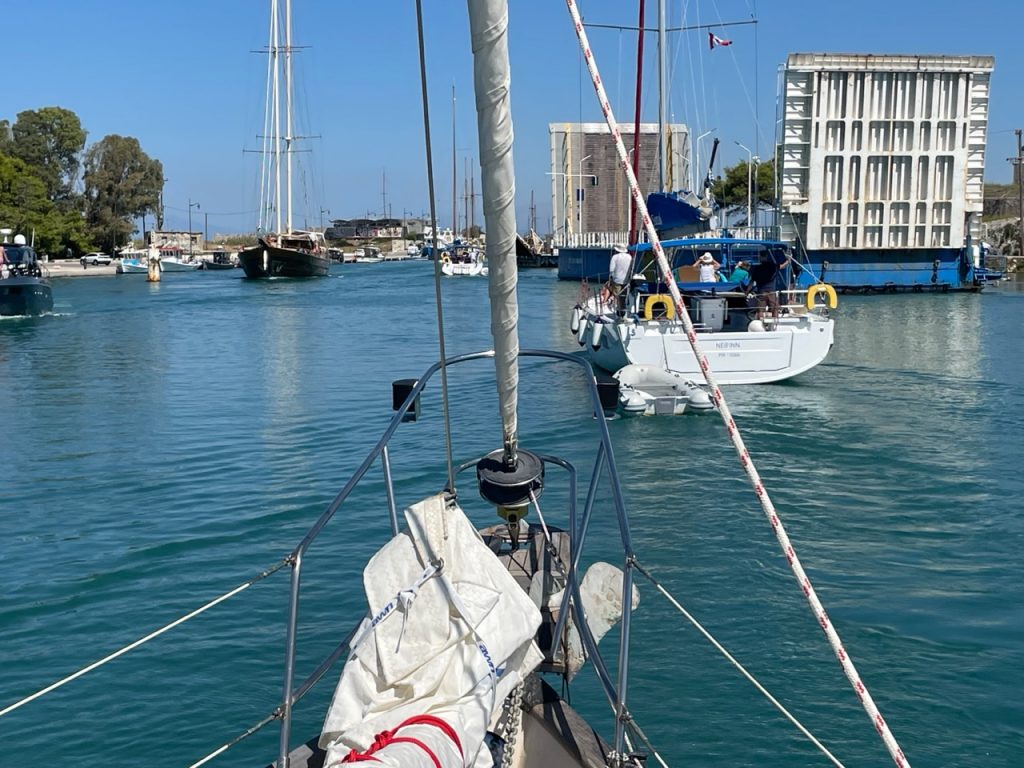
… says the Kurpfälzer or the Kurpfälzerin.  This means something like “first of all, things turn out differently...”. That's what's happening to us at the moment: the northern and southern Ionian Islands are separated by the island of Lefkas. A canal leads to this island from the south, over which there is a floating bridge, the only car connection to the island and the only way to get north or south by boat. The bridge opens once every hour so that boats can pass through without having to drive around the outside of the island, which is spectacularly scenic but inconvenient. There are no safe anchorages on the route, it is open sea and Italy is opposite.

Suddenly we are informed that the bridge's safety certificate has expired, that the bridge has to go into dry dock and that the passage is now closed to boats until further notice. Nobody knows for how long. Dozens to hundreds of charter sailors who were travelling north or south and have to drop off their boats on time now have a 60-mile detour ahead of them, and many will not arrive in time.

For us it's just inconvenient, a detour, but we still have enough time before we pick up our guest Felix in Kerkyra.

This is Greece - after all, Christmas always comes unexpectedly and unexpectedly ......

… sagt  der Kurpfälzer oder die Kurpfälzerin.  Das meint so viel wie „erstens kommt es anders ...“. So ergeht es uns zurzeit: Die nördlichen und die südlichen Ionischen Inseln werden durch die Insel Lefkas getrennt. Zu dieser Insel führt von Süden ein Kanal, über den eine drehbare Schwimmbrücke geht, die einzige Autoverbindung auf die Insel, und die einzige Möglichkeit, per Boot nach Norden oder nach Süden zu kommen. Die Brücke macht(e) alle Stunde einmal auf, damit die Boote durchkonnten, ohne außenherum um die Insel fahren zu müssen, was landschaftlich spektakulär, aber unbequem ist. Es gibt auf der Strecke keine sicheren Ankerplätze, dort ist offenes Meer, gegenüber liegt Italien.

Plötzlich erhalten wir die Meldung, dass das Sicherheitszertifikat dieser Brücke abgelaufen ist, dass sie ins Trockendock muss und dass die Passage für Boote ab sofort bis auf weiteres geschlossen ist. Wie lange, weiß keiner. Dutzende bis Hunderte von Charterseglern, die im Norden oder im Süden unterwegs waren und ihre Boote zum Termin abgeben müssen, haben jetzt einen Umweg von 60 Meilen vor sich, viele werden nicht pünktlich kommen.

Für uns ist es nur unbequem, ein Umweg, aber wir haben noch genug Zeit, bis wir unseren Gast Felix in Korfu aufnehmen.

Das ist Griechenland – Weihnachten kommt ja schließlich auch immer völlig unverhofft und unerwartet ......

Nachdem wir im gemütlichen Hafen Agia Eufemia (Insel Kefallonia) sechs Tage gelegen hatten - erst vor Anker und dann an der Pier, gings weiter, nach Norden.

Die Nachbarinsel, Ithaka, Insel des Odysseus, kannten wir schon, aber noch nicht die Nordküste. Also fuhren wir bei immer noch sehr wechselhaftem Wetter in die Avales-Bucht, eine schöne nach Norden offene Bucht an der Nordspitze von Ithaka. Hier gingen wir vor Anker und lagen ruhig und sicher – bis das Gewitter kam. Mit stürmischen Böen und Platzregen. Natürlich hatten wir mal wieder die Plane vergessen, die unsere etwas undichte Luke über der Schlafkoje abdichtet. Was tun bei Platzregen? Walter zog sich splitternackt aus und rannte an Deck, legte die Plane über die Luke und beschwerte sie. Besser, als ein nasses Bett zu haben.

Mittlerweile wurde das Wetter immer ein wenig stabiler und ruhiger, nicht mehr so viele Gewitterzellen, nicht mehr so viele dichte Wolken. Also Anker auf und einige Meilen nach Norden, teilweise bei schönem Segelwind, in die tief eingeschnittene Bucht von Sivota im Süden der Insel Lefkas. Den Ponton von Iannis kannten wir schon, hier legt man am Steg der Taverna Delfinia an und bekommt Strom und Wasser, wenn man dort essen geht – eine echte Win-Win-Situation. In Sivota herrscht immer noch rege Bautätigkeit, es werden an den Steilhängen Ferienwohnungen und Villas gebaut. Man hat wunderbare Ausblicke auf die Inseln Arkoudi, Atokos, Meganisi, Draghonera und Ochia im Süden, außerdem natürlich auf die hohen Berge auf dem Festland. Eine Szenerie wie in einem riesigen Binnenmeer mit lauter Bergkuppen am Horizont.

Iannis hatte zwei für zwei Nächte Platz für uns, dann kamen die nächsten Flotillen. Genügend Zeit für eine große Waschaktion und eine kleine Wanderung. Dann ging es weiter nach Nordosten, an den Inseln Kastos und Kalamos vorbei in die große weite Bucht von Mytikas. Das Wetter blieb ruhig, so dass wir neben dem (immerzu vollen und zu hektischen) Hafen ruhig und sicher ankern konnten.

Am nächsten Tag: Kastos, ein winziges Dorf auf der gleichnamigen Insel, das hochgelobt wird wegen seiner Idylle und seiner zu einer Bar umgebauten Windmühle – aber eben deswegen: Der kleine Hafen bis auf den letzten Platz mit Segelbooten besetzt, der halbrunde Strand vor dem Dorf dicht an dicht mit Booten vollgepackt, die mit Landleine festgemacht waren, kein Platz, der uns gefällt.

Also ankerten wir frei vor dem kleinen Strand neben dem Hafen, ein schöner Platz, allerdings vor einer Felswand, und der Wind sollte drehen. Neben uns lagen mittlerweile noch etwa 10 Boote, die auch keinen Platz mehr gefunden hatten. Baden und schwimmen zwischen unzähligen kleinen Fischen – wunderbar.

Der Anker hielt, nachts um zwei drehte der Wind und brachte eine Dünung, die uns vor lauter Geschaukel kaum weiter ruhig schlafen ließ, wir rollten im Bett hin und her.

Dann  Anker auf und halb um die Insel Richtung Nordosten. Ziel war die Insel Meganisi, dort eine kleine Bucht, Karnagio. Die Buchten auf Meganisi sind alle schmal, tief eingeschnitten, wie Fjorde, man ankert dicht am Ufer mit Buganker und Landleine, das war uns aber nicht geheuer. Karnagio ist ein Restaurant, das sich einen langen Steg (Catwalk steht in einer Beschreibung) ans Ufer gelegt hat. Dort, wie in Sivota, hat man Strom, Wasser, Duschen – und geht essen.

Karnagio ist eine reine Idylle mit einem kleinen schattigen Strand vor dem Restaurant, kristallklares Wasser, direkt hinter dem Steg Bäume – man hat den Eindruck, man liegt im Wald.

Dazu kommt noch, dass das Dorf Vathy einen Spaziergang weit entfernt ist, hier ist es wunderschön.

Also blieben wir zwei Tage und genossen Baden, Spaziergänge, Essen und die Landschaft.

After spending six days in the cozy port of Agia Eufemia (Kefallonia island) - first at anchor and then at the pier - we headed north.

We already knew the neighboring island, Ithaca, the island of Odysseus, but not yet the north coast. So, with the weather still very changeable, we sailed into Avales Bay, a beautiful bay open to the north at the northern tip of Ithaca. We anchored here and lay calm and safe - until the storm came. With stormy gusts and downpours. Of course, we had once again forgotten the tarpaulin that seals our slightly leaky hatch above the sleeping berth. What to do in the downpour? Walter undressed stark naked and ran on deck, put the tarpaulin over the hatch and weighed it down. Better than having a wet bed.

In the meantime, the weather became a little more stable and calmer, not so many thunderstorm cells, not so many dense clouds. So we weighed anchor and sailed a few miles to the north, sometimes with a good wind, into the deep bay of Sivota in the south of the island of Lefkas. We were already familiar with Iannis' pontoon, where you moor at the jetty of the Taverna Delfinia and get electricity and water if you eat there - a real win-win situation. There is still a lot of building activity in Sivota, with vacation apartments and villas being built on the steep slopes. There are wonderful views of the islands of Arkoudi, Atokos, Meganisi, Draghonera and Ochia to the south, and of course the high mountains on the mainland. The scenery is like a huge inland sea with lots of mountain peaks on the horizon.

Iannis had space for us for two nights, then the next flotillas arrived. Enough time for a big wash and a short hike. Then we continued northeast, past the islands of Kastos and Kalamos into the large, wide bay of Mytikas. The weather remained calm, so we were able to anchor quietly and safely next to the (always crowded and too hectic) harbor.

The next day: Kastos, a tiny village on the island of the same name, which is highly praised for its idyllic setting and its windmill converted into a bar - but that's precisely why: The small harbor filled to capacity with sailboats, the semicircular beach in front of the village packed tightly with boats tied up with shore lines, not a place we like.

So we anchored free in front of the small beach next to the harbor, a nice spot, but in front of a rock face, and the wind was supposed to shift. In the meantime, there were about 10 boats moored next to us that hadn't found a place either. Bathing and swimming among countless small fish - wonderful.

The anchor held, the wind shifted at two in the morning and brought a swell that made it hard for us to sleep peacefully because of all the rocking, we rolled back and forth in bed.

Then we weighed anchor and sailed halfway around the island in a north-easterly direction. Our destination was the island of Meganisi, where we found a small bay, Karnagio. The bays on Meganisi are all narrow, deeply cut, like fjords, you anchor close to the shore with a bow anchor and shore line, but we weren't comfortable with that. Karnagio is a restaurant that has built a long catwalk on the shore. There, as in Sivota, you have electricity, water, showers - and you can eat.

Karnagio is a pure idyll with a small shady beach in front of the restaurant, crystal-clear water, trees directly behind the jetty - you get the impression you're in the forest.

What's more, the village of Vathy is just a short walk away - it's beautiful here.

So we stayed for two days and enjoyed swimming, walking, eating and the scenery.

Kefallonia is the largest of the Ionian Islands, it also has the highest mountain of the islands, Ainos, 1628m. Last year we were in the main town of Argostoli and spent several days there in a deserted marina, taking the bus across the island - beautiful.

Now we've been here in Agia Eufemia for 6 days, 2 of them at anchor, then at the pier. The weather is very changeable, so we prefer the pier with its many tavernas and stores.

We hired a car for a day and went to see the places we hadn't seen before - simply amazing.

We first went along the large bay of Sami to the Melissani karst spring. Like many other tourists, we let ourselves be rowed through the crystal clear water, looked up into the sky and laughed at our rower's jokes. The water that collects there flows underground to the south for 14 days. After about 30 km it arrives at Argostoli. Last year we had seen where it comes to the surface again.

Melissani karst spring

[ngg src="galleries" ids="138" display="basic_slideshow"]

Then we went up high into the national park on the Ainos peak with its huge forests of Kefallonia pines, which got their name from here. A bit like the Allgäu, but with indescribable views of Argostoli, the sea and the southernmost of the islands, Zakynthos. The western side is extremely steep, so that we look directly down to the turquoise sea 1600 m below us.

Ainos National Park

[ngg src="galleries" ids="139" display="basic_slideshow"]

We continue through karstified, sometimes desert-like mountains down to Argostoli, then back up onto the road, which is cut into the steep slope high above the west coast, with views of bays with vertical rock faces.

[ngg src="galleries" ids="140" display="basic_slideshow"]

Then a highlight: a tiny narrow road down to Myrtos Beach, said to be one of the most beautiful beaches in the Mediterranean. And it's true. Incredible turquoise, a huge white beach in front of vertical white cliffs with caves and grottos.

Myrtos Beach

[ngg src="galleries" ids="141" display="basic_slideshow"]

As we were in the Northwest of the Island already we visited Assos, a spectacular village situated on a headland between two bays, with a Byzantine fortress. Car-free. Colourful little houses, a fishing port, beautiful tavernas - also wonderful. The return journey then takes us through rather lovely green valleys with palm trees, yuccas and cypresses, and is of course also extremely winding.

Assos

[ngg src="galleries" ids="142" display="basic_slideshow"]

At the end of the trip, we returned to the taverna Palazzo al Mare, where we enjoyed excellent food and good wine - then we had to digest all our experiences with an ouzo on board.