Springe zum Inhalt

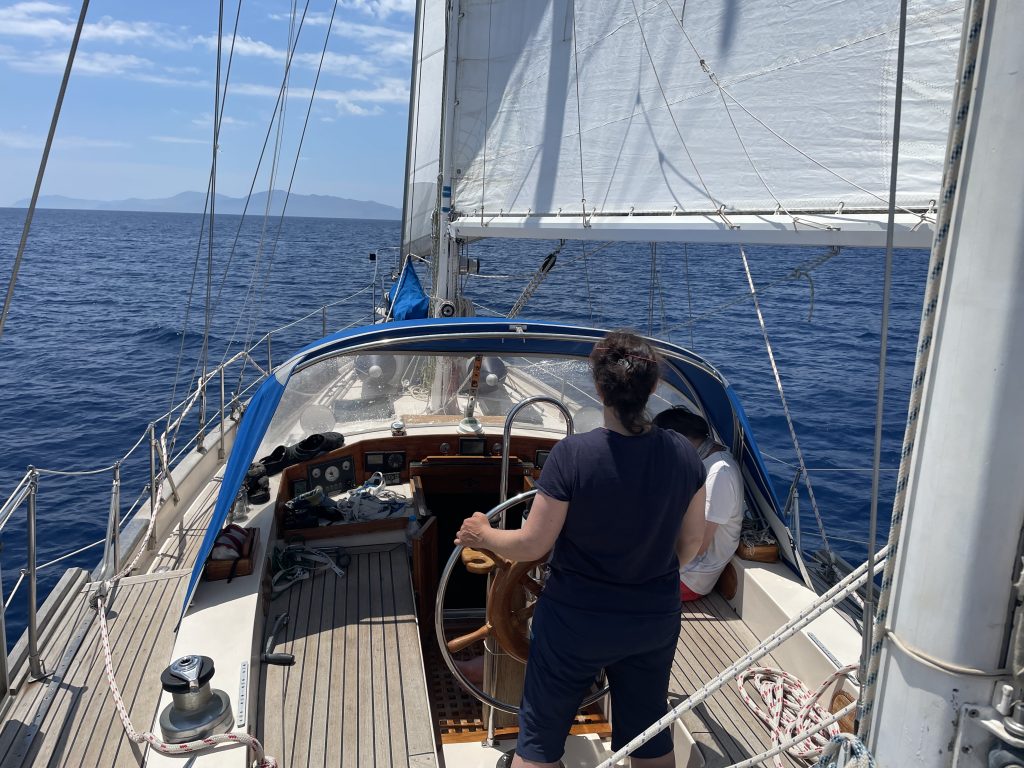
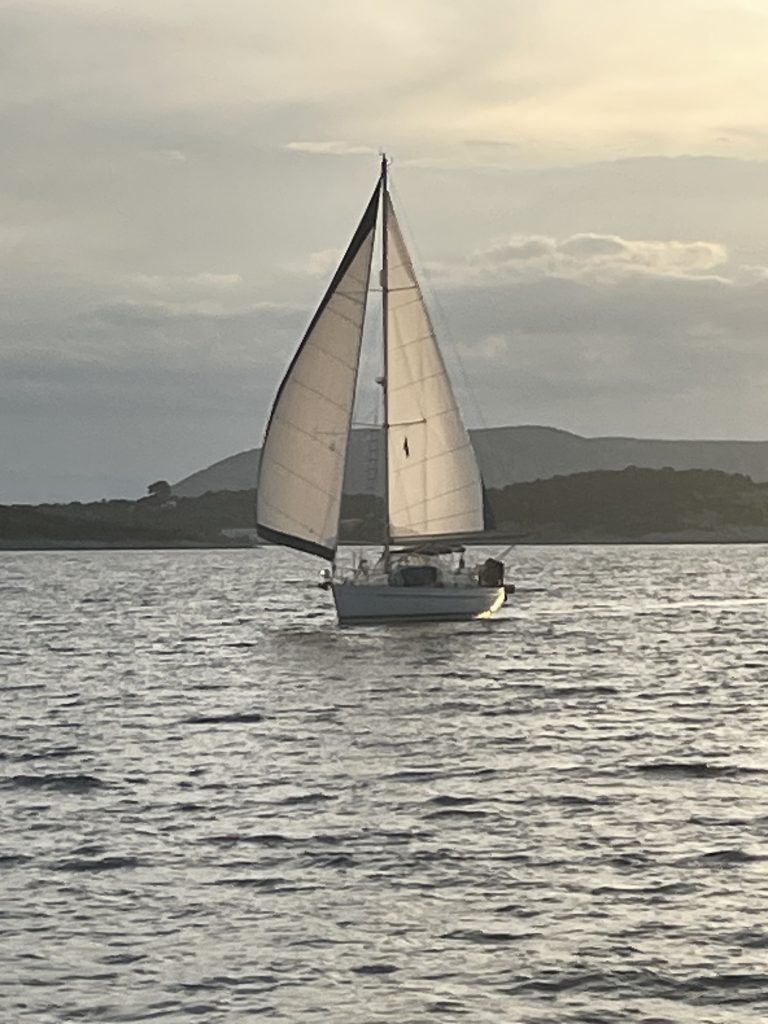
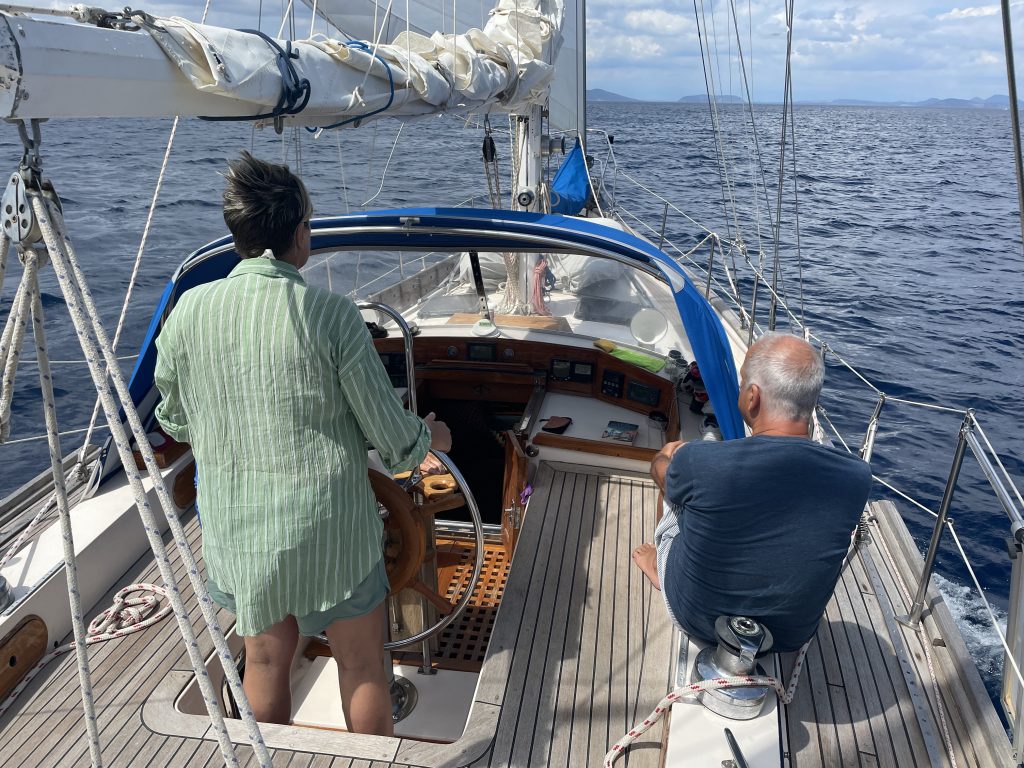
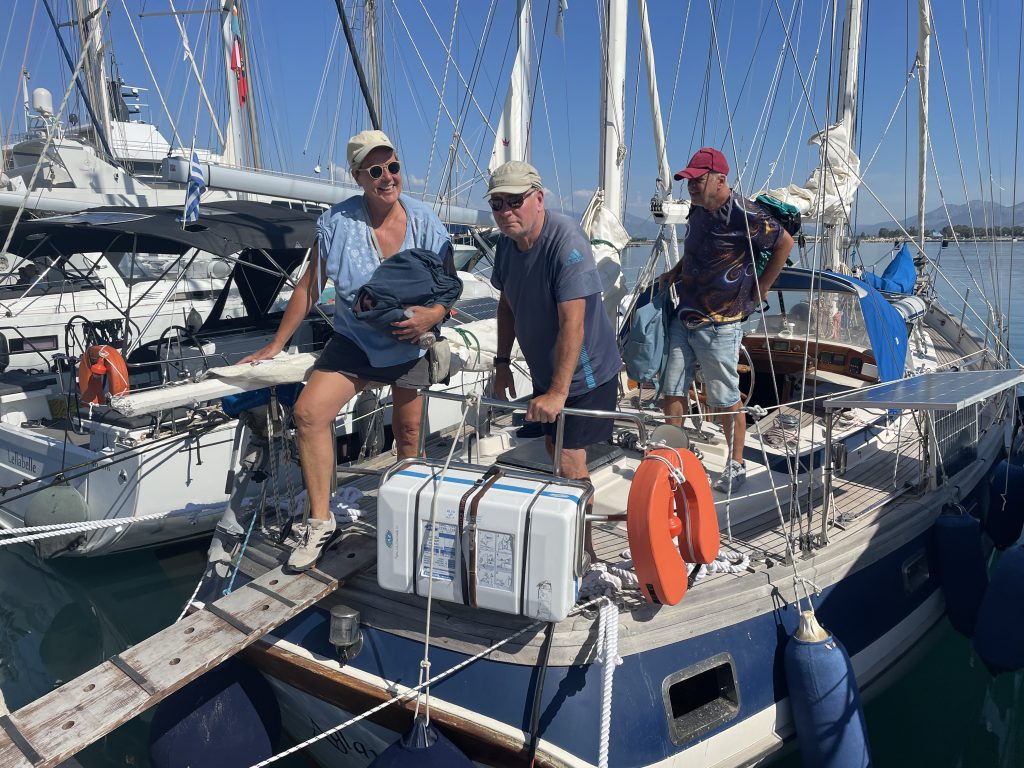
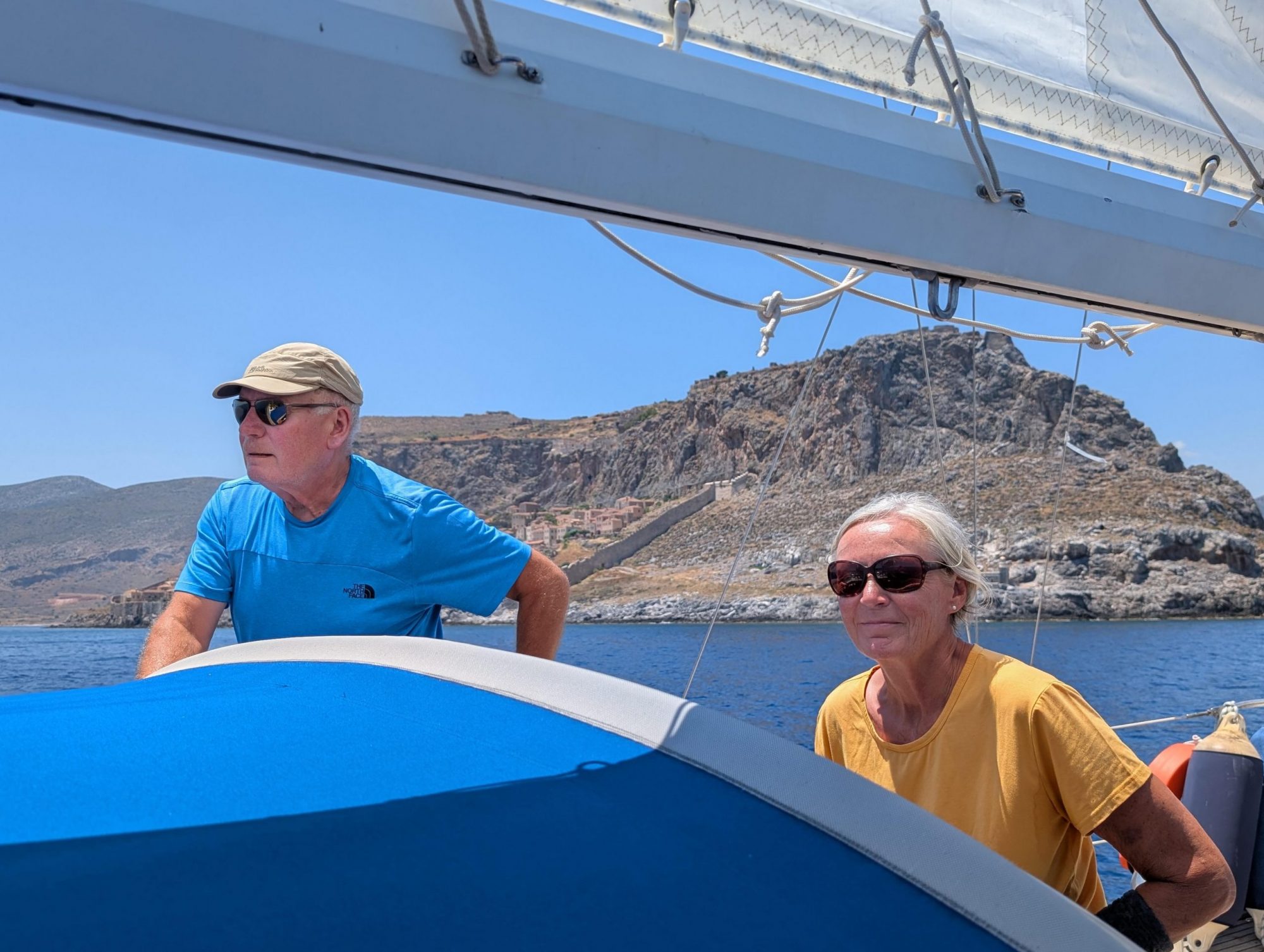
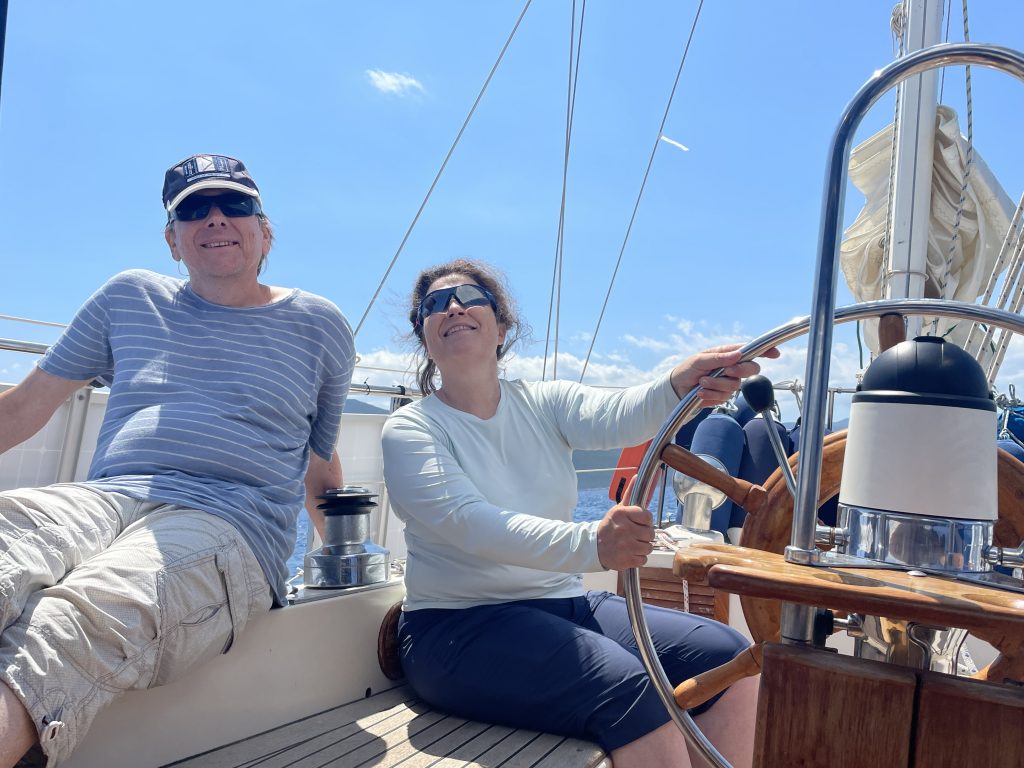
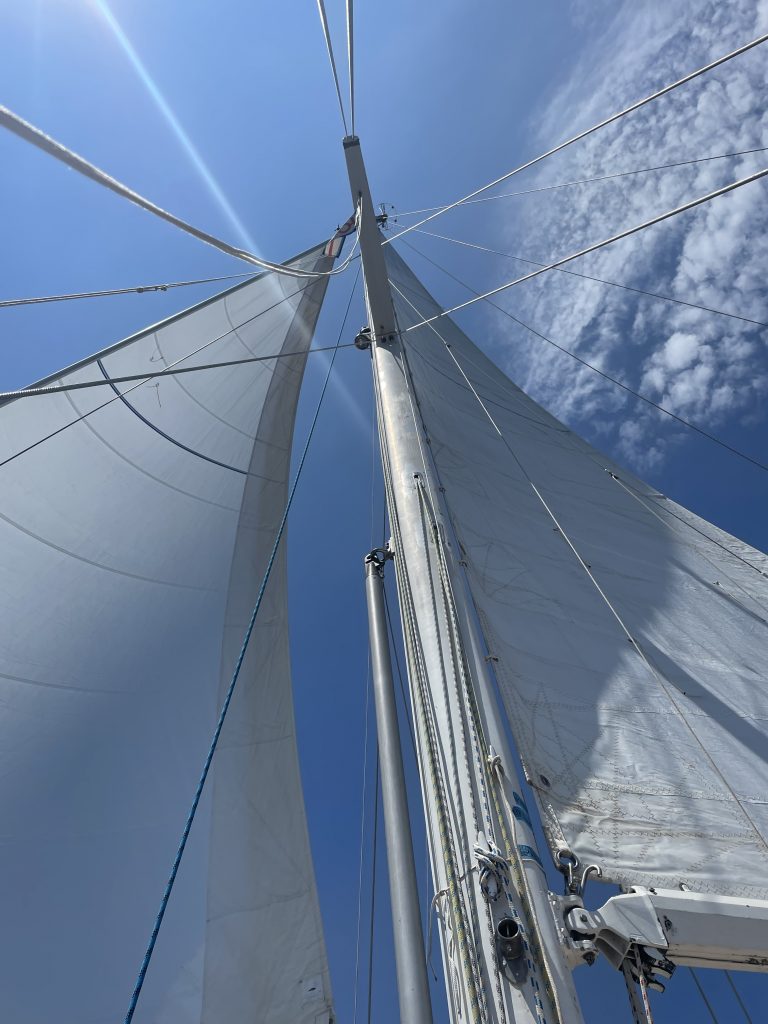
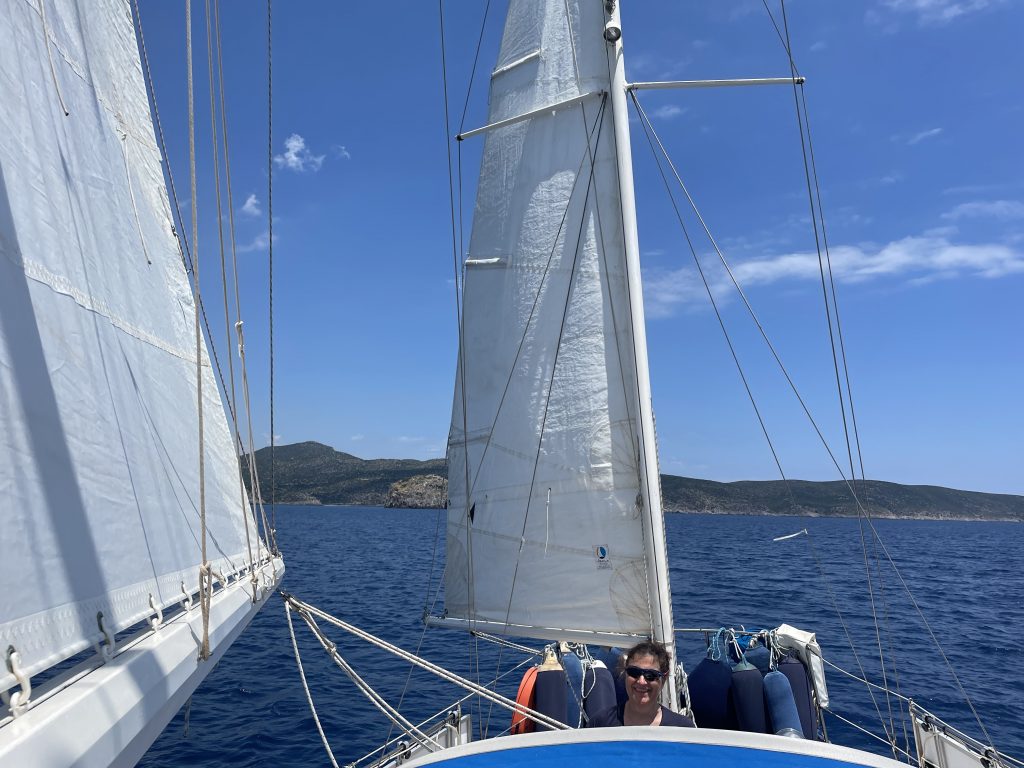
After a short stop in Nafplion, our neighbours Andrea and Axel join us on board for a week. We sailed with them once before in 2022, back then in the Northern Sporades. Once again, we can see that all the sails are perfectly trimmed when we’re out on the water with them. We’re heading south from Nafplion in the Argolic Gulf. The sailing involves everything from tacking into the southerly wind to focused steering with a tailwind and a storm jib on the mainsail. We don’t have long distances to cover and need to make little headway before we reach Monemvasia in a week’s time. This means we can make the most of almost every breeze.
Back to Astros, where we’d already been a few days ago with our previous guests. Then on to Kilada Bay. Of course Andrea and Axel also take a trip to the Franchthi Cave in the dinghy. Then across the gulf to the west, to Leonidi. We’d spent a restless night here a few years ago, moored alongside, with plenty of swell. Experience makes you wiser. This time we’re moored with the bow anchor and stern to the pier. The lady from the tavern welcomes us with a bag full of fruit. In the evening we go there for dinner and enjoy the rustic, delicious food.
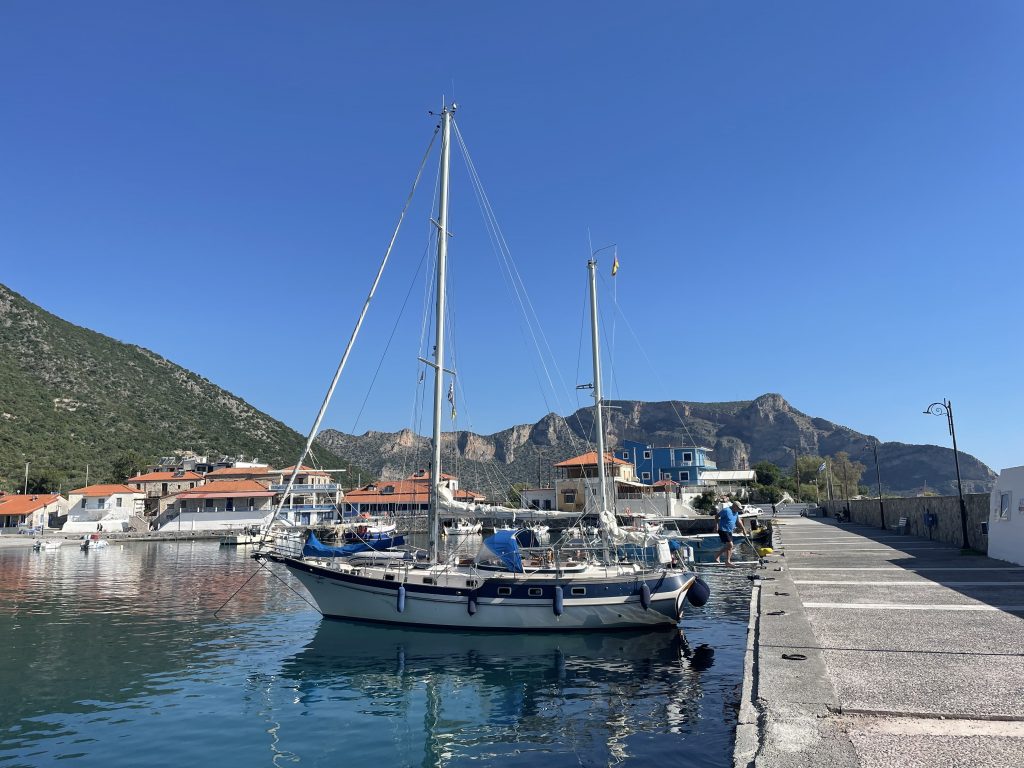
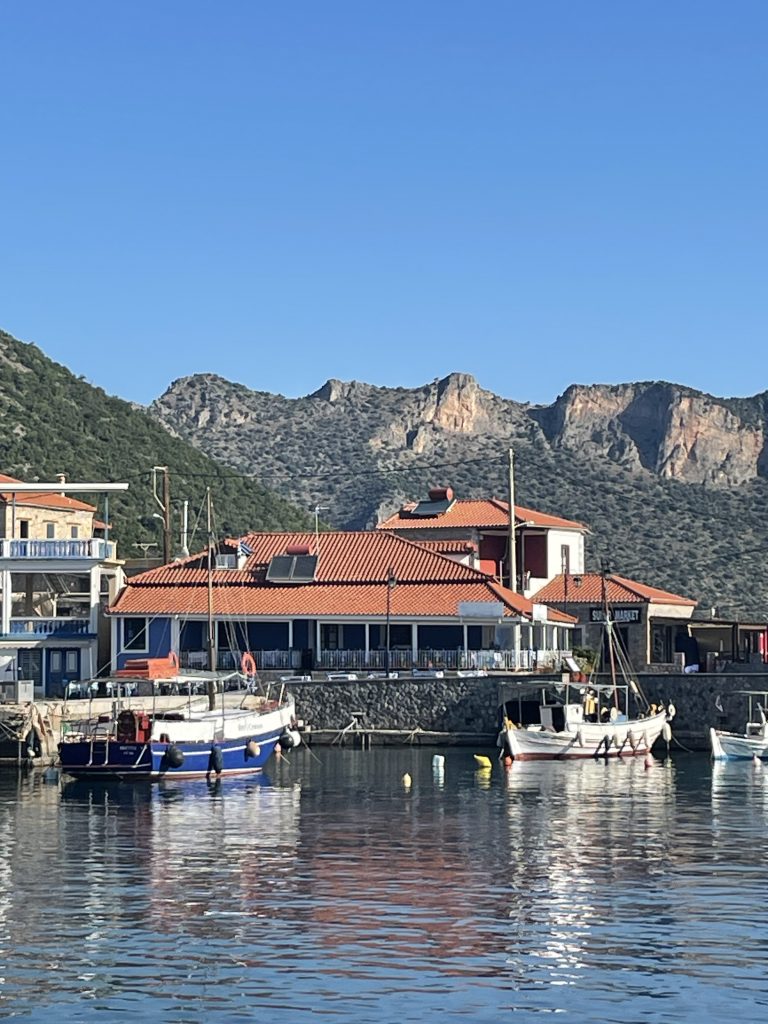
Next destination: Kiparissi. We’re also familiar with this well-sheltered bay and its charming little village from previous years. The bay is full of boats, including large motor yachts (one with a helicopter). We’re amazed at how busy it is here. This isn’t the Kiparissi we’re used to know. We drop anchor in Chapel Cove. It’s relatively quiet here. There’s little light, so in the evening we can admire a magnificent starry sky. The clear water is tempting for a swim. The next day, we decide to see what’s going on in the village, so we row the dinghy to the small jetty by the chapel and walk along a lovely path with plenty of views of our boat. It’s Sunday and siesta time, so there’s nothing going on.
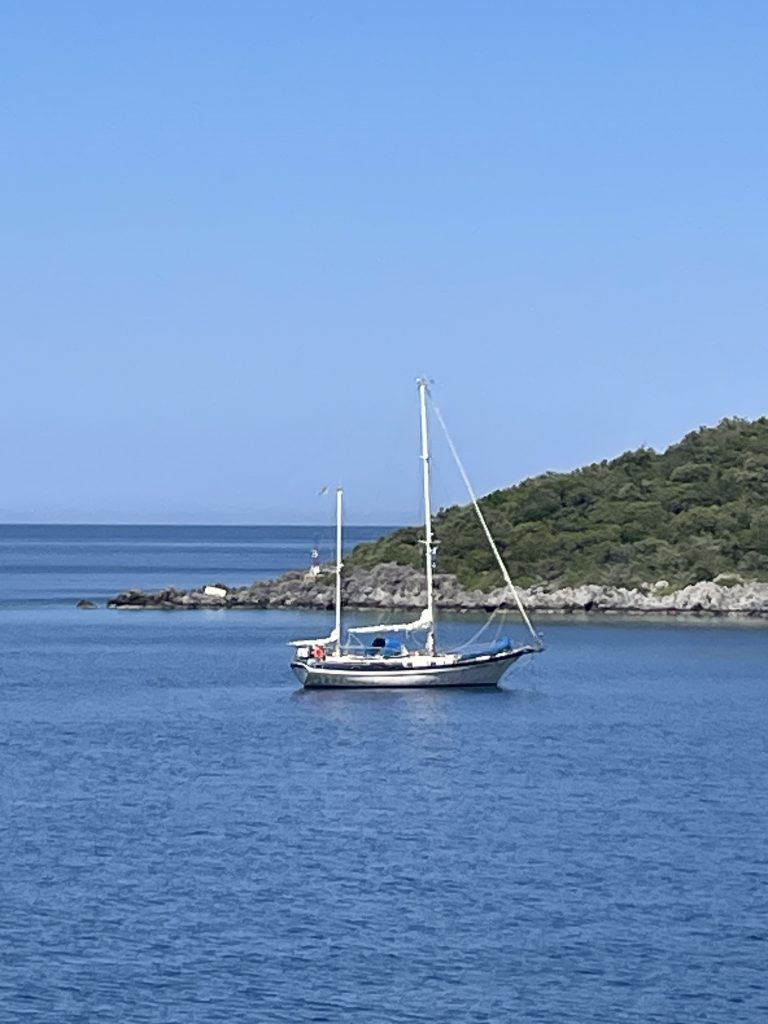
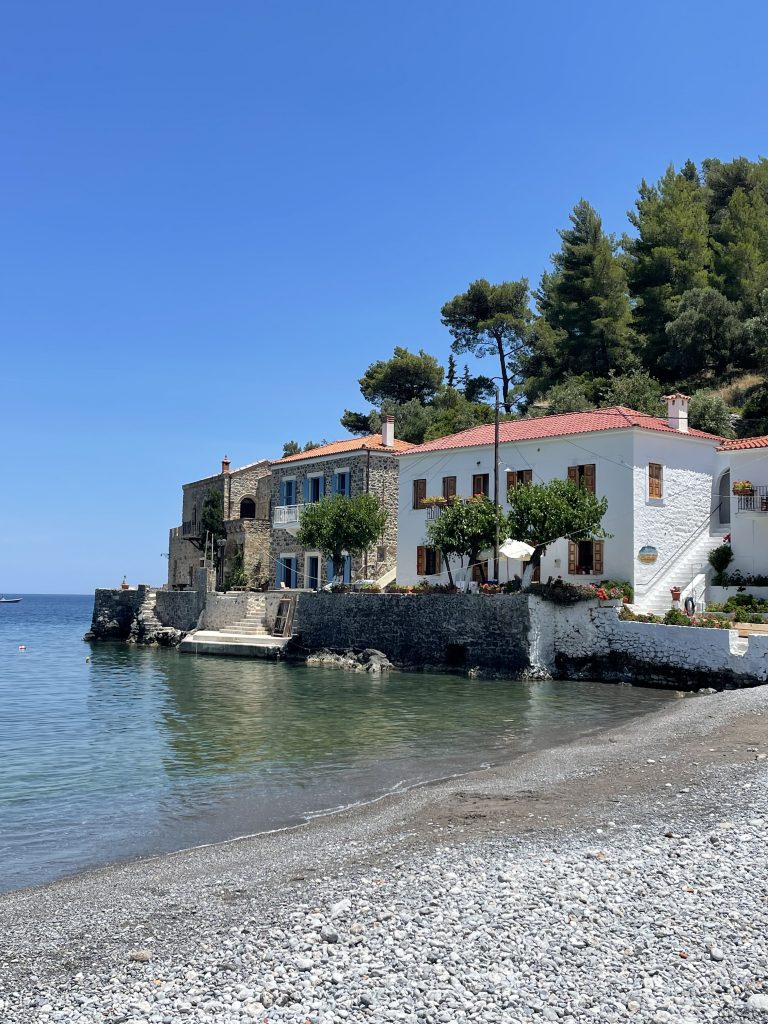
So we treat ourselves to another lovely evening under the starry sky and set off the next morning further south along the coast into Gerakas Fjord. Another lovely day’s sailing before we moor at the small jetty in Gerakas Port. There’s plenty going on here too. We buy wine on tap and sit right by the jetty for dinner, so close that we have to be careful not to fall into the water when we get up.
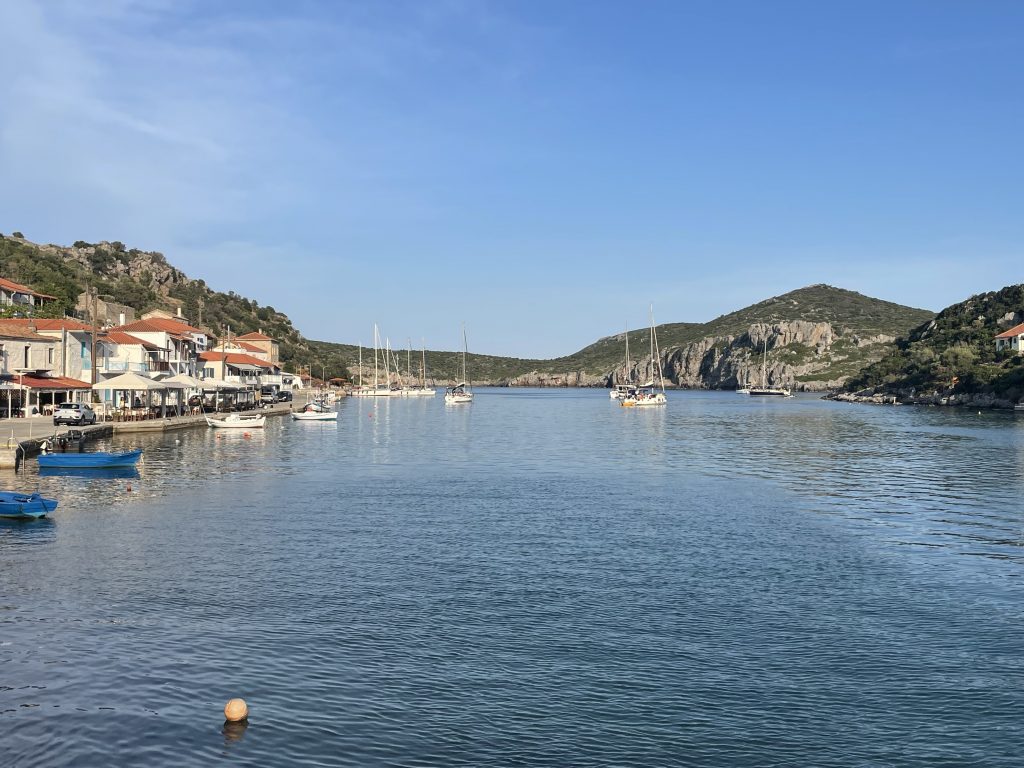
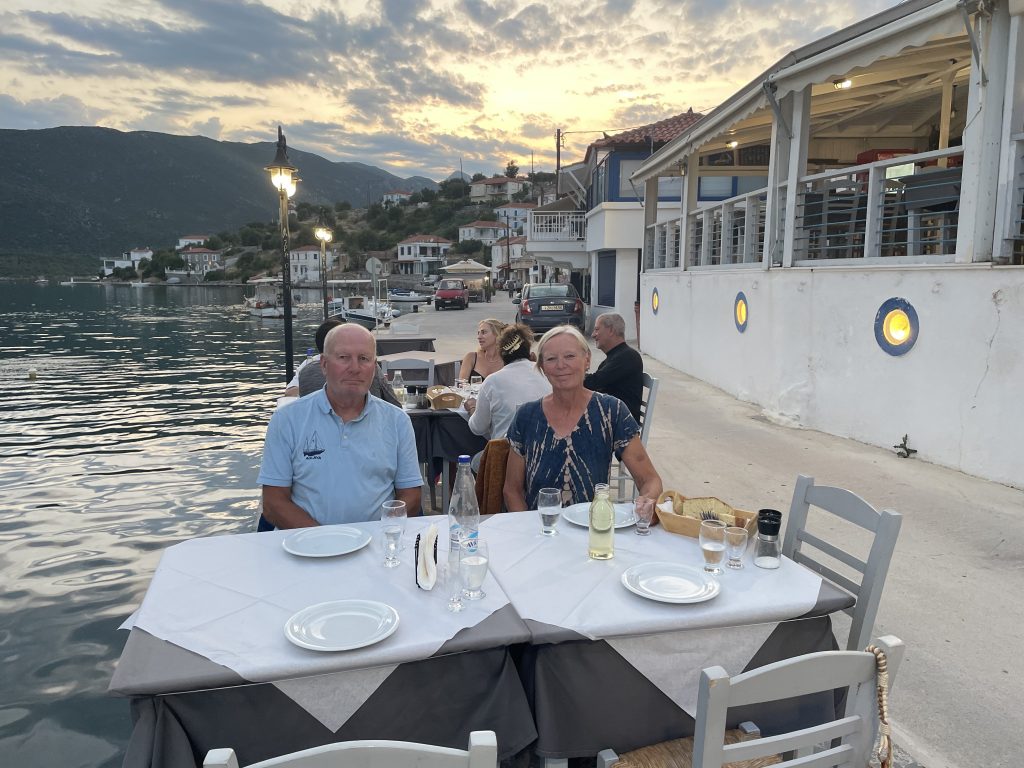
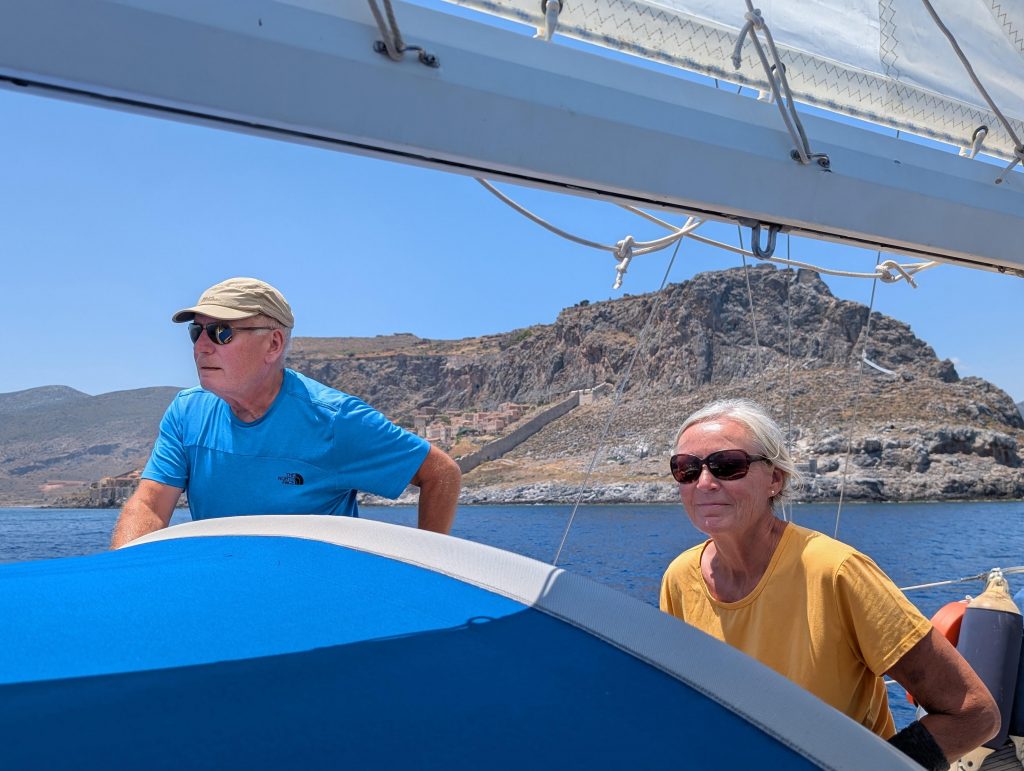
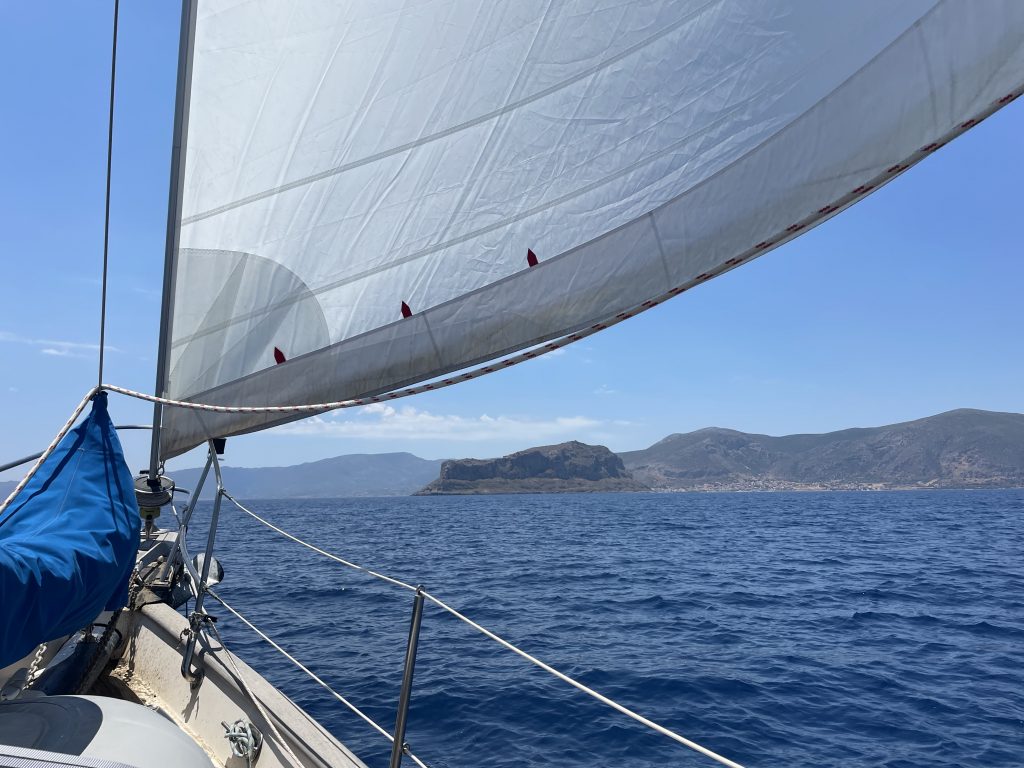
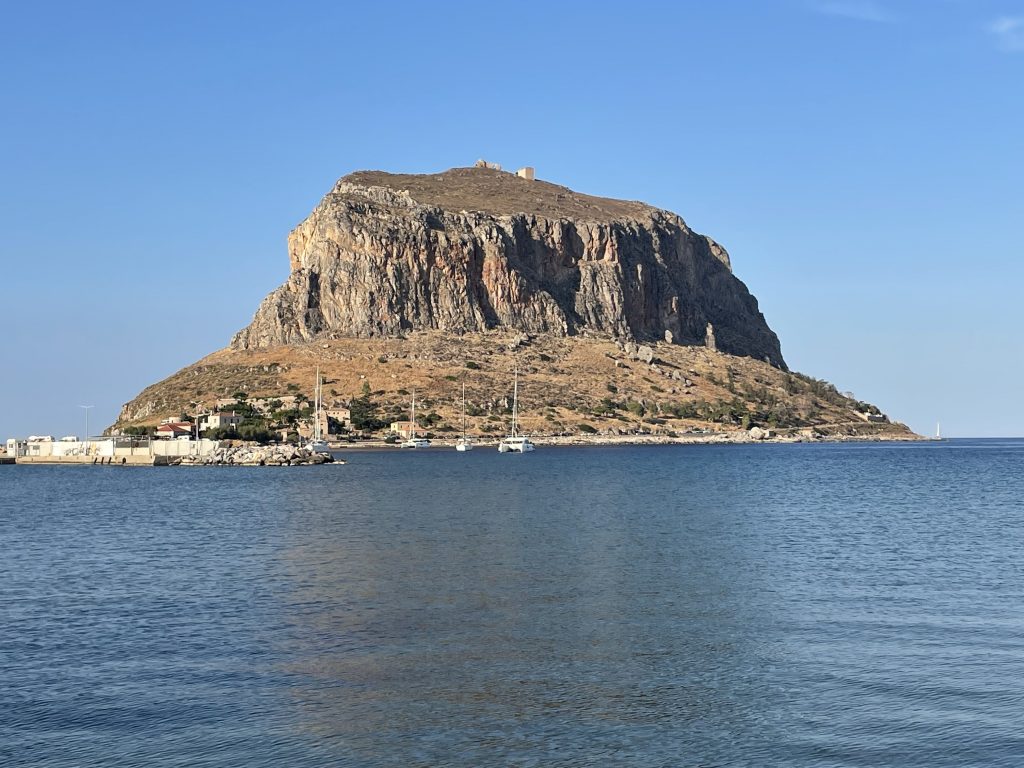
A light tailwind pushes us towards the rock of Monemvasia the next day. We know Mateo from previous visits here. We’d written to him to say we were coming and sent a photo of the boat as a memento. So there he is, standing on the pier, taking our stern lines. A lovely reunion. Here too, the harbour is full and many boats are anchored off it. Here, too, the harbour is full and many boats are anchoring outside. As the Corinth Canal has been closed since October 2025 due to extensive renovation work, boats wishing to travel from the Ionian Sea to the Aegean Sea – and vice versa – have to sail around the Peloponnese. 
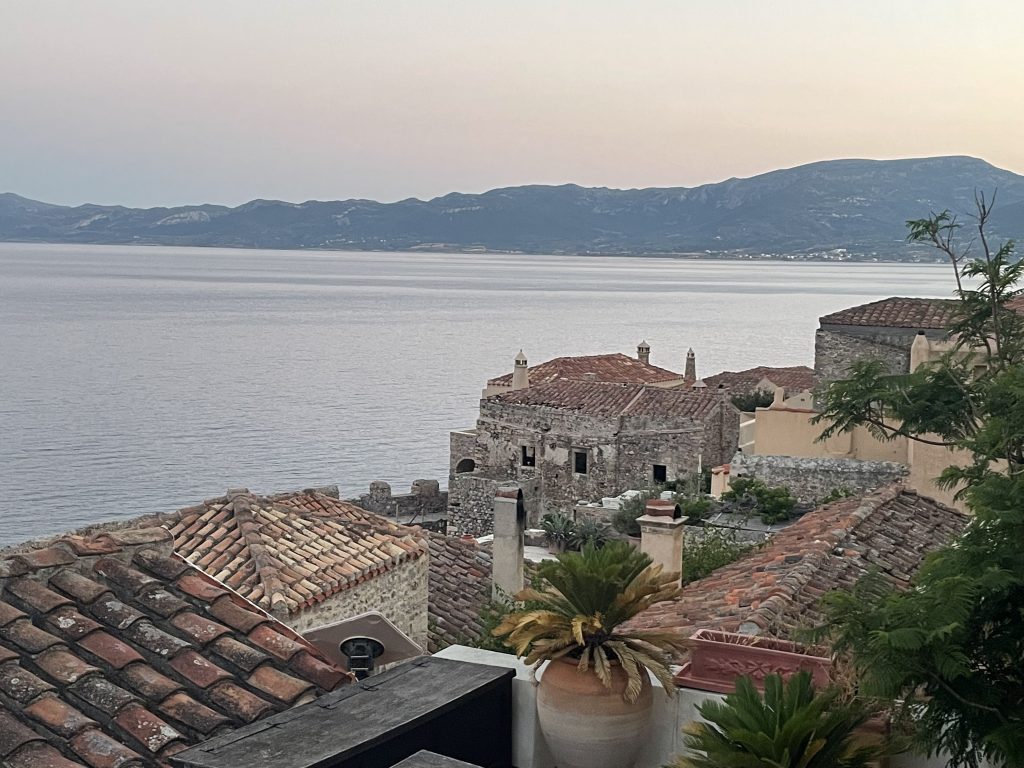
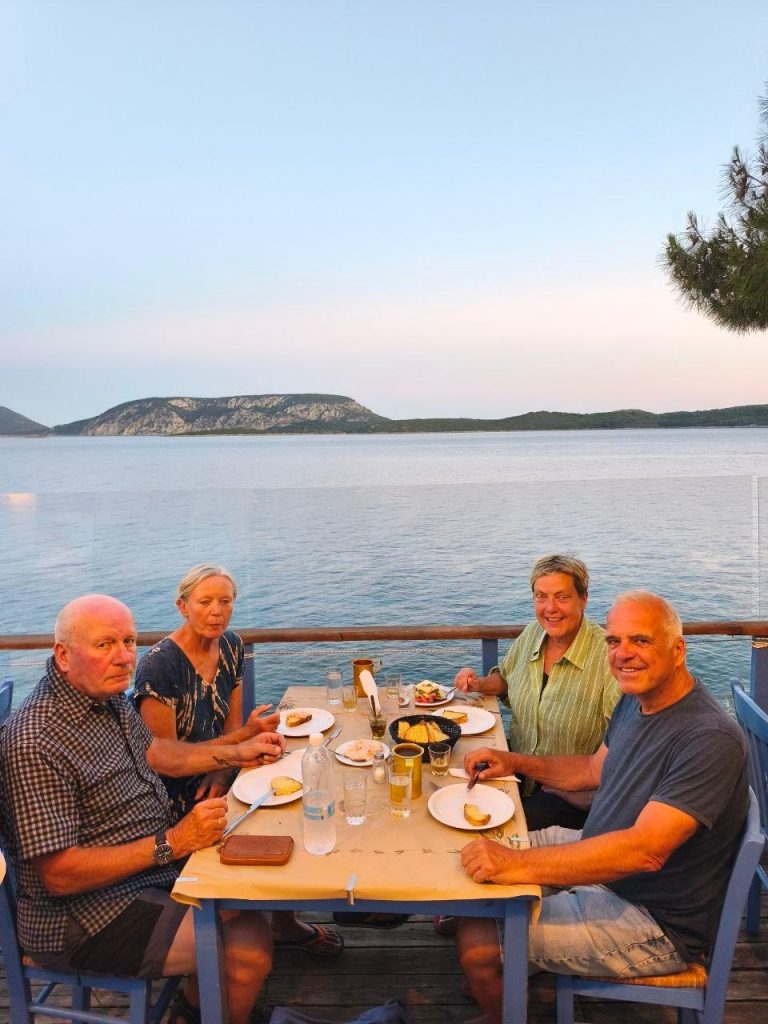
In the evening, we walk along the rock to the lower town and, invited by Andrea and Axel, enjoy a delicious dinner with a view of the sea. It was their last day of sailing with us for this year. A wonderful time for us!
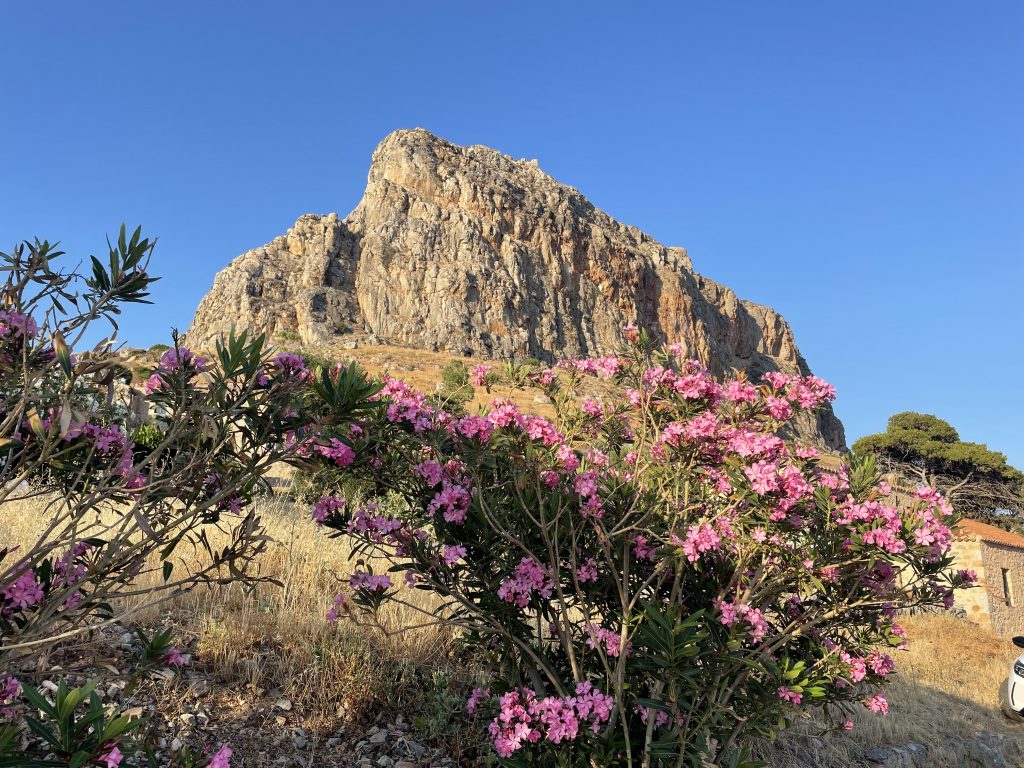
But we still have a special final day as a foursome: we drive through the mountains in a hire car to Sparta and a little further on to the Byzantine medieval town of Mystras. We’d never seen such a large complex, built so steeply built into the mountainside, before. Climbing the steep paths costs us a lot of sweat. But we wouldn’t have missed this visit with so many fantastic views, including of the valley and the mountains. In Sparta, it’s time to say, “Adios, Andrea and Axel, it was lovely having you with us! We’ll see you again soon back at home.” The two of them are taking the bus to Athens the next day. We’re back in Monemvasia, resting a bit, doing our laundry and getting ready for the next stages of our journey to Kalamata.

Pictures of Mystras

[imagely id="197"]
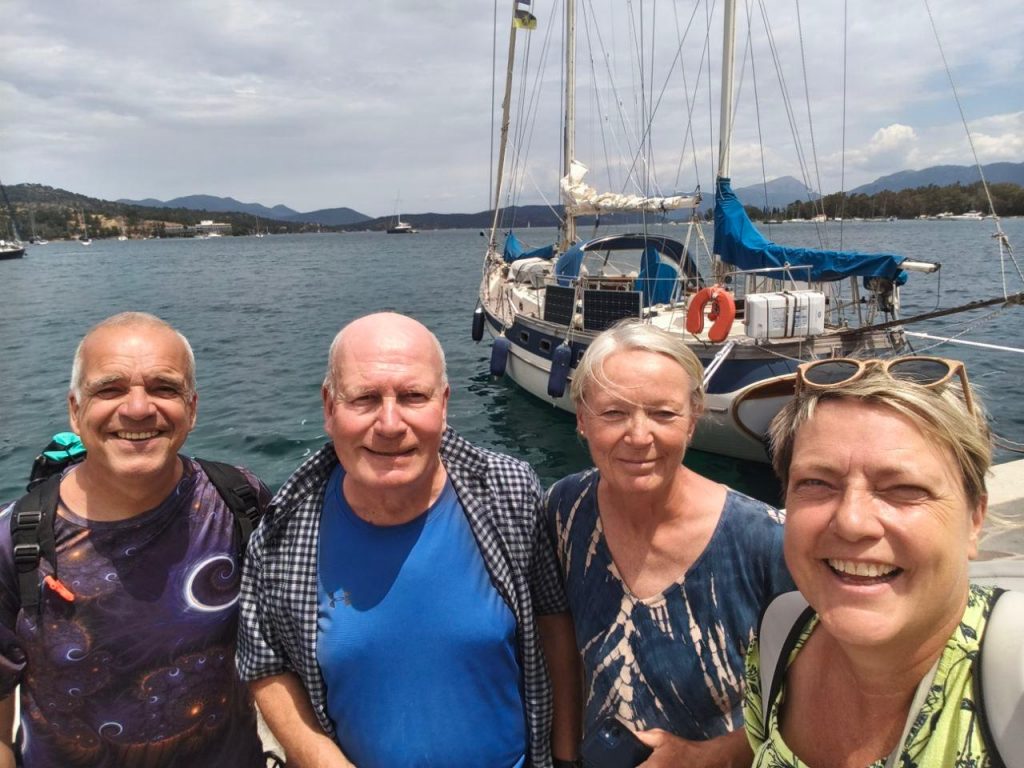
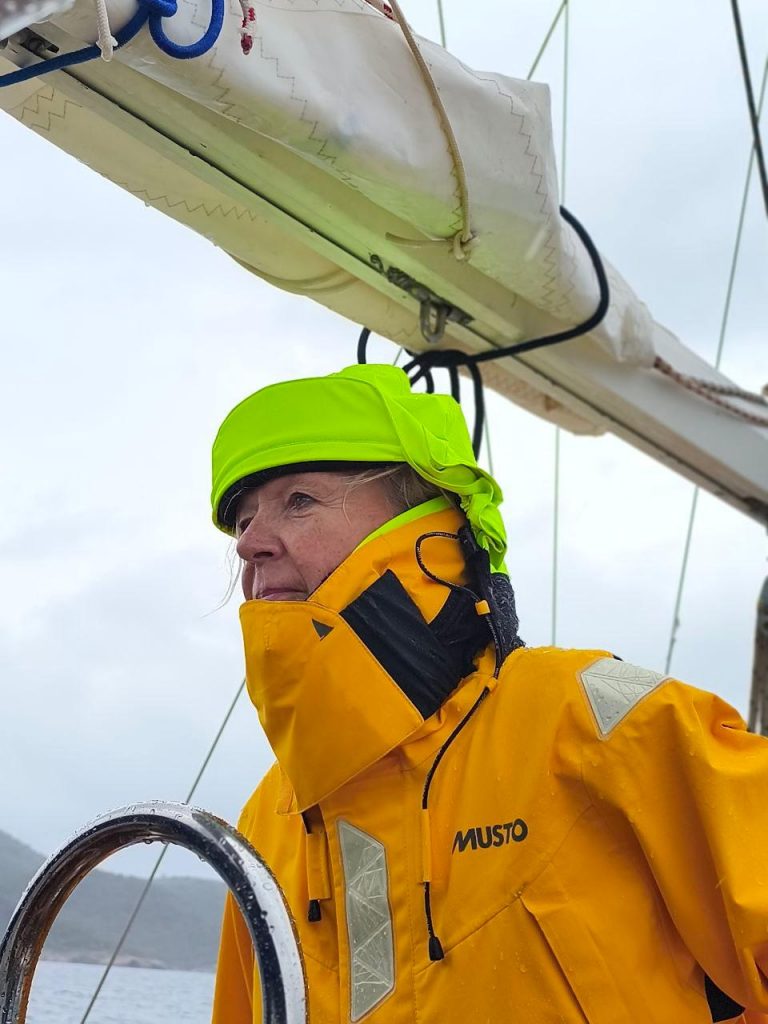
On 22 May, our friends Annegret and Andreas come on board in Poros. The four of us are now sailing together for ten days – a lovely change of pace. Short legs and mostly good sailing winds make the ten days a relaxed and varied time. Only the first day is wet and a bit rough. We sail round the island of Poros in heavy rain and strong winds with a swell. But then it clears up and we have a peaceful night at anchor in Ormos Soupia, a little way south-west of Poros. 

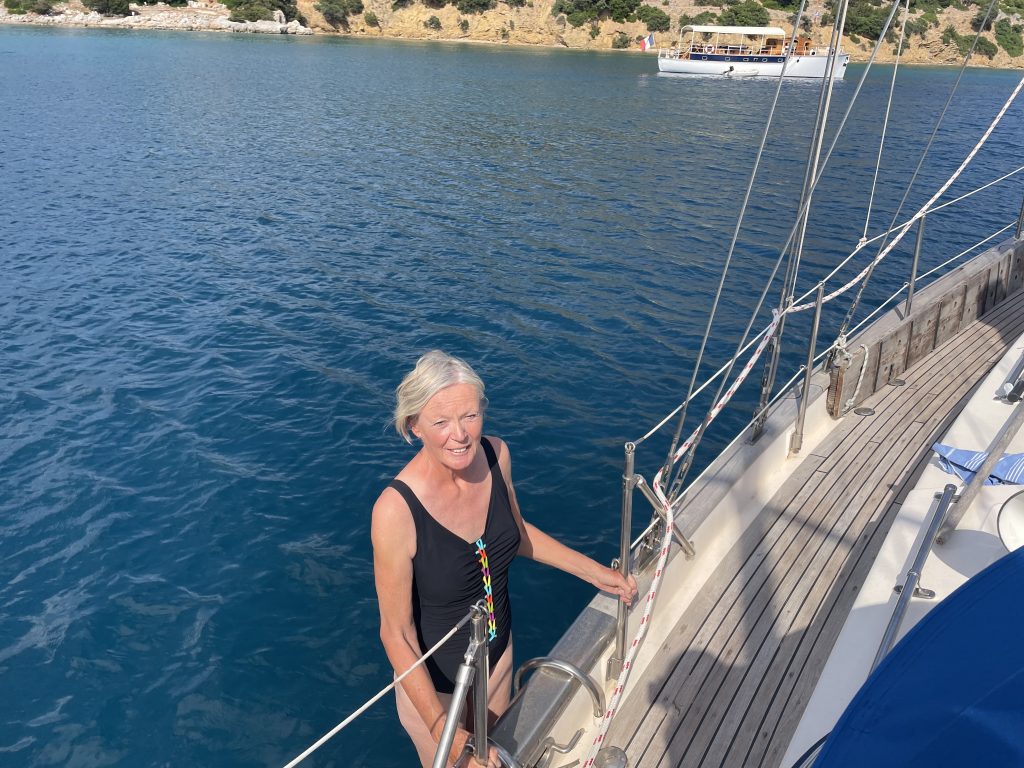
Next destination: the uninhabited little island of Dokos. On the north side there is a large, well-sheltered bay, which is actually marked as a restricted area on the nautical chart. When we arrive, there are several large motor yachts moored there. Well, then we can anchor there too. In the evening, after the large yachts have packed away their ‘water toys’, it becomes quiet. The wind dies down, the water’s surface becomes smooth, and we go for a swim from the boat for the first time this year. The water is still quite cold, but crystal clear. 

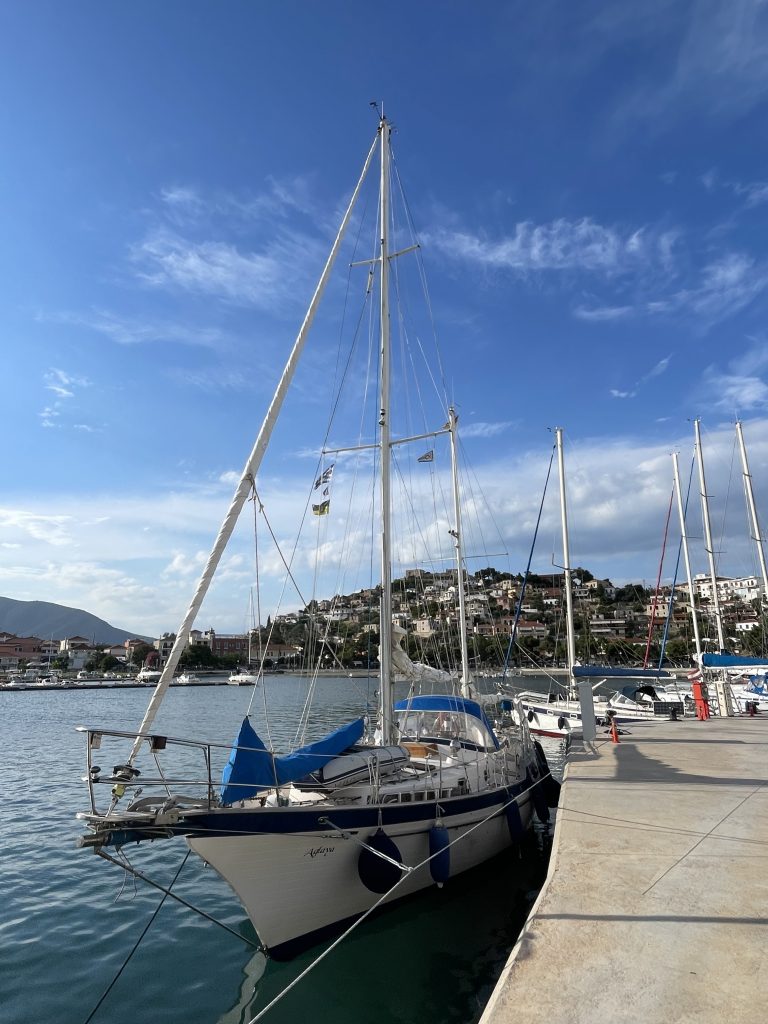
The next day, a lovely easterly wind takes us to Ermioni. Annegret, a novice at the helm, manages 6.6 knots with just the headsail and mizzen. From then on, we have another capable helmswoman on board. But Andreas also takes the helm time and again over the next few days and keeps us on course. There’s plenty going on in Ermioni. On the north side, the few berths in the harbour are taken. A marina is being built in the bay. It’s said to have 300 berths. We tie up at the south pier. We’re already familiar with it. We were here for the first time in 2020, our first year with Aglaya. 

After a lovely walk through the pine forest on the peninsula, we set off the next day – again with a lovely sailing breeze – on to Porto Heli. We could easily drop anchor in the large bay, but we fancy a bit of luxury and a hot shower. That’s why we’d booked into the marina. Porto Heli is a nice place, but the marina is a bit dull. So we’re looking forward to our next anchorage.

In the very well-sheltered bay of Kilada, we moor right in front of the prehistoric Franchthi Cave. People lived here as far back as 20,000 BC. Back then, the sea level was significantly lower and people kept livestock here. Now the cave lies right by the sea. Of course we take a trip there in the dinghy. Our new dinghy is actually only suitable for two people. With three of us on board – and with the wind and waves – the trip turned out to be a wet and rather adventurous affair. In the evening and at night, the cave is lit up, a magnificent sight. We like our anchorage so much that we decide to stay another day, swimming, reading, admiring the beautiful landscape around us and, of course, the starry sky at night. Right at the back of the bay, by the way, is the large Basimakopoulos boatyard. That is where Aglaya spent the winter of 2022/2023 on land.

A strong southerly wind and squalls drive us to Astros on the opposite side of the Argolic Gulf the next day. Strong crosswinds and a high swell make it impossible for us to moor in the small harbour with the bow anchor and stern to the pier. Reversing straight in is out of the question. So we moor alongside the pier in a somewhat precarious spot. With the help of other sailors, we manage to secure ourselves quite well after all. And as is usually the case, things calm down again in the evening and we can go for a relaxed meal at the best taverna in Astros.

From the Franconian castle ruins towering above Astros, there is a sweeping view across the gulf and you can even see as far as Nafplion. That is our next destination. Unfortunately, due to a lack of wind, we have to motor the ten nautical miles. As compensation, we can see flying fish leaping above the mirror-smooth water’s surface. In the harbour of Nafplion, we are greeted by two friendly men in orange vests. They assign us a berth and take our giant white ropes. With the wind coming from diagonally behind, the reverse manoeuvre to the pier goes smoothly.

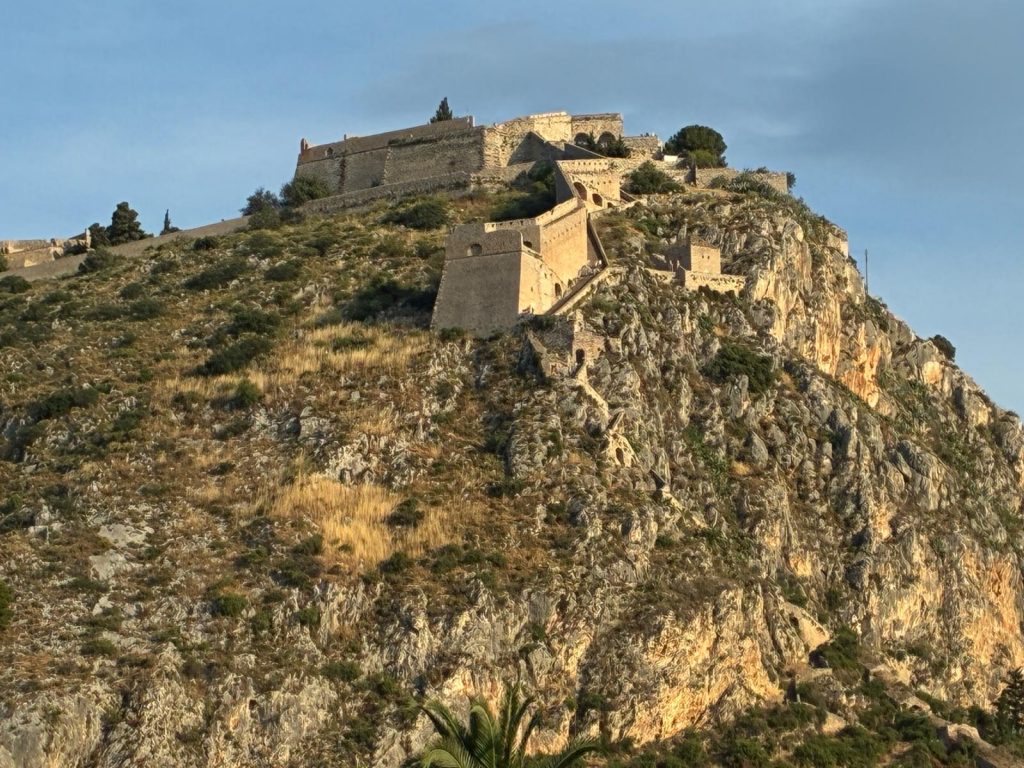
We are now moored directly below the Venetian fortress of Palamidi. A stunning backdrop. Annegret and Andreas are spending their last night on board. We said our goodbyes to them today. They are now on their way to Athens by bus. We had a lovely, varied and relaxing time together.

1

Am 22. Mai kommen unsere Freunde Annegret und Andreas in Poros an Bord. Zehn Tage sind wir nun zu viert unterwegs, eine schöne Abwechslung. Kurze Strecken und meist schöner Segelwind machen die zehn Tage zu einer entspannten, abwechslungsreichen Zeit. Nur der erste Tag ist nass und etwas heftig. Wir umrunden die Insel Poros bei viel Regen und starkem Wind mit Dünung. Aber dann klart es auf und wir haben eine ruhige Ankernacht in der Ormos Soupia, ein Stück südwestlich von Poros. 

Nächstes Ziel: die unbewohnte kleine Insel Dokos. Hier gibt es auf der Nordseite eine große, gut geschützte Bucht, auf der Seekarte eigentlich als Sperrgebiet ausgewiesen. Als wir ankommen, liegen dort mehrere große Motoryachten. Na, dann können wir ja auch dort ankern. Am Abend, nachdem die großen Yachten ihre „Wasserspielzeuge“ eingepackt haben, wird es ruhig. Der Wind lässt nach, die Wasseroberfläche wird glatt und wir gehen zum ersten Mal in diesem Jahr vom Boot aus Schwimmen. Ist noch ganz schön kalt, das Wasser, dafür aber glasklar. 

Am nächsten Tag bringt uns ein schöner Ostwind nach Ermioni. Annegret als Neuling am Ruder bringt es nur mit Vorsegel und Besan auf 6,6 Knoten. Von da an haben wir eine gute Steuerfrau mehr an Bord. Aber auch Andreas steht in den nächsten Tagen immer wieder am Ruder und hält Kurs.

In Ermioni ist viel los. Auf der Nordseite sind die wenigen Plätze im Hafen belegt. In der Bucht wird eine Marina gebaut. 300 Plätze soll sie haben. Wir legen an der Südpier an. Die kennen wir schon. 2020, in unserem ersten Jahr mit Aglaya, waren wir zum ersten Mal hier. 

Nach einem schönen Spaziergang durch den Kiefernwald auf der Halbinsel geht es am nächsten Tag - wieder mit schönem Segelwind - weiter nach Porto Heli. In der großen Bucht könnten wir gut ankern, aber wir wollen mal etwas Luxus und eine warme Dusche. Daher hatten wir uns in der Marina angemeldet. Porto Heli ist zwar ein netter Ort, aber in der Marina ist es langweilig. So freuen wir uns auf unseren nächsten Ankerplatz.

In der sehr gut geschützten Bucht von Kilada legen wir uns direkt vor die prähistorische Franchthi-Höhle. Schon 20.000 Jahre B.C. haben hier Menschen gelebt. Da war der Meeresspiegel deutlich niedriger und die Menschen haben hier Vieh gehalten. Nun liegt die Höhle direkt am Meer. Natürlich machen wir mit dem Schlauchboot einen Ausflug dorthin. Unser neues Schlauchboot ist eigentlich nur für zwei Personen geeignet. Zu dritt war der Ausflug - auch wegen Wind und Welle - eine nasse und sportliche Angelegenheit. Am Abend und nachts ist die Höhle beleuchtet, ein toller Anblick.

[ngg src="galleries" ids="196" display="basic_slideshow"]

An unserem Ankerplatz gefällt es uns so gut, dass wir noch einen weiteren Tag bleiben, schwimmen, lesen, die schöne Landschaft um uns herum anschauen und nachts natürlich den Sternenhimmel. Ganz hinten in der Bucht ist übrigens das große Boatyard von Basimakopoulos. Dort hat Aglaya den Winter 2022/2023 an Land verbracht.

Ein starker Südwind und Gewitterböen bringen uns am nächsten Tag auf die gegenüberliegende Seite des Argolischen Golfs nach Astros. Starke Böen von der Seite und eine hohe Dünung machen es uns unmöglich in dem kleinen Hafen mit Buganker und Heck zur Pier anzulegen. Gerade rückwärtsfahren ist unmöglich. So legen wir uns an einem etwas prekären Platz längsseits an die Pier. Mit Hilfe von anderen Seglern können wir uns dann doch ganz gut festmachen. Und wie meistens wird es am Abend wieder ruhig und wir können ganz entspannt in der besten Taverna von Astros Essen gehen.

Von der fränkischen Burgruine, die über Astros thront, hat man einen weiten Blick über der Golf und kann schon bis hinüber nach Nafplion sehen. Das ist unser nächstes Ziel. Leider müssen wir mangels Wind die zehn Seemeilen motoren. Als Entschädigung können wir über der spiegelglatten Wasseroberfläche fliegende Fische sehen. Im Hafen von Nafplion werden wir von zwei freundlichen Männern in orangefarbenen Westen begrüßt. Sie weisen uns einen Platz zu und nehmen unsere weißen Riesen an. Mit Wind von schräg hinten klappt auch die Rückwärtsfahrt an die Pier gut.

Nun liegen wir direkt unterhalb der venezianischen Festung Palamidi. Eine tolle Kulisse. Annegret und Andreas verbringen ihre letzte Nacht an Bord. Heute haben wir sie verabschiedet. Nun sind sie mit dem Bus unterwegs nach Athen. Wir hatten eine schöne, abwechslungsreiche und entspannte Zeit zusammen.

During the night, whilst still moored at the pier in Kea, a strong north-north-westerly wind blows, driving heavy swells into the harbour. Our neighbours, a flotilla of three boats, are also taking a look at the situation in the morning. Is it safe to cast off with strong gusts coming from the side, without the propeller being pushed onto the neighbouring boat’s anchor chain? We are the first to give it a go, and it just about works. Even in the harbour, the swell is so strong that Gisela doesn’t walk around the boat to fetch the fenders. First, we motor out a bit to see just how rough it really is with the wind and swell. And it really does get rough. Aglaya has never been shaken about like this with us on board before. The bow keeps dipping into the water, the water rises up to the rubbing strake, and huge breaking waves splash us in the cockpit and cover the whole boat in salt. But Aglaya is holding her own bravely; she’s a strong lady, and we’re brave and resilient too, because we’ve never experienced such a violent and chaotic swell for a whole day before.

We’re on our way to Poros in the Saronic Gulf, a good 40 nautical miles – a long journey. Steering is exhausting; we take turns every half hour. Once, whilst changing at the helm, Walter injures his foot. Treating the wound has to wait until the evening.

When things calm down briefly off Cape Sounion, we hoist the mizzen and ease out the jib a little. But then the wind and swell pick up again and we can’t hold our course. So we motor the last stretch straight towards the south side of Poros to strike the sails there. 

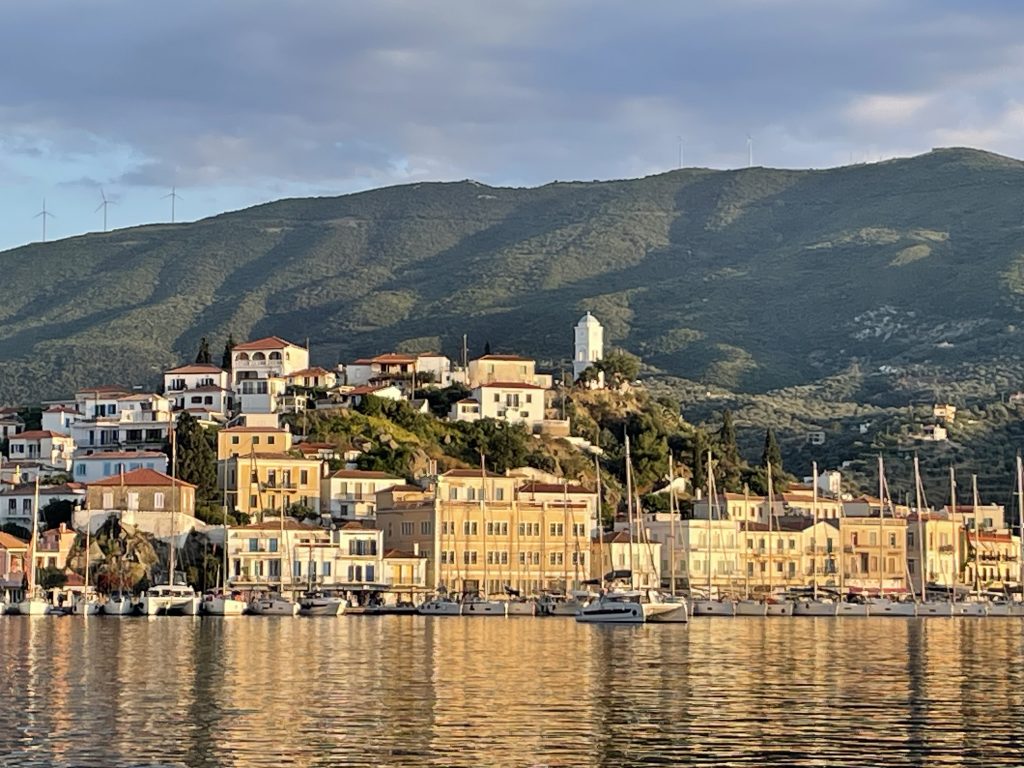
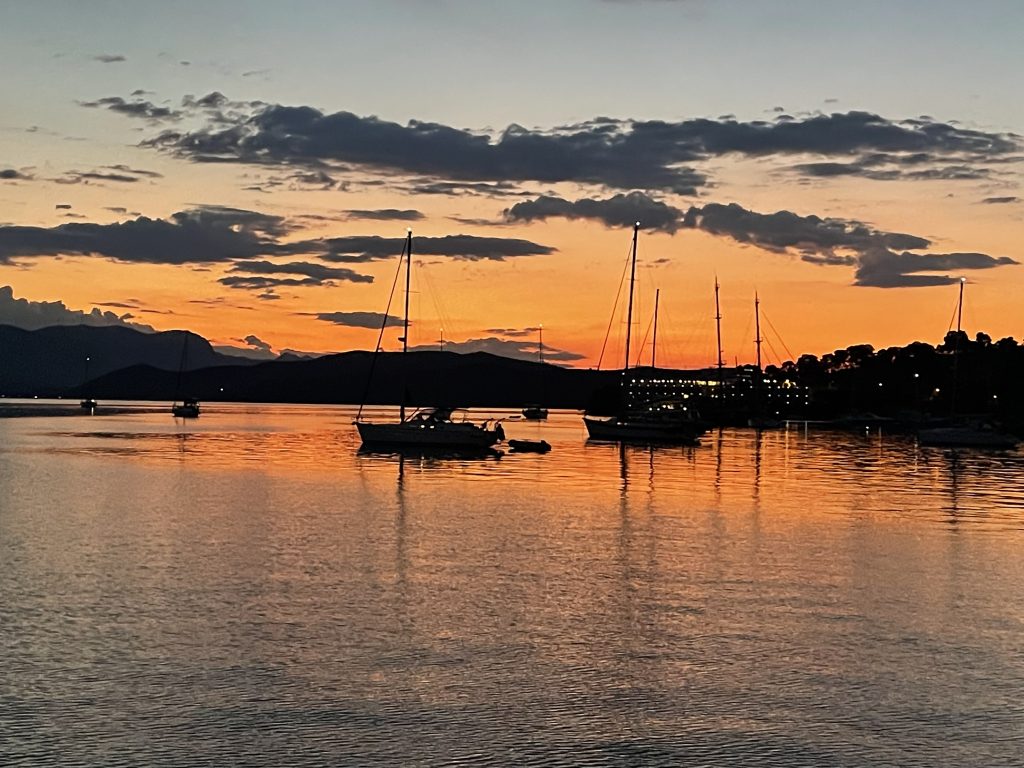
We’ve made it to Poros; we were underway for ten hours. Windy had forecast 25 knots of wind, but we had a steady 35 to just under 40. The whole pier in Poros is full. So we drop anchor in the bay, enjoying the peace and quiet and the lovely view of the town. The next morning there’s space, so we moor at the pier, tidy up and give the boat a good clean. Annegret and Andreas are arriving tomorrow on the ferry from Athens. Aglaya will sparkle for them.

We don‘t have fotos from our wilde ride. We needed our hands to steer, to fix us on the boat and to worf with the sails. But of course we can show you the view from our anchorage at Poros.

3

In der Nacht, noch auf Kea an der Pier, bläst der Wind stark aus Nordnordwest und drückt starken Schwell in den Hafen. Auch unsere Nachbarn, eine Dreier-Flottille, schauen sich das am Μοrgen an. Kann man bei starken Windböen von der Seite gefahrlos ablegen, ohne mit der Schraube auf die Ankerkette vom Nachbarboot gedrückt zu werden? Wir wagen es als erste und es klappt so gerade. Schon im Hafen ist die Dünung so stark, dass Gisela nicht auf dem Boot herumläuft, um die Fender reinzuholen. Erst einmal ein Stück raus motoren, um zu schauen, wie heftig es wirklich ist mit Wind und Dünung. Und es wird wirklich heftig. So durchgeschüttelt wurde Aglaya mit uns noch nie. Der Bug taucht immer wieder ins Wasser ein, das Wasser steigt bis zur Scheuerleiste und große Brecher machen uns im Cockpit nass und salzen das ganze Boot ein. Aber Aglaya schlägt sich tapfer, ist einfach eine starke Lady, und wir sind auch tapfer und ausdauernd, denn so eine heftige und chaotische Dünung über einen ganzen Tag haben wir noch nie erlebt.

Wir sind auf dem Weg nach Poros im Saronischen Golf, gut 40 Seemeilen, lange Strecke. Das Steuern ist kräftezehrend, alle halbe Stunde lösen wir uns ab. Einmal beim Wechsel am Ruder verletzt sich Walter seinen Fuß. Die Wundversorgung muss bis zum Abend warten.

Als es vor Kap Sounion kurz etwas ruhiger wird, ziehen wir den Besan auf und ein Stück der Fock raus. Aber dann werden Wind und Dünung wieder stärker und wir können den Kurs nicht halten. So motoren wir das letzte Stück direkt auf die Südseite von Poros zu, um dort die Segel zu bergen. 

Wir haben den Ritt nach Poros geschafft, zehn Stunden waren wir unterwegs. Windy hatte 25 Knoten Wind vorhergesagt, wir hatten beständig zwischen 35 und knapp 40. In Poros ist die ganze Pier belegt. So legen wir uns in der Bucht vor Anker, genießen die Ruhe und den schönen Blick auf den Ort. Am nächsten Morgen gibt es Platz, wir legen uns an die Pier, räumen auf und putzen. Morgen kommen Annegret und Andreas mit der Fähre von Athen. Da soll Aglaya wieder glänzen.

Bilder von unterwegs haben wir nicht. Wir haben jeder beide Hände gebraucht, um zu steuern, uns festzuhalten und die Segel zu bedienen. Aber einen schönen Blick von unserem Ankerplatz, den haben wir natürlich.

Unspoilt coastline, countless wind turbines and just two sheltered harbours – that’s Euboea on the eastern side, which is exposed to the Meltemi. But as we’re already familiar with the sheltered Inside Passage on the western side, we now want to continue southwards along the eastern coast. A long stretch from the beautiful and hospitable island of Skyros to the south-west brings us, in wind and rain, to the fishing harbour of Agioi Apostoloi. Here you can moor well sheltered, if you manage to tie up. A fisherman showed us to a berth and wanted to take our lines. But with strong gusts of wind, you have to tighten the lines quickly. Our fisherman, however, remains completely calm and, despite our shouts, first ties a knot in the bow line. By then we’re already at a right angle with the bow to the pier. Next attempt, same result. It works on the third try. Just as well, because now it’s really starting to rain. We take a breather below deck and later spend quite some time marvelling at a full rainbow from the cockpit. All’s well again. We enjoy a cosy evening on board.

[ngg src="galleries" ids="193" display="basic_slideshow"]

Next day, next leg, to the Cycladic island of Andros. We haven’t been there yet; we want to take a day’s break there and have a look around the island. Once again, things turn out differently: there’s still space for us in our chosen harbour, Batsi, but with a strong crosswind we can’t manage to back up to the pier using the bow anchor. What a pity! But there’s no point in complaining. We motor the three nautical miles to Gavrion ferry port. A man from the port authority tells us the harbour is full. It doesn’t look very nice here either. Next option: drop anchor. And that’s often not the worst option at all. We drop anchor off a beach; we’re all alone here. Little light from the mainland, lots of stars in the sky, a bit of swell, then a quiet night.

[ngg src="galleries" ids="194" display="basic_slideshow"]

In the morning, strong gusts of wind wake us. A little less than a steady 32 knots would have been enough for the next leg to the island of Kea. Sailing with just the mizzen and a strong swell from behind, we cover the 25 nautical miles at speeds of up to 6.4 knots. Steering is exhausting, but with a change at the helm every half hour, we arrive safely in Korissia on Kea. Mooring goes well here despite a bit of a crosswind. Never before have we had to put so many things back in their places below deck after sailing. Lots of things had slid and flown about, but nothing was broken.

We’ve been to the island of Kea four years ago. Here we’re moored nicely at the pier. And we treat ourselves to another day ashore, visit the Chora, and say to the stone, sleeping lion, “Hello, it’s lovely to see you again!” We reckon the lion isn’t sleeping, but smiling. We follow this up with a lovely hike up in the hills with views of Andros, Euboea, and south towards Poros. That’s where we’re heading tomorrow.  

[ngg src="galleries" ids="195" display="basic_slideshow"]

Unbebaute Küste, sehr viele Windräder und nur zwei geschützte Häfen - das ist Euböa auf der gegen den Meltemi ungeschützten Ostseite. Aber da wir die geschützte Inside-Passage auf der Westseite schon kennen, wollen wir nun an der Ostseite entlang weiter nach Süden. Von der schönen und gastfreundlichen Insel Skyros ein langer Schlag nach Südwesten bringt uns bei Wind und Regen in den Fischerhafen Agioi Apostoloi. Hier kann man gut geschützt liegen, wenn man es schafft, anzulegen. Ein Fischer wies uns einen Platz zu, wollte unsere Leinen annehmen. Aber bei starken Windböen muss man ja dann die Leinen schnell festziehen. Unser Fischer aber macht in aller Seelenruhe trotz unserer Rufe erst einmal einen Knoten in die Vorleine. Da liegen wir schon im rechten Winkel mit dem Bug zur Pier. Nächster Versuch, mit dem selben Ergebnis. Beim dritten Mal klappt es dann. Ist gut, denn jetzt fängt es richtig an zu regnen. Wir verschnaufen unter Deck und können dann später vom Cockpit aus längere Zeit einen kompletten Regenbogen bestaunen. Alles wieder gut. Wir machen uns einen gemütlichen Abend an Bord.

[ngg src="galleries" ids="193" display="basic_slideshow"]

Nächster Tag, nächste Etappe, zur Kykladeninsel Andros. Die kennen wir noch nicht, wollen dort einen Tag Pause machen und uns die Insel anschauen. Es kommt mal wieder anders: In unserem Wunschhafen Batsi ist zwar noch Platz für uns, aber bei starkem Seitenwind schaffen wir es nicht mit Buganker rückwärts an die Pier. Schade! Aber hadern hilft nicht. Wir motoren in den drei Seemeilen entfernten Fährhafen Gavrion. Ein Mann von der Hafenbehörde bedeutet uns, dass der Hafen voll ist. Es sieht hier auch gar nicht nett aus. Nächste Option: ankern. Und das ist oft gar nicht die schlechteste. Wir legen uns vor einem Strand vor Anker, sind hier ganz alleine. Wenig Licht von Land, viele Sterne am Himmel zu sehen, etwas Schwell, dann ruhige Nacht.

[ngg src="galleries" ids="194" display="basic_slideshow"]

Am Morgen wecken uns starke Windböen. Etwas weniger als beständige 32 Knoten hätten uns für die nächste Etappe zur Insel Kea auch gereicht. Nur mit Besan und starker Dünung von hinten segeln wir die 25 Seemeilen, mit bis zu 6,4 Knoten Speed. Das Steuern ist anstrengend, aber mit einem Wechsel am Ruder alle halbe Stunde kommen wir gut in Korissia auf Kea an. Das Anlegen klappt hier trotz etwas Seitenwind gut. Noch nie haben wir nach dem Segel so viele Sachen unter Deck wieder eingeräumt. Da war vieles hin und her gerutscht und geflogen, aber es gab keinen Bruch.

Die Insel Kea kennen wir schon von vier Jahren. Hier liegen wir schön an der Pier. Und wir gönnen uns wieder einen Landtag, besuchen die Chora, sagen dem steinernen, schlafenden Löwen „Guten Tag, es ist schön, dich wiederzusehen!“. Wir finden ja, dass der Löwe nicht schläft, sondern lächelt. Wir schließen noch eine schöne Wanderung auf der Höhe mit Blick nach Andros, Euböa, und nach Süden Richtung Poros an. Da wollen wir morgen hin.  

[ngg src="galleries" ids="195" display="basic_slideshow"]