Springe zum Inhalt

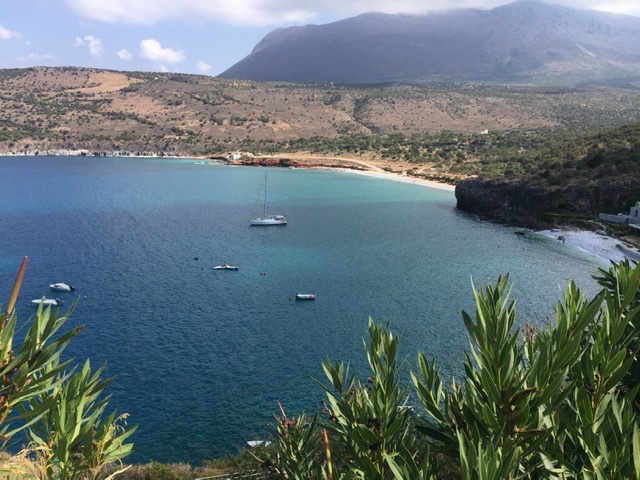
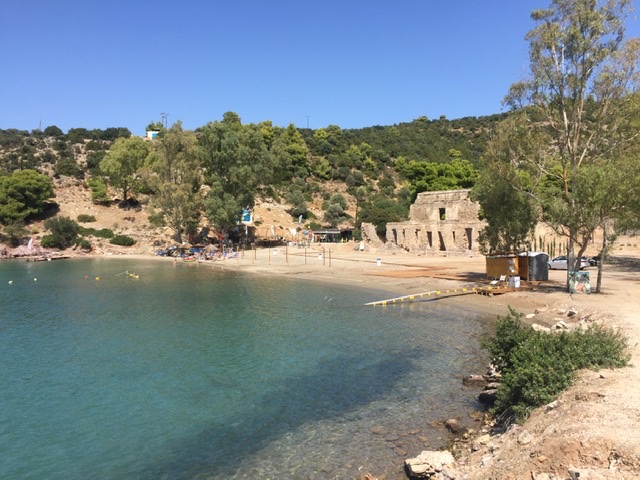
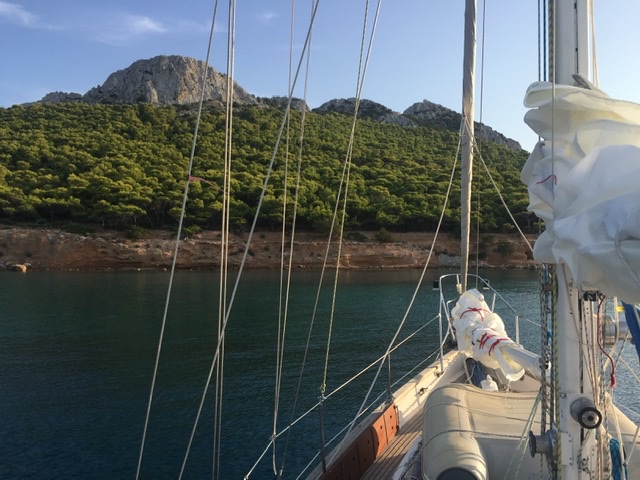
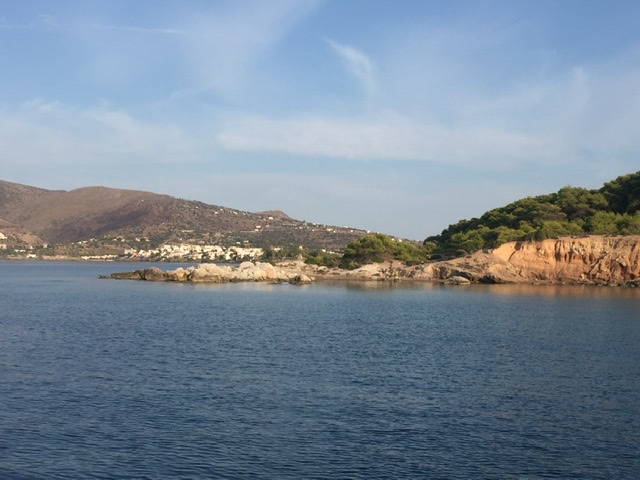
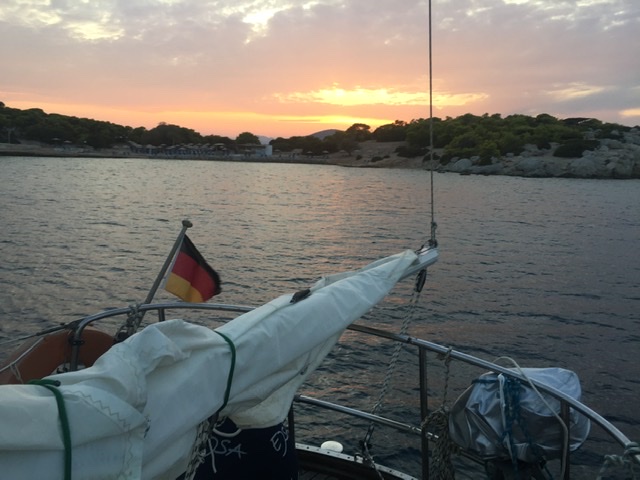
Moni is not just the abbreviation for a woman's name. Moni is also a tiny uninhabited islet just west of the island of Aigina in the Saronic Gulf. If you come - like us - from the south, it looks like a barren, grey rocky ridge whose walls drop steeply to the sea. Completely inaccessible and without any green. But: We anchored there beautifully overnight. Actually we didn't want to go there at all, but to the harbour of Perdika on the southwest side of Aigina. But it was full. So we looked for an alternative. We had just passed the narrowness between Aigina and Moni, when Moni showed her beautiful green north side. The slopes below the rocks were covered with light green pines and there was a small bay. The weather was predicted to be calm for the night, so we had found our anchorage. The last day's guests, who were bathing at the small beach, were picked up by a taxi boat one by one. Then it became quiet, only now and then a bird call. With wonderfully clear water we could see to the bottom and go swimming. And at night an impressive starry sky. When can you see the Orion directly above the mast top of your own boat?
4

Moni ist nicht nur die Abkürzung für einen Frauennamen. Moni ist auch ein winziges unbewohntes Inselchen direkt westlich vor der Insel Aigina im Saronischen Golf. Kommt man - wie wir - von Süden, sieht sie aus wie ein karger, grauer Felsrücken, dessen Wände steil zum Meer abfallen. Also völlig unzugänglich und ohne jegliches Grün. Aber: Wir haben dort wunderschön über Nacht geankert. Eigentlich wollten wir dort gar nicht hin, sondern in den Hafen von Perdika an der Südwestseite von Aigina. Der war aber voll. So suchten wir nach einer Alternative. Die Enge zwischen Aigina und Moni hatten wir gerade passiert, da zeigte Moni ihre schöne grüne Nordseite. Die Hänge unterhalb der Felsen mit hellgrünen Pinien bewachsen und eine kleine Bucht. Es war für die Nacht ruhiges Wetter vorhergesagt, so hatten wir unsere Ankerbucht gefunden. Die letzten Tagesgäste, die an dem kleinen Strand badeten, wurden nach und nach von einem Taxiboot abgeholt. Dann wurde es still, nur ab und zu ein Vogelruf. Bei wunderbar klarem Wasser konnten wir bis auf den Grund sehen und schwimmen gehen. Und nachts ein eindrucksvoller Sternenhimmel. Wann kann man schon direkt über der Mastspitze des eigenen Bootes den Orion sehen?


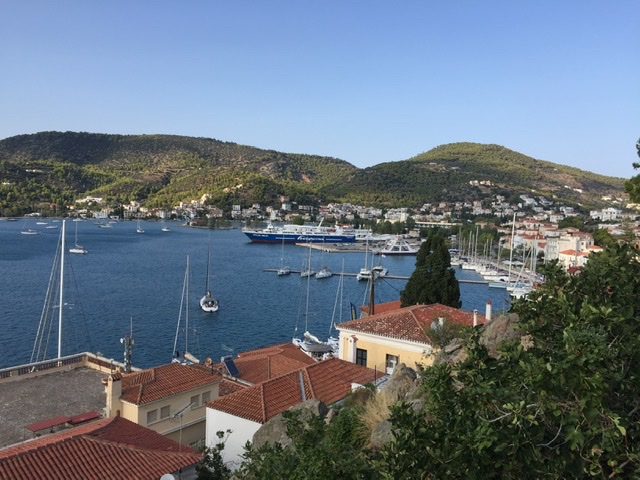
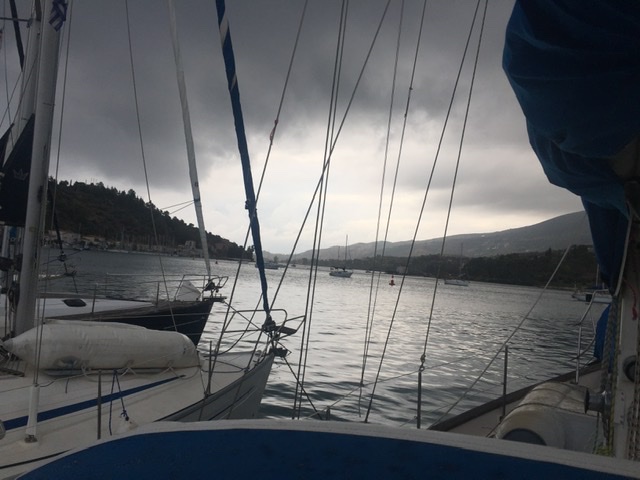
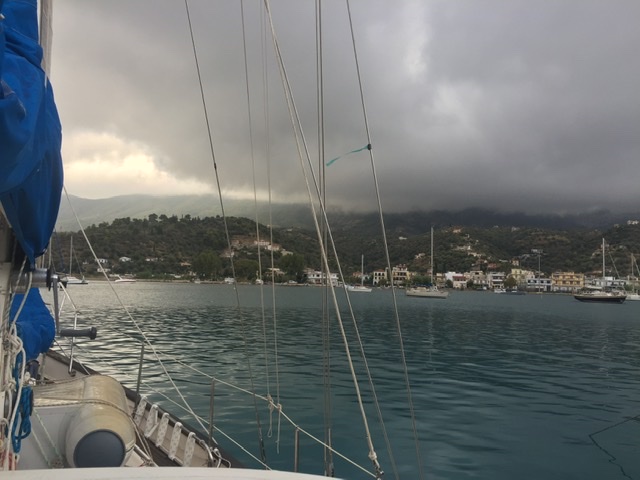
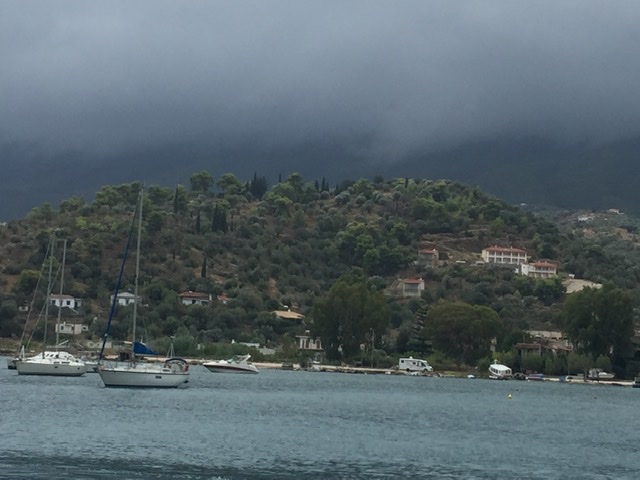
Wir haben zweimal verlängert - so dass wir eine Woche dort lagen. Die Insel liegt an der äußersten Südostspitze des Peloponnes, vom Festland nur durch einen 500m breiten Kanal getrennt. Einer der sichersten Häfen Griechenlands, heißt es - obwohl es gar kein umschlossener Hafen ist: Man liegt an einer langen 2 km langen Pier, gegenüber das Festland, aber dadurch geschützt. Hier haben wir auch den Medicane abgewettert, der auf den Ionischen Inseln heftig gewütet hatte, der aber hier „nur“ als Starkwind und Wolkenbruch ankam.
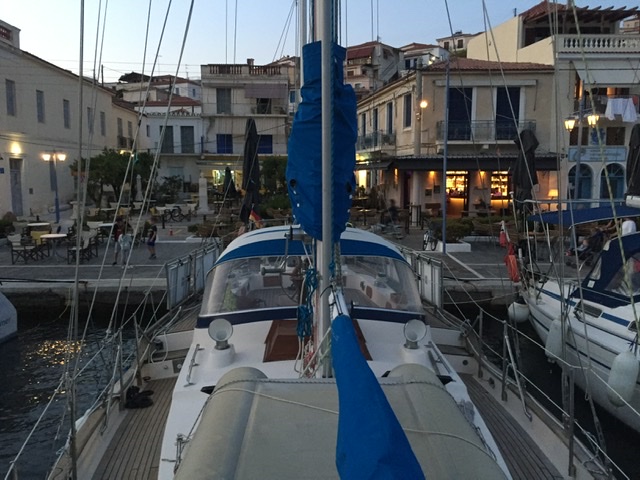
Im Hafen ist natürlich immer viel los, auch weil hier die Schnellfähre von Athen ankommt, außerdem viele kleine Taxiboote zwischen dem Festland und der Insel verkehren. Mitten im Hafen ankern auch Segel- und Motorboote.
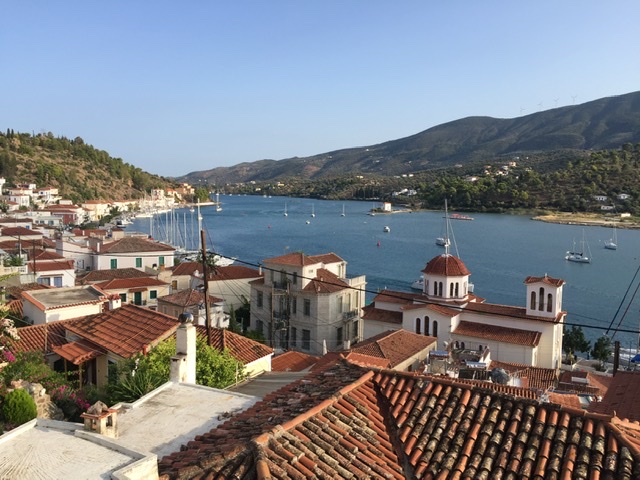
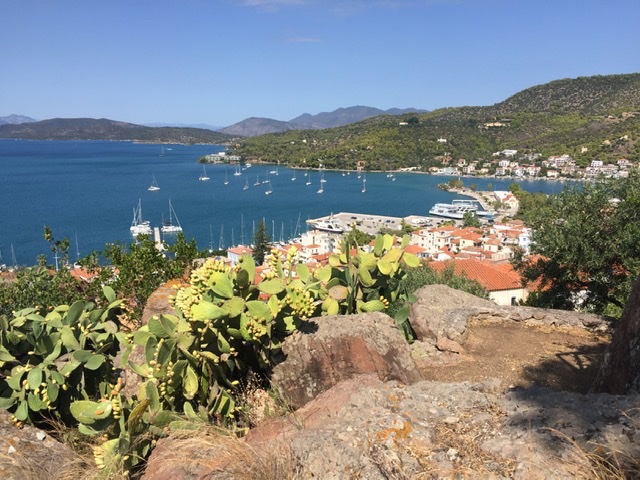
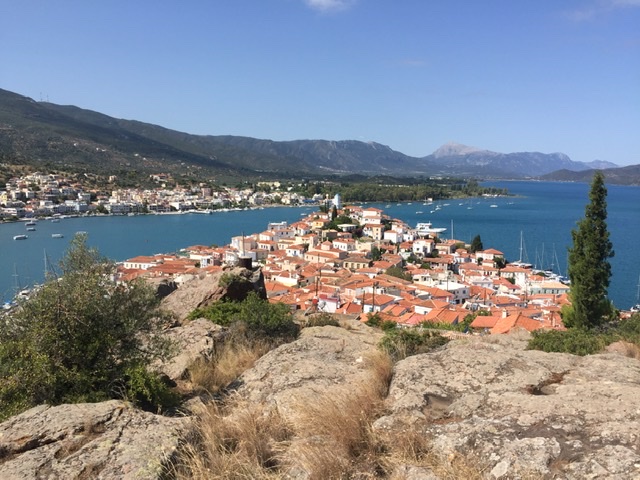
Direkt an der Pier zieht sich der Ort Poros entlang, eine Taverne an der anderen, innen kleine Gässchen. Und die Stadt ist grandios den Hang entlang hochgebaut, verwinkelte steile Gässchen, Treppen, Durchgänge - hier braucht man kein Autoverbot, hier kommt sowieso kein Auto hoch. Oben ein blauweißer Uhrturm von dem man einen herrlichen Blick auf die Stadt, den Hafen und verschiedene Buchten hat. Ankerbuchten gibt es hier viele, die Love Bay, die Russian Bay (hier hat der russische Zar eine Marinebasis errichtet, von der noch eine Ruine steht) und viele andere.
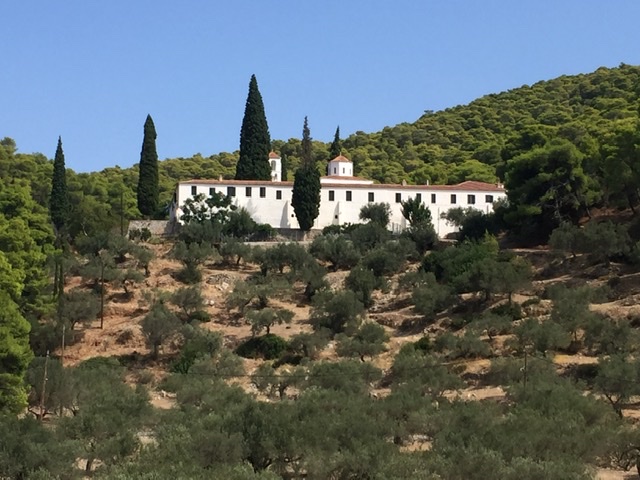
In einem langen Spaziergang kommt man am Ufer entlang mit vielen Ausblicken auf die Buchten und die umliegenden Inseln zum „Kloster des lebensspendenden Frühlings“, auf einer Anhöhe über der „Monastery Bay“ gelegen, mit dichtem Wald und davor zum Strand hinüber mit vielen Olivenbäumen bewachsen.
Auf halber Höhe zwischen den verwinkelten Gassen und Gängen gibt es auch Restaurants, nicht nur am Hafen. Hier haben wir etwas ganz Ausgefallenes gegessen: Schnecken! Viel kleiner als Weinbergschnecken, etwas würziger im Geschmack , mit einer unglaublichen Sauce aus Tomaten, Knoblauch, Wein, Wacholder und Zimt.
Manchmal hatten wir das Gefühl, wenn wir nicht aufpassen, kommen wir hier überhaupt nicht mehr weg

Kloster des lebensspendenen Frühlings (Zodóchos Pighi)


We extended twice - so we stayed there for nearly one week. The island is located at the extreme south-eastern tip of the Peloponnese, separated from the mainland only by a 500m wide channel. One of the safest harbours in Greece, it is said - although it is not an enclosed harbour at all: You lie on a 2km long pier, opposite the mainland, but protected by it. Here we weathered the Medicane, which had raged violently on the Ionian Islands, but which arrived here "only" as strong wind and cloudburst.
In the harbour there is always a lot going on, of course, also because the fast ferry from Athens arrives here and there are many small taxi boats between the mainland and the island. Sailing boats and motor boats also anchor in the middle of the harbour.
Directly at the pier the town of Poros stretches along, one tavern at the other, inside small Lines. And the town is grandiosely built up along the slope, winding steep alleys, stairs, passages - you don't need to ban Cars here, no car can get up here anyway. At the top there is a blue and weite clocktower, from which you have a wonderful view over the city, the harbour and various bays. There are many anchor bays here, Love Bay, Russian Bay (here the Russian Tsar built a naval base, of which a ruin still stands) and many others.
In a long walk along the shore with many views of the bays and the surrounding islands you can reach the "Monastery of the life-giving spring", situated on a hill above the "Monastery Bay", with dense forest and in front of it overgrown with many olive trees towards the beach.
Halfway up between the winding alleys and corridors there are also restaurants, not only at the harbour. Here we ate something very special: snails! Much smaller than the snails we know from France, a little spicier in taste, with an incredible sauce of tomatoes, garlic, wine, juniper and cinnamon.
Sometimes we had the feeling that if we were not careful, we would not get out of here at all.

Monastery of the life-giving spring (Zodóchos Pinghi)

Limeni


Anchoring has many advantages: You don't have to be careful not to get too close to other boats, you don't have to be careful not to touch other boats in a narrow box, exact going Backware (with a long keel!) is not necessary either. Also you don't need help from land to take the ropes…..narrow harbours, noisy towns/villages…….
When anchoring in a bay you find a nice place and then drop the anchor - no. It is not quite that simple. The weather should be as calm as possible, not too much wind, as stable as possible from one direction - but you have the least influence on that.
The place has to be chosen so that you don't get too close to other boats. You have to take into account the radius in which the boat will swing, i.e. swing back and forth at the anchor. Which of course also depends on the wind direction. Will the wind calm down at night? Or will it change direction?
The depth of the water is important for the anchor to hold well. There are different philosophies here: some say you have to chain (= let out) seven times the water depth, others say three and a half times.
In good weather you can still see five metres to the bottom without any problems. What is the anchorage ground? Sand? Silt? Grass? Stones/ Rocks? Will the anchor hold? Will it wedge between stones on the ground?
How should you bury the anchor to make it stable? How hard should you pull the anchor so that it pushes into the ground? When the anchor is down, it is said: wait and see - landmarks, houses, trees, towers……always check whether the boat is in the same proportion or whether it is shifting.
Swell can be unpleasant, especially at night when the boat rocks up and down violently and pulls on the anchor. Then you sleep badly.
We have had different experiences, it depends on the shape, size and location (open or rather closed) of the bay. Seven wind forces are easy to cope with - if the anchor holds.
In a very narrow bay, a small fishing boat with a fisherman sleeping on it bumped into our boat at two o'clock in the night - we were probably just as frightened as the fisherman who then tried to get away.
One should not sleep as soundly at anchor at night as in the harbour. In Portocheli the boat behind us had suddenly come damn close, so our anchor had slipped. And so far that a little bit of pulling in the chain would not have been enough. So we started the engine, raised the anchor and looked for a new place - at four in the night. But then the anchor was sitting and kept us well in our place for the next two days and nights in strong winds.
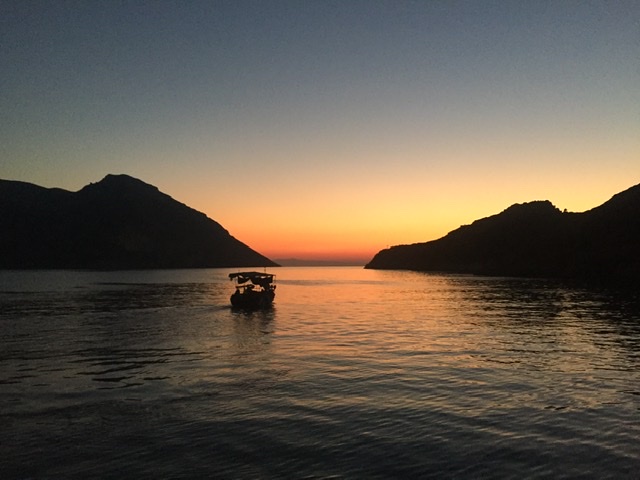
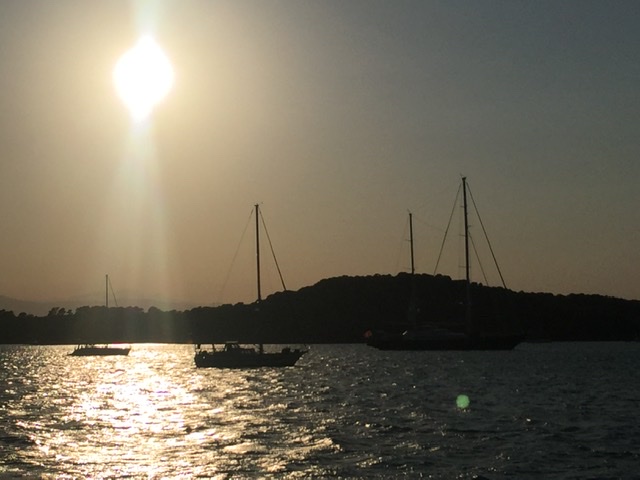
We always sleep (in good weather) outside in the cockpit when anchoring. And this is where one of the fascinating experiences of anchoring comes into play: no disturbing light far and wide, an unbelievable number of stars - and sometimes even shooting stars, you don't find anything like that in any harbour.

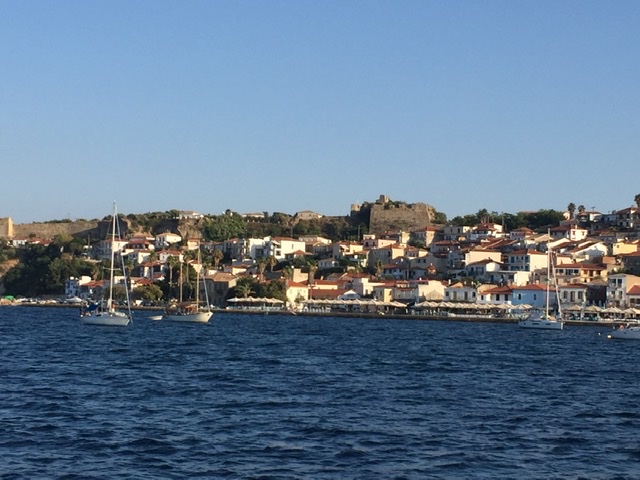
Koroni
Porto Kagio
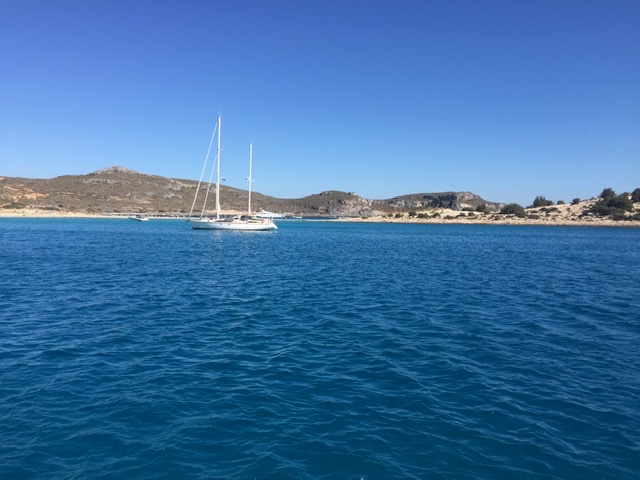
Elafonisos
Portocheli
Russian Bay (Insel Poros)

Limeni


Ankern hat viele Vorteile: Man muss nicht aufpassen, dass man anderen Booten nicht zu nahe kommt, man muss nicht aufpassen, dass man in einer engen Box andere Boote touchiert, exakt Rückwärtsfahren (mit Langkieler!) entfällt ebenfalls. Auch braucht man keine Hilfe von Land, die einem die Leinen entgegennimmt…..enge Häfen, laute Städte/ Dörfer…….
Beim Ankern in einer Bucht sucht man sich einen schönen Platz und lässt dann den Anker fallen - nein. Ganz so einfach ist es nicht. Das Wetter sollte möglichst ruhig sein, möglichst nicht zu viel Wind, möglichst stabil aus einer Richtung - darauf hat man allerdings den wenigsten Einfluss.
Der Platz muss so gewählt sein, dass man anderen Booten nicht zu nahe kommt, dabei muss man berücksichtigen, in welchem Radius das Boot schwojen, also am Anker hin und her schwingen wird. Was natürlich auch wieder von der Windrichtung abhängt. Wird der Wind sich nachts beruhigen? Oder wird er seine Richtung ändern?
Damit der Anker gut hält, ist die Wassertiefe wichtig. Hier gibt es verschiedene Philosophien: Die einen sagen, man muss das Siebenfache der Wassertiefe an Kette stecken (= rauslassen), die anderen sagen, das Dreieinhalbfache.
Bei gutem Wetter kann man noch ohne weiteres fünf Meter auf den Grund sehen. Was ist der Ankergrund? Sand? Schlick? Gras? Steine/ Felsen? Wird der Anker halten? Wird er sich zwischen Steinen auf dem Grund verkeilen?
Wie sollte man den Anker eingraben, damit er stabil hält? Wie kräftig rückwärts fahren, damit er sich in den Grund drückt? Wenn dann der Anker unten ist, heißt es: Warten und Peilen: Landmarken, Häuser, Bäume, Türme…..immer wieder überprüfen, ob das Boot gleich im Verhältnis dazu liegt oder ob es sich verschiebt.
Dünung kann unangenehm sein, besonders nachts, wenn das Boot heftig auf und ab schaukelt und am Anker zerrt. Dann schläft man schlecht.
Wir haben unterschiedliche Erfahrungen gemacht, das hängt unter anderem von der Form, Größe und Lage (offen oder eher geschlossen) der Bucht ab. Sieben Windstärken kann man gut verkraften - wenn denn der Anker hält.
In einer sehr engen Bucht ist nachts um zwei ein kleines Fischerboot mit einem darauf schlafenden Fischer leicht an unser Boot gestoßen - wir waren wohl genauso erschrocken wie der Fischer, der dann das Weite gesucht hat.
Man sollte nachts vor Anker nicht ganz so fest schlafen wie im Hafen. In Portocheli war plötzlich das hinter uns liegende Boot verdammt nah gekommen, also war unser Anker gerutscht. Und zwar so weit, dass ein Stück weit Einziehen der Kette nicht gereicht hätte. Also Motor an, Anker hoch und einen neuen Platz suchen - nachts um vier. Dann saß der Anker aber und hielt uns die nächsten zwei Tage und Nächte bei kräftigem Wind gut auf unserem Platz.
Wir schlafen (bei gutem Wetter) beim Ankern immer draußen im Cockpit. Und spätestens hier kommt eines der faszinierenden Erlebnisse beim Ankern zum Tragen: Kein störendes Licht weit und breit, unglaublich viele Sterne - und auch manchmal Sternschnuppen, sowas hat man in keinem Hafen.

Koroni
Porto Kagio
Elafonisos
Portocheli
Russian Bay (Insel Poros)


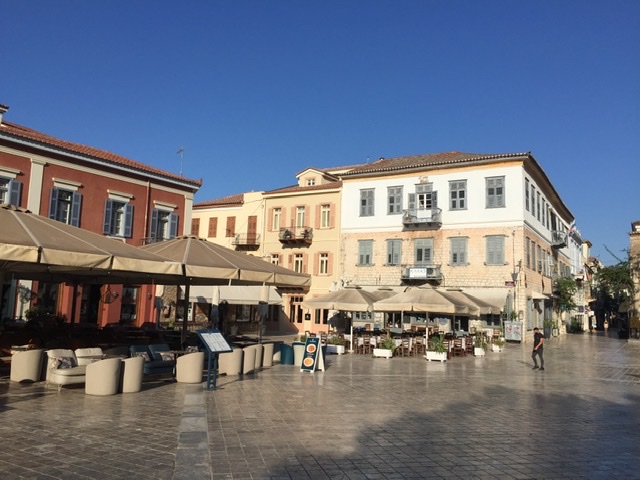
The beautiful town of Nafplion is the former Greek capital from independence 1829 to 1832, an originally Mycenaean settlement, later conquered by the Byzantines, the Franks, the Venetians and the Turks, the latter two alternating at short intervals.
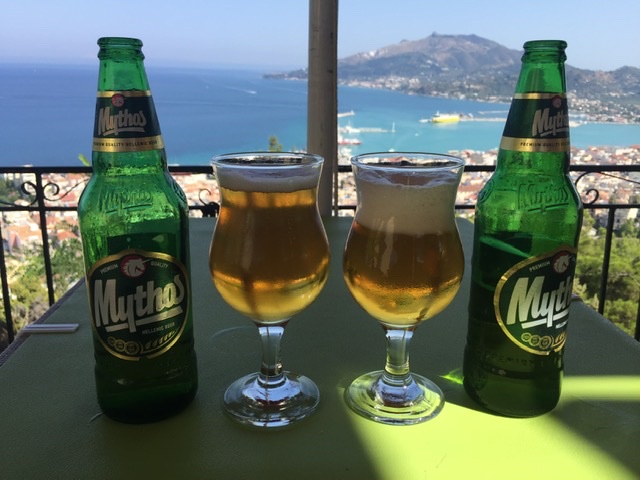
In 1832 the Greek National Assembly elected Otto of Bavaria (!), a Wittelsbach, as king - certainly the central European powers, Germany, Russia and France, had a hand in this, supporting Greece in its fight for freedom against the Turks. Otto began his reign at the age of 17 - after all, he ruled for 30 years until he was forced to abdicate after an uprising. An important decision of his government: he introduced the German (Bavarian) purity law for brewing beer: The beers you can drink in Greece, Mythos, Alpha, Fix, Mamos, Zeos and a few more, taste excellent.
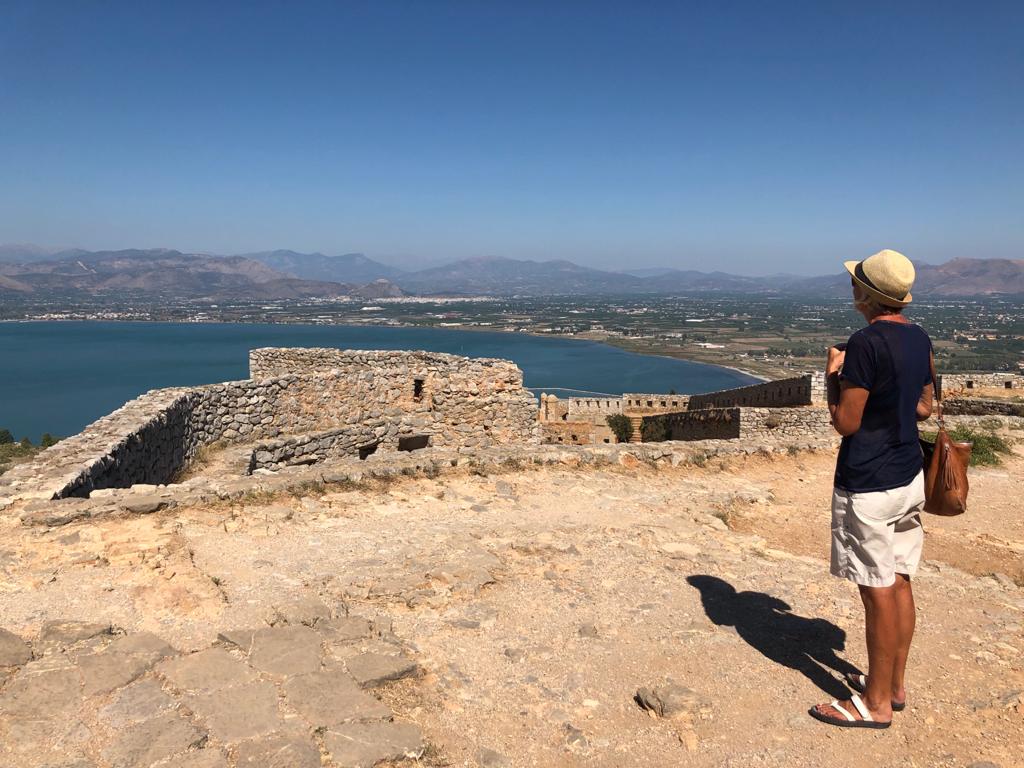
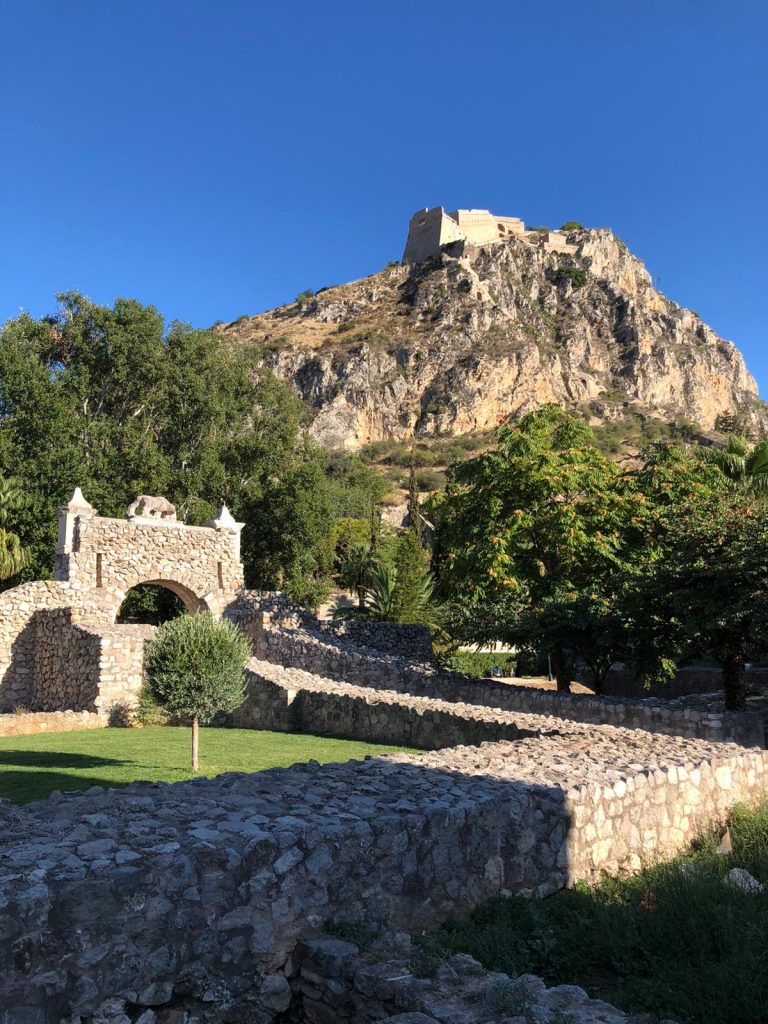
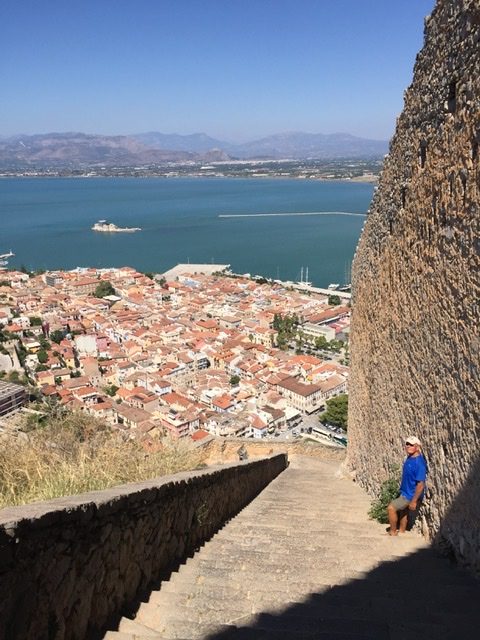
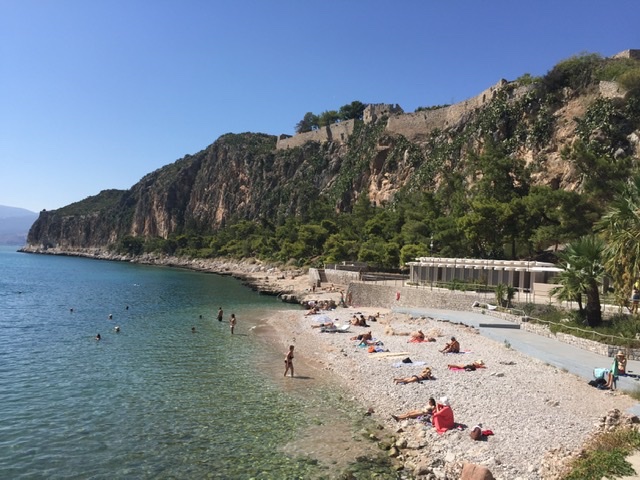
The fortress Palamidi is gigantic on a steep rock, 216 m above the sea, Venetian-Turkish style, accessible by almost 1000 steps up the rock. At the top, besides the impressive fortress, within which there is also a small Byzantine church, you have a wide view of Argolis in the north and Arcadia in the south. On the south side of the fortress is a large turquoise blue bathing bay, 10 minutes walk from the city.
The town itself is situated between the rock (on which there is also a second, smaller fortress) and the large harbour. At the edge of the harbour in the middle of the water there is another small fortress, Bourtzi, only accessible by boat.
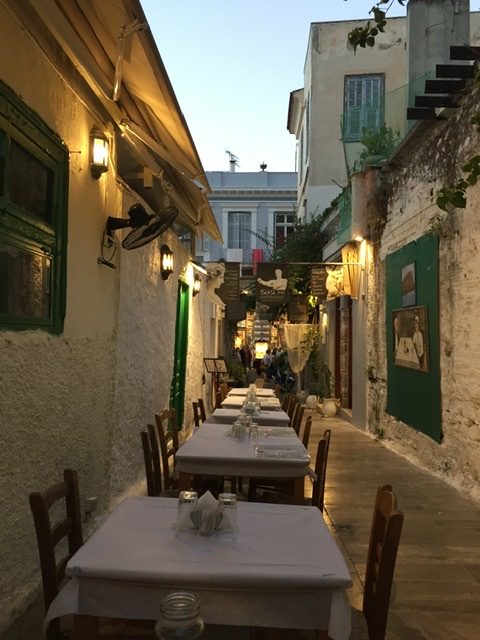
Small alleys, paved with marble, boutiques, workshops where olive wood is worked, jewellery is made or sandals are sewn, make up the flair. As well as the countless taverns and pubs, which of course serve excellent fish dishes, but also classics like moussaka, stuffed tomatoes, lamb with lemon sauce - wonderful. The flair is urban, you notice that Nafplion was once the Greek capital.
The travel guide says: Nafplion is a dream destination. True. We were there for five days and it was wonderful.

Palamidi Castle
1000 steps
Beautiful villas and beautiful squares
Narrow lanes with many tavernas
Greek Beer brewed with German purity law: We like Mythos best
Urban beach